
The Evolution of Executive Boardroom Spatial Dynamics in 2026
In the architectural landscape of 2026, the concept of static space is rapidly becoming a financial liability. High-traffic venues like Executive Boardrooms are now the front lines of spatial optimization. A venue that can transform its floor plan within minutes is a venue that can maximize its revenue per square foot or pedagogical efficiency. However, the true challenge lies not just in movement, but in the maintenance of acoustic sovereignty. When a grand hall is divided, each section must function as an independent acoustic island. This requires more than just a wall; it requires a precision-engineered partition system that balances structural integrity, mechanical reliability, and aesthetic integration.
For a Executive Boardroom, the stakes are exceptionally high. Whether it is preventing cross-talk in corporate meetings, managing the high-decibel energy of a classroom, or maintaining the pristine silence of a luxury ballroom, the technical specifications must be uncompromising. In this guide, we delve into the core engineering principles that define a high-performance movable partition system, from the logarithmic nature of sound measurement to the structural load requirements of 12-meter spans.
1. Deep Acoustic Flanking Analysis: The Total Envelope Strategy
Acoustic performance is often misunderstood as being solely about the panel’s center-of-wall STC rating. In reality, sound behaves like water; it finds the path of least resistance. In Executive Boardroom environments, sound often ‘flanks’ or bypasses the partition through the ceiling plenum, the HVAC ducts, or even the floor structure. Engineering a true STC 50-55+ environment requires a ‘Total Envelope’ strategy.
This includes the installation of high-density mineral wool baffles in the plenum area directly above the track. These baffles must be compressed to 70% of their original thickness to ensure zero air gaps. Furthermore, the vertical profiles of the panels must feature nested EPDM (Ethylene Propylene Diene Monomer) seals with integrated magnetic strips. This ensures that when the panels are closed, they snap into a hermetic alignment. At EBUNGE, we utilize a triple-fin seal design at the top and bottom of each panel, applying a calculated pressure of 40kg per linear meter. This mechanical compression eliminates the ‘gap’ between the wall and the floor, which is the primary cause of acoustic failure in cheaper systems.
2. Structural Load and Mechanical Integrity
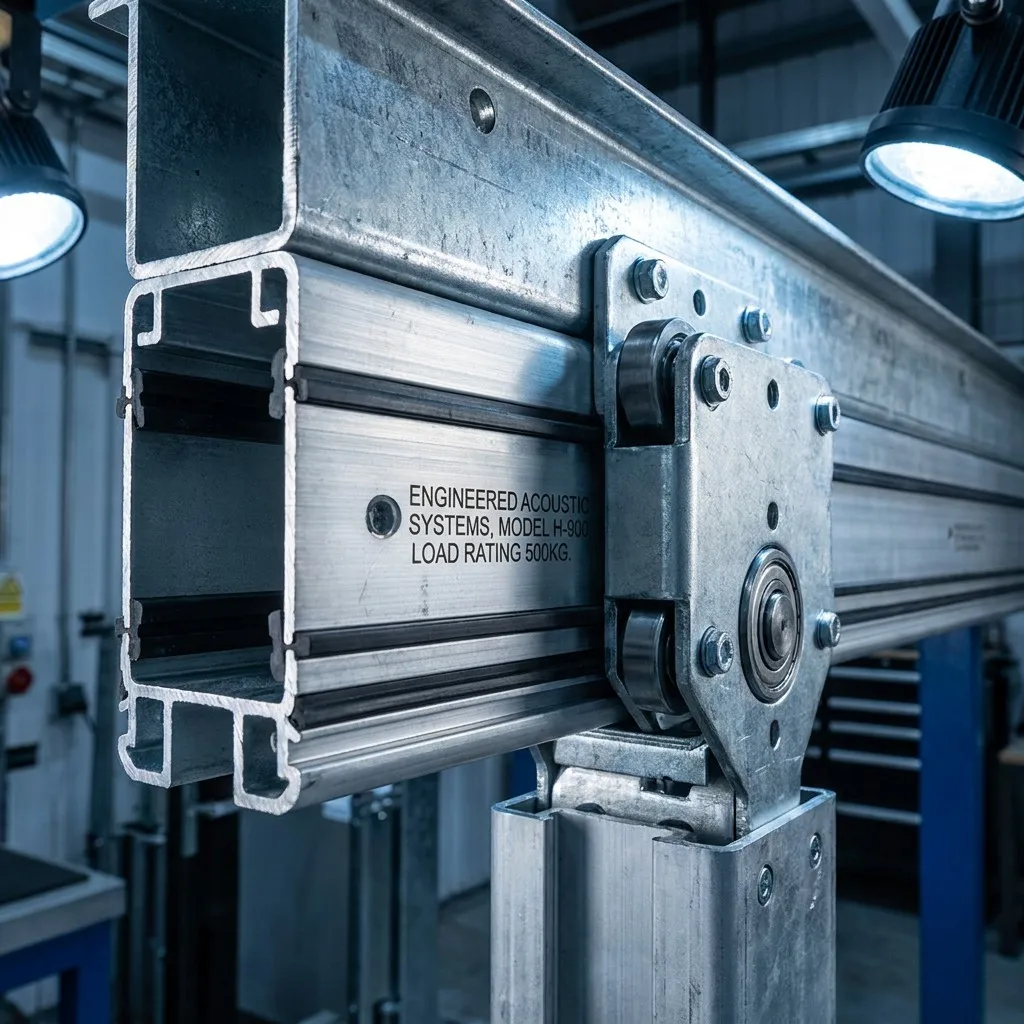
The reliability of a movable wall system depends entirely on its structural skeleton. For Executive Boardrooms, where the ceiling heights can reach significant levels, the weight of the panels exerts immense vertical loads. A Series 100 panel, for instance, can weigh upwards of 500kg. This weight must be supported by a dedicated steel framework anchored to the building’s primary structure. The primary engineering concern here is ‘track deflection’. If the overhead beam sags by even 5mm under the weight of the stacked panels, the mechanical seals will lose contact with the floor, destroying the acoustic seal.
Our track systems are manufactured from 6063-T6 architectural grade aluminum, reinforced with cold-rolled steel. The carrier systems use precision-machined polymer-coated rollers with stainless steel bearings, tested for 150,000 cycles—equivalent to 20 years of daily operation. The goal is ‘Silent Operation’. In a five-star hotel or a professional corporate environment, the movement of the walls must be effortless and quiet, avoiding any grinding or vibration that would disrupt the professional ambiance.
3. Material Science: Mass, Density, and Damping
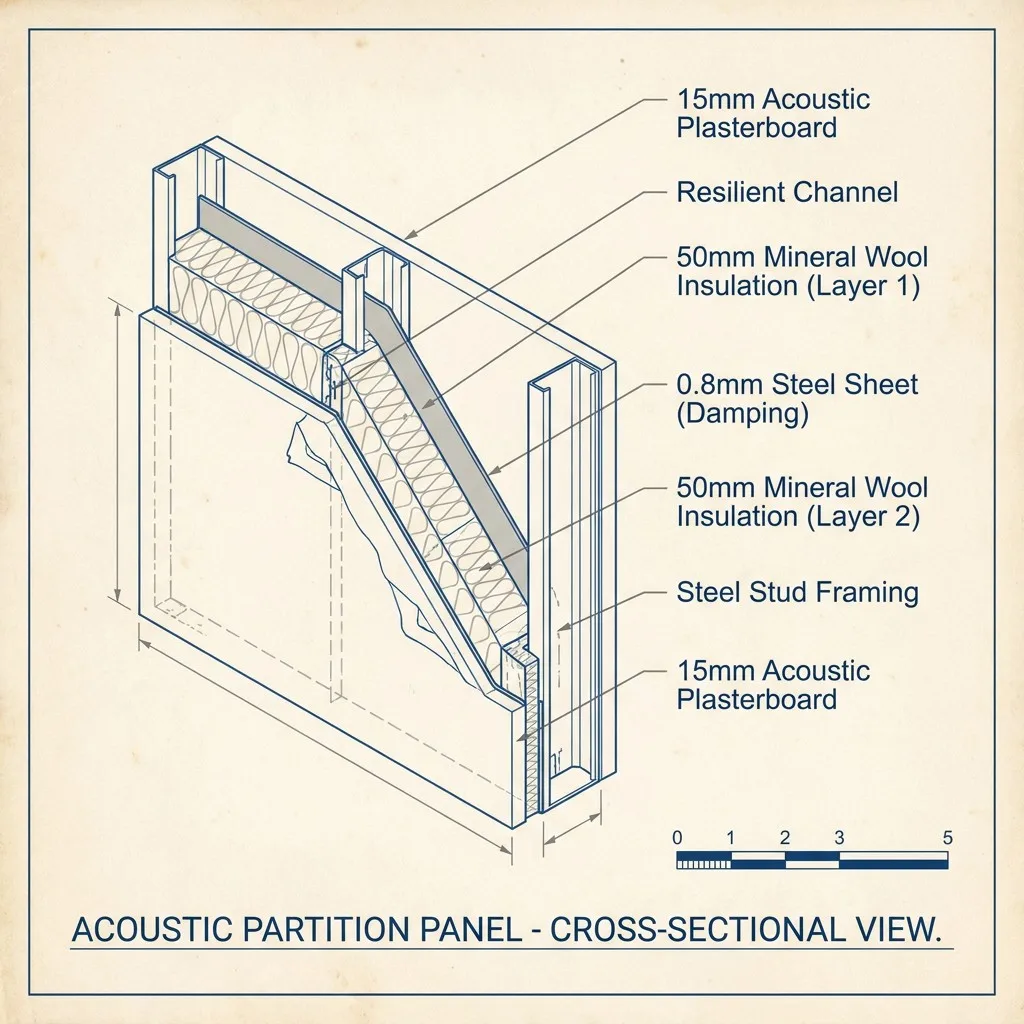
To achieve high STC ratings, we utilize the ‘Mass-Spring-Mass’ principle. The core of an EBUNGE panel is not a single layer, but a composite of decoupled materials. We use 1.2mm acoustic damping membranes sandwiched between high-density rock wool (100kg/m³) and internal steel plates. This combination effectively stops sound energy by converting it into heat through internal friction within the rock wool fibers. The outer skin, whether it is melamine, wood veneer, or acoustic fabric, provides the final layer of both protection and aesthetic integration.
Environmental sustainability is also a core component of the V9.0 standard. Our aluminum frames are 100% recyclable, and our core materials are sourced from sustainable minerals. By choosing a durable, long-lasting system, facility managers reduce the ‘Embodied Carbon’ of their building, as they avoid the cycle of demolition and reconstruction associated with fixed walls.
4. Aesthetic Integration and Surface Engineering
A functional partition should never be an eyesore. In 2026, the trend is ‘Invisible Flexibility’. For luxury Executive Boardrooms, we offer a vast array of finishes. Whether you require real wood veneers with book-matched grains, acoustic fabric wraps for sound absorption, or mirrored surfaces for dance and fitness studios, the integration must be seamless. The vertical aluminum profiles are recessed, creating a ‘butt-joint’ appearance that mimics a permanent, solid wall when the system is fully deployed.
Beyond aesthetics, the choice of finish also impacts the internal acoustics of the room (Acoustic Absorption). Perforated panels or fabric-covered mineral wool can reduce the reverberation time (T60), improving speech intelligibility—a critical factor for meeting rooms and classrooms. This dual-purpose engineering—Isolation to keep sound out, and Absorption to manage sound within—is the hallmark of a professional installation.
- Structural Anchorage: Never mount the track directly to a drywall ceiling. It must be supported by a dedicated steel framework.
- Floor Levelness: A floor deviation of more than 3mm over the span will lead to sound leakage at the bottom seals.
- Bypass Stacking: Ensure the storage pocket is deep enough to prevent ‘panel clashing’ during high-speed reconfiguration.
Engineer-led FAQ
- Q: Can these partitions be automated with a building management system (BMS)?
A: Yes. Our Auto-Drive series features RS485 and TCP/IP protocols, allowing for remote operation via a central touch-screen or mobile app. - Q: What is the maintenance schedule for Executive Boardroom partitions?
A: We recommend a professional inspection every 6 months to lubricate carriers and verify the seal pressure. - Q: How do you handle air conditioning when the room is divided?
A: The HVAC system must be zoned accordingly. We can integrate pass-through vents within the panels if necessary, though this requires specialized acoustic baffles. - Q: Can the panels be made fire-rated?
A: Absolutely. We offer 30, 60, and 90-minute fire-rated cores certified to international standards. - Q: Is it possible to have a pass door in the middle of the wall?
A: Yes, we provide integrated pass doors that maintain the system’s overall STC rating. - Q: What is the lead time for a custom installation?
A: Typical manufacturing lead time is 15-20 days, followed by 3-5 days for installation depending on the project scale.
7+1 Quotation Data List (Engineering Reference)
- 1. Project Type: Professional Executive Boardroom Spatial Solution
- 2. Opening Height: Custom (up to 12,000mm)
- 3. Total Span: Custom (Unlimited with multi-directional track)
- 4. Required STC: 45 / 50 / 53 / 56
- 5. Surface Finish: Custom (Veneer, Fabric, Melamine, Glass)
- 6. Stacking Layout: Side, Center, or Remote Stacking
- 7. Operational Mode: Manual / Semi-Automatic / Fully Motorized
- +1 Engineering Support: Contact for a structural load calculation and CAD shop drawings.