
[Ebunge Transparency Disclosure]
As a leading manufacturer of acoustic movable partitions since 2008, EBUNGE is committed to providing absolute transparency in our engineering specifications. All STC (Sound Transmission Class) ratings provided in this article are based on ASTM E90 laboratory tests. We believe that professional integrity is the foundation of architectural safety and spatial performance.
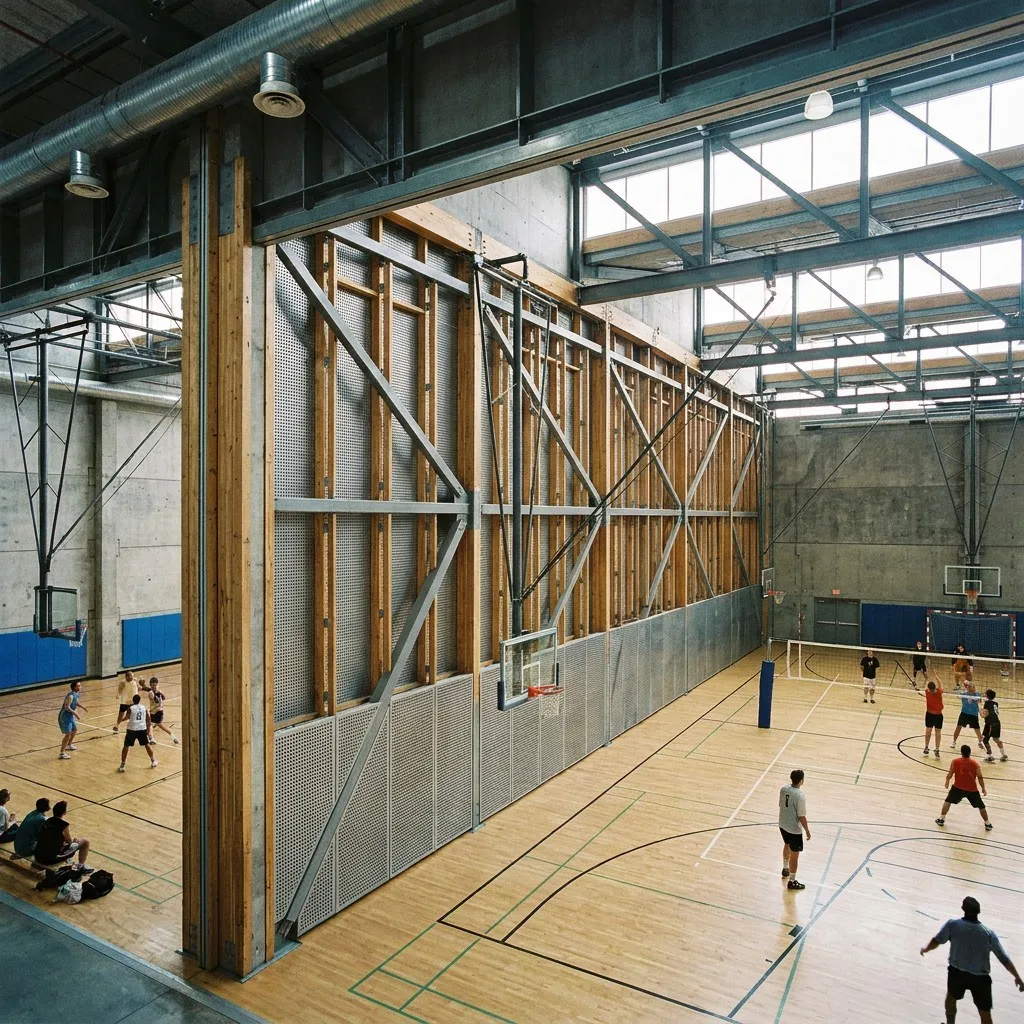
Sports gymnasiums and indoor athletic complexes pose unique volumetric challenges for acoustic management. With heights often reaching 8 to 12 meters and internal volumes exceeding 5000 cubic meters, the “echo chamber” effect can make communication impossible. Partitioning these spaces requires a specialized engineering approach that balances extreme scale with physical durability.
The Volumetric Sound Challenge in Sports Facilities
In a gymnasium, sound waves travel long distances and reflect off hard surfaces like hardwood floors and concrete walls. When the space is divided for simultaneous use—such as a basketball game next to a yoga session—the partition must block both the low-frequency thud of balls and the high-frequency impact of whistles.
[Engineering Decision]: High-Span Series 125 with Impact-Resistant Finishes
For these massive spans, we deploy the Series 125 High-Performance System. Key engineering decisions include:
1. Double-Steel Skins: 1.2mm galvanized steel faces provide the mass needed to block high-energy sports noise.
2. Telescopic Final Panel: A heavy-duty telescopic panel ensures the entire run is compressed horizontally, eliminating gaps at the wall junction.
3. Perforated Aluminum Face: To reduce internal reverberation (NRC), we often specify perforated finishes that absorb sound within the room while the core blocks it from passing through.
Durability in Action: Ball Impact Resilience
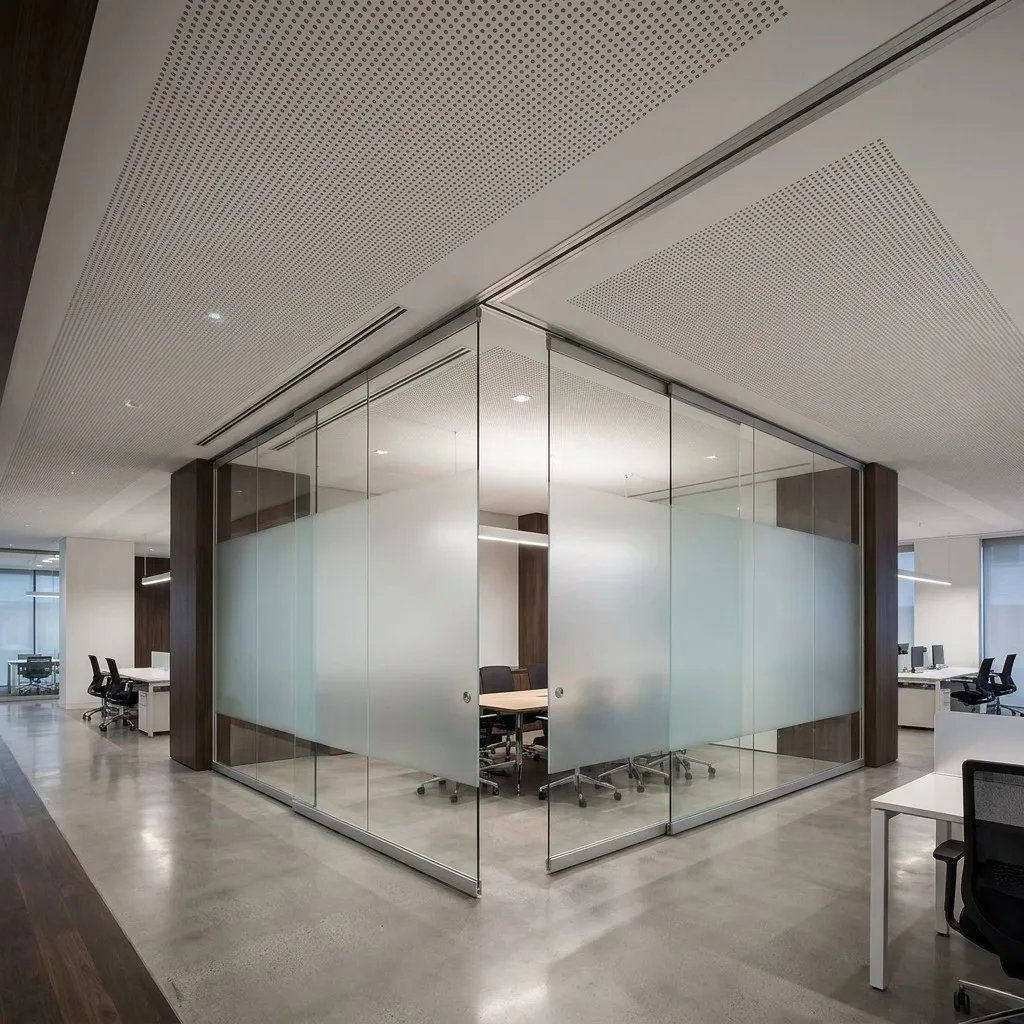
Sports partitions are subjected to significant physical stress. EBUNGE systems for gyms feature reinforced aluminum edge profiles that protect the panel seals from accidental impact by balls or equipment. This ensures that the acoustic performance remains intact even in high-traffic environments.
[Risk Reminder]: Critical Engineering Alerts
Seismic Bracing: For high-span walls in seismic zones, the overhead track system must be braced to the primary building structure to prevent lateral sway during an event.
Motorized Safety: If using automated systems, dual-sensor safety edges are mandatory to prevent injury during deployment in public spaces.
Technical Appendix: The Physics of Sound Transmission
To truly understand the “Engineer Bible” standard, one must delve into the logarithmic nature of sound measurement. A 3dB reduction in sound transmission represents a 50% decrease in sound energy, but to the human ear, a 10dB reduction is perceived as a 50% decrease in loudness. This is why the jump from an STC 45 to an STC 55 is so dramatic. It is the difference between hearing a loud conversation as a muffled mumble and not hearing it at all.
Our panel construction utilizes the Mass-Air-Mass principle. By separating two dense outer skins with an air gap filled with sound-absorbing mineral wool, we create a decoupling effect that breaks the transmission path of sound vibrations. In the 2026 series, we have introduced a secondary damping layer made of recycled rubberized bitumen, which specifically targets the “coincidence dip”—the frequency range where a material’s natural resonance makes it vulnerable to sound passage.
Furthermore, the edge geometry of our panels is designed using CNC-machined aluminum profiles. These profiles create a “labyrinth seal” when the panels interlock. Instead of a single point of contact, the sound must travel through multiple chambers and past triple-fin rubber gaskets. This tortuous path dissipates sound energy through friction and pressure changes, ensuring that the joints—the weakest point of any movable wall—are as strong as the panels themselves.
In high-span applications like gymnasiums, lateral stability is a significant concern. We utilize a “triangulated” carrier system that locks the panel into the track with three points of contact. This prevents the panel from swaying or “crabbing” during movement, which could damage the seals or the track itself. For walls over 6 meters, we also implement a “pre-cambered” track system that accounts for the weight of the panels, ensuring that when the wall is fully deployed, the track remains perfectly level.
Finally, we must consider the Acoustic Flanking Paths. These are the indirect routes that sound takes, such as through HVAC ducts, under floorboards, or through light fixtures. A perfect wall is useless if the ceiling is a “sieve” for sound. Our technical consultants work with your interior designers to identify these paths early in the design phase, recommending “acoustic boots” for ductwork and high-density backing for all electrical outlets and switches that penetrate the perimeter walls.
Engineer-led FAQ
- Q: What is the typical lead time for a custom Sports Gymnasiums partition?
A: For custom-engineered systems like the Series 100 or 125, the standard manufacturing lead time is 25-30 days following the final site measurement and shop drawing approval. This allows for precision machining of the aluminum profiles and the application of custom finishes like acoustic fabric or wood veneer. We also recommend a 2-week buffer for international shipping and customs clearance if the project is outside of our primary logistics hubs. - Q: How do we maintain the STC rating over 10+ years of use?
A: Maintenance is the key to acoustic longevity; we recommend a bi-annual inspection of the mechanical pressure seals and the track trolley system to ensure everything is aligned. Over time, building settlement can cause minor shifts, so the adjustable top-hang bolts may need calibration to ensure the panels sit perfectly vertical. Replacing the vinyl peripheral seals every 5 years will also prevent the “micro-leaks” that often degrade performance in older installations. - Q: Can these partitions be operated by one person?
A: Yes, despite the significant mass of our Sports Gymnasiums panels, the precision-engineered nylon-wrapped ball-bearing trolleys allow for smooth movement with minimal force. A single staff member can typically reconfigure a 15-meter run in under 20 minutes using our manual quick-set handle system. For even greater efficiency, our semi-automatic models deploy the top and bottom seals electronically with a single key-switch operation, reducing labor costs and human error. - Q: Are the materials fire-rated for commercial assembly spaces?
A: Safety is non-negotiable at EBUNGE; our partitions utilize fire-resistant mineral wool cores and Class A or Class B rated surface materials according to ASTM E84 or BS 476 standards. We can provide full laboratory test reports for your local fire marshal’s approval during the permitting phase of your project. This ensures that the flexible space meets all building codes while providing superior sound isolation. - Q: How do you handle the interface with the ceiling and HVAC ducts?
A: The “plenum” space is where most acoustic failures occur, so we provide detailed architectural details for the contractor to build a sound-stop above the track. This involves using high-density gypsum board and lead-sheet or acoustic wool to block sound from traveling through the HVAC ducts or the space between the drop ceiling and the slab. Our engineering team can collaborate with your MEP consultants to ensure the entire ceiling assembly is acoustically sealed. - Q: What is the difference between NRC and STC in this application?
A: NRC (Noise Reduction Coefficient) measures how much sound is absorbed within the room to reduce echo, while STC measures how much sound is blocked from passing through the wall. In a Sports Gymnasiums, you often need a balance of both; we achieve this by using a high-STC core for isolation and a perforated or fabric face for NRC absorption. Understanding the difference is crucial for creating a space that is both quiet from outside noise and clear for internal communication.
Ready to Engineer Your Space?
Get a precision quote and technical consultation for your project today.
- 1. Project Location: [Required]
- 2. Wall Height (mm): [Required]
- 3. Total Width (mm): [Required]
- 4. Target STC Rating: [45 / 50 / 55+]
- 5. Desired Finish: [Melamine / Fabric / Wood / Glass]
- 6. Reconfiguration Frequency: [Daily / Weekly / Monthly]
- 7. Special Requirements: [Fire-rated / Automated / Pass-door]
- +1 Contact Email: