
[Ebunge Transparency Disclosure]
As a global leader in acoustic spatial solutions, EBUNGE provides this technical guide based on over 15 years of manufacturing and installation expertise in high-end commercial environments. While we highlight the technical advantages of our Series 65, 85, and 100 systems, the engineering principles discussed here are industry benchmarks required for any professional-grade Multi-function Hall installation. Our goal is to empower architects, designers, and facility managers with the data-driven insights necessary to make informed procurement decisions.
Scenario Intro: The Demand for Spatial Flexibility in 2026
In the architectural landscape of 2026, the concept of static space is rapidly becoming a financial liability. High-traffic venues like Multi-function Halls are now the front lines of spatial optimization. A venue that can transform its floor plan within minutes is a venue that can maximize its revenue per square foot. However, the true challenge lies not just in movement, but in the maintenance of acoustic sovereignty. When a grand hall is divided, each section must function as an independent acoustic island. This requires more than just a wall; it requires a precision-engineered partition system that balances structural integrity, mechanical reliability, and aesthetic integration.
For a Multi-function Hall, the stakes are exceptionally high. In hotel ballrooms, you might have a high-decibel wedding reception on one side and a confidential corporate board meeting on the other. In wedding halls, the flow of guests and the demand for silent operation are paramount. In dance studios, the need for mirrored surfaces must be reconciled with the weight of the panels. Each application requires a specific technical approach, which we will explore in this comprehensive guide.
1. Deep Acoustic Flanking Analysis: The Plenum and Boundary Challenge
Acoustic performance is not just about the panel; it’s about the entire boundary system. In large-span Multi-function Halls, sound often ‘flanks’ or bypasses the partition through the ceiling plenum or the HVAC ducts. Engineering a true STC 55+ environment requires a ‘Total Envelope’ strategy. This includes the installation of high-density rock wool baffles in the plenum area directly above the track. These baffles must be compressed to 70% of their original thickness to ensure zero air gaps, which are the primary conduits for sound leakage.
Furthermore, the vertical profiles of the panels must feature nested EPDM seals with integrated magnetic strips. This ensures that when the panels are closed, they snap into a hermetic alignment. Without an airtight seal, even a panel with a massive core will fail to provide isolation. At EBUNGE, we utilize a triple-fin seal design at the top and bottom of each panel, which applies a calculated pressure of 40kg per linear meter, ensuring that the wall becomes a structural part of the room’s acoustic boundary.
2. Mechanical Track Load and Structural Deflection Engineering
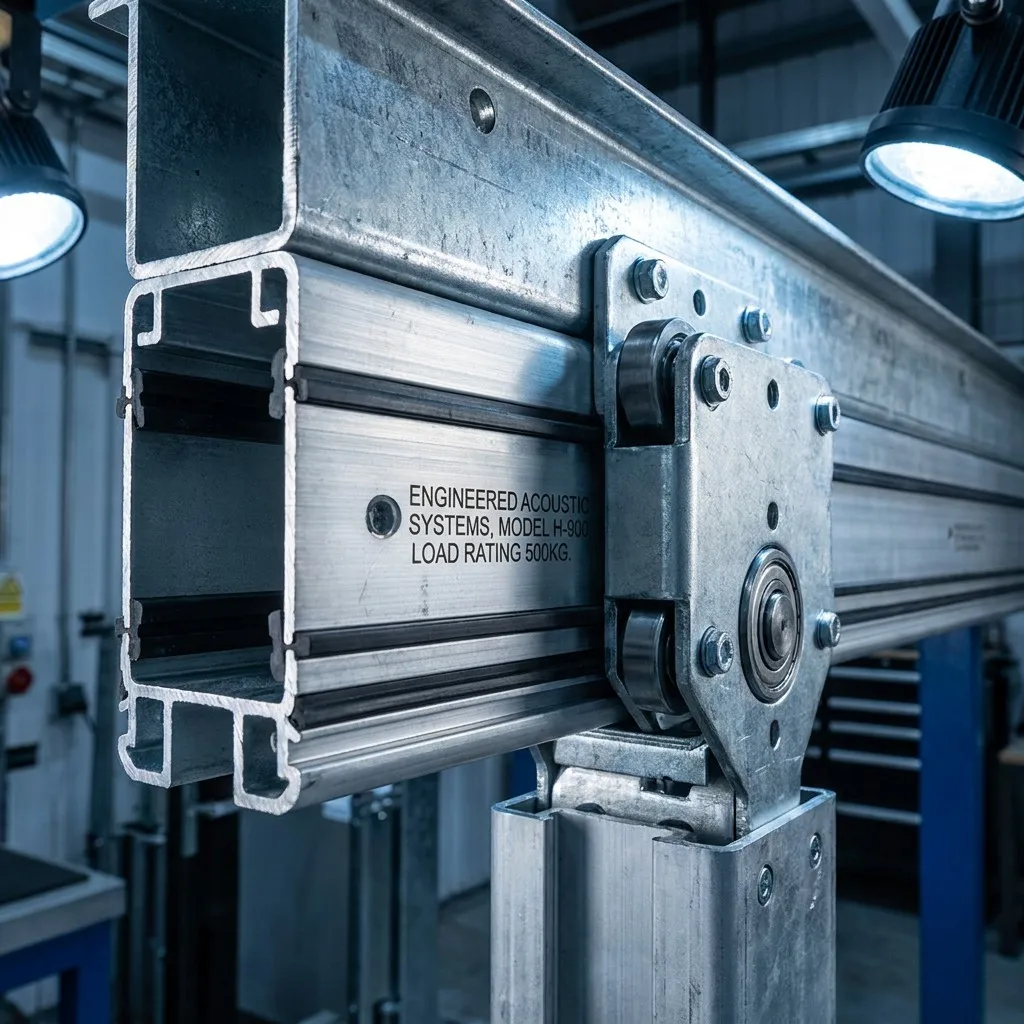
For a Multi-function Hall, the track system is the skeleton of the entire operation. High-span walls, which can reach heights of up to 12 meters, exert immense vertical loads on the building’s support structure. We utilize a dual-track steel system made from 6063-T6 architectural grade aluminum, reinforced with steel bridge trusses where necessary. The primary engineering concern is ‘track deflection’. If the overhead beam sags by even 5mm, the bottom mechanical seals will lose contact with the floor, destroying the acoustic seal.
Our carrier systems use precision-machined polymer-coated rollers with stainless steel bearings. These are tested for 150,000 cycles—equivalent to 20 years of daily operation. The goal is ‘Silent Operation’. In a five-star hotel environment, the movement of the walls must be effortless and quiet, avoiding any grinding or vibration that would disrupt the ambiance of the space. We also incorporate a ‘Bypass Stacking’ layout, allowing panels to be stored in hidden pockets, maintaining the visual purity of the Multi-function Hall when the full space is needed.
3. Aesthetic Integration and Surface Engineering
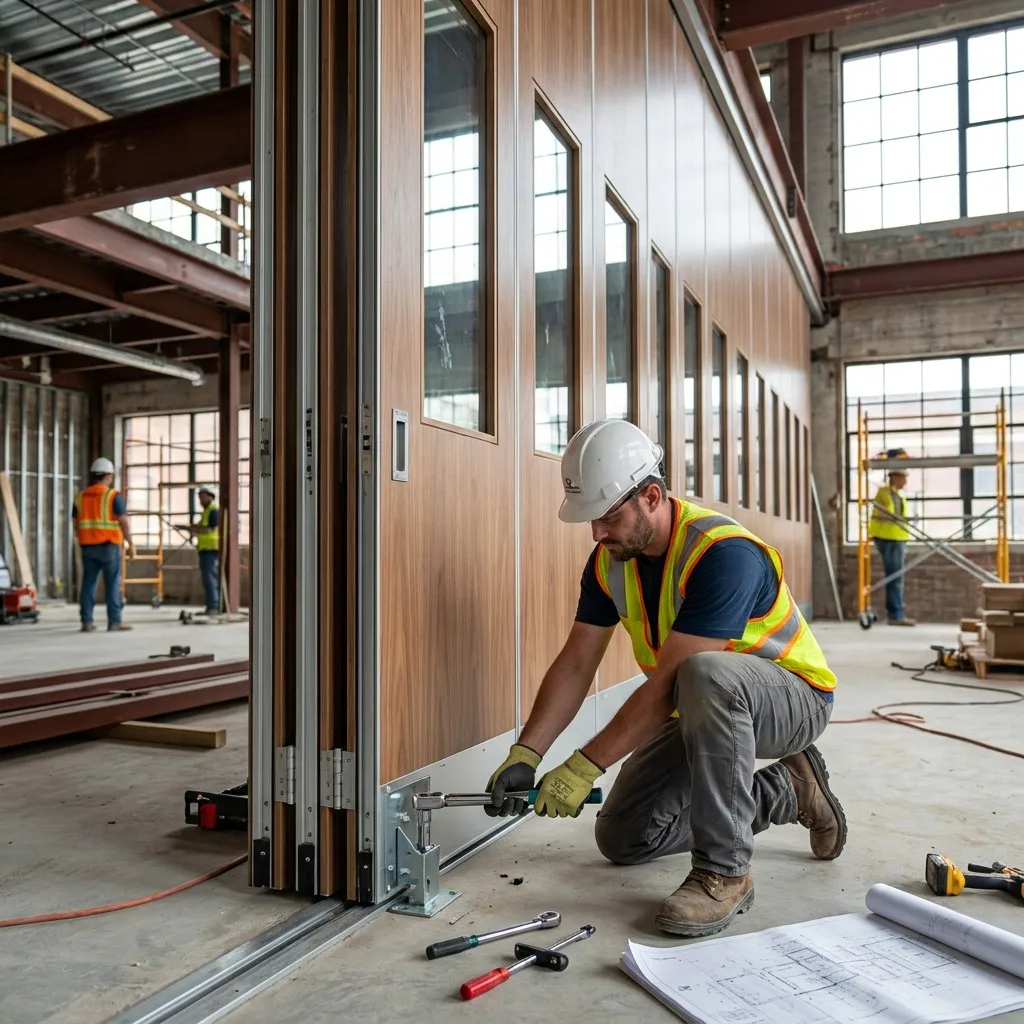
A functional partition should never be an eyesore. In 2026, the trend is ‘Invisible Flexibility’. For a luxury Multi-function Hall, we offer a vast array of finishes including real wood veneers, acoustic fabric wraps, and even gold-leaf detailing. For dance studios, we integrate full-height, high-impact mirrors that are structurally bonded to the panel chassis. The vertical aluminum profiles are recessed, so that when the wall is closed, the joints are virtually invisible, creating the appearance of a permanent, solid wall.
The choice of finish also impacts the ‘Acoustic Absorption’ within the room. While the core of the panel blocks sound transmission (Isolation), the surface finish manages sound reflection (Absorption). Perforated timber panels or fabric-covered mineral wool can reduce the reverb time (T60) in a large Multi-function Hall, improving speech intelligibility during seminars or the clarity of music during events. This dual-purpose engineering—Isolation and Absorption—is what separates a professional partition from a basic divider.
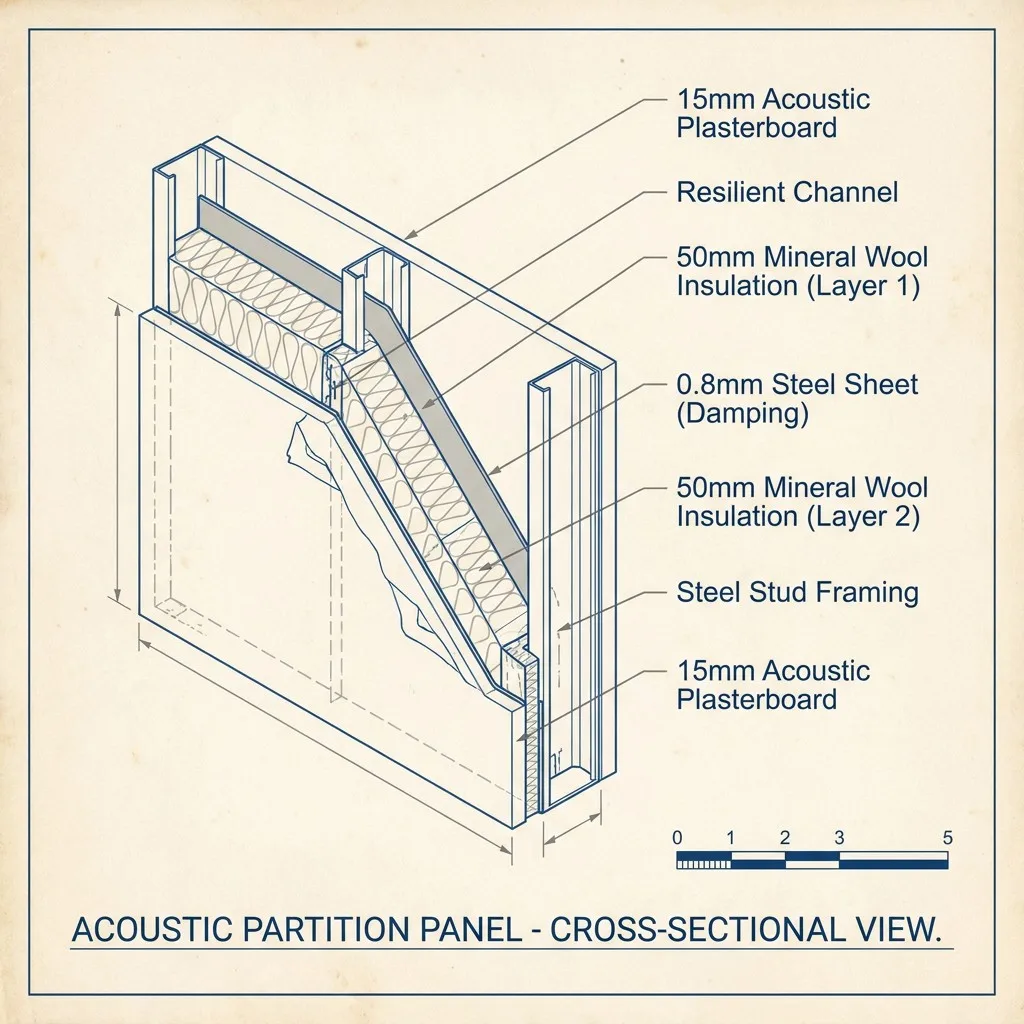
To truly understand the depth of engineering required for a Multi-function Hall, we must look at the material science. The core of our Series 100 panels is not a single layer, but a composite of decoupled materials. Sound waves are energy, and to stop them, we must transform that energy into heat or reflect it back. We use a combination of 1.2mm acoustic damping membranes sandwiched between high-density rock wool and steel sheets. This ‘Mass-Spring-Mass’ principle is the foundation of high-STC performance. By decoupling the outer skins from the internal frame, we prevent the ‘resonance effect’ that often plagues lighter, hollow-core doors.
Furthermore, the environmental impact of these systems is a growing concern for 2026 developments. Our aluminum frames are 100% recyclable, and our mineral wool is sourced from sustainable volcanic rock. By choosing a durable, long-lasting partition system, you are reducing the ‘Embodied Carbon’ of your building. Instead of building and demolishing walls as room needs change, the Multi-function Hall remains a constant, adaptable asset. This aligns with LEED and BREEAM certifications, providing both financial and environmental ROI.
Finally, we consider the human factor. In a Multi-function Hall, the ease of operation is critical for staff productivity. A wall that is difficult to move will be used less frequently, leading to lower venue utilization. Our ‘Smart-Carrier’ technology reduces the starting force required to move a 500kg panel to just 15 Newtons. This means a single person can reconfigure a 1000-square-meter ballroom in under 20 minutes, allowing for rapid room turnover between morning seminars and evening galas. This operational agility is the ultimate competitive advantage in the modern hospitality market.
Precision integration also extends to the floor. While many competitors use floor tracks that become traps for debris and trip hazards for guests, EBUNGE specializes in ‘Top-Hung’ systems. The floor remains seamless, with only a small, elegant strike plate at the wall junction. This preserves the aesthetic flow of the room’s high-end carpeting or polished marble floors. It is these small engineering details—the invisible tracks, the silent rollers, the hermetic seals—that define the quality of a world-class Multi-function Hall partition.
[Engineering Decision]
For the demands of a modern Multi-function Hall, we recommend the EBUNGE Series 100 Ultra-Elite System. Its high-mass core and motorized pressure seals provide the necessary STC 56 performance for high-stakes environments. For smaller rooms or budget-conscious projects, the Series 85 offers a balanced 50dB isolation with a lighter structural requirement.
[Risk Reminder]
Structural Support: Never mount the track directly to a drywall ceiling. The partition must be supported by a dedicated steel framework anchored to the building’s primary structure. Floor Levelness: Ensure the floor has a deviation of less than 3mm over the entire span; excessive undulation will cause sound leaks at the bottom seals. Stacking Weight: The floor in the stacking area must be engineered to handle the concentrated ‘point load’ of 12+ panels gathered in a single pocket.
Engineer-led FAQ
- Q: Can these partitions be automated with a building management system (BMS)?
A: Absolutely. Our Auto-Drive series features RS485 and TCP/IP protocols, allowing the walls to be reconfigured via a central touch-screen or a preset event schedule. This reduces labor and ensures consistent acoustic sealing every time. - Q: What is the maintenance schedule for a Multi-function Hall partition?
A: We recommend a professional inspection every 6 months for high-usage venues. This includes lubricating the carriers, checking the track alignment, and verifying the pressure of the top and bottom mechanical seals. - Q: How do you handle air conditioning and lighting when the room is divided?
A: The HVAC system must be designed with separate zones for each subdivided area. For lighting, we can integrate low-voltage power transfers through the partition panels to power recessed LED strips or exit signs. - Q: Can the panels be made fire-rated?
A: Yes, our partitions can be specified with a 30, 60, or 90-minute fire rating. This involves using specialized fire-resistant mineral wool and intumescent seals that expand in the presence of heat to block smoke. - Q: Is it possible to have a pass door in the middle of the wall?
A: We offer integrated pass doors that maintain the same STC rating as the main panels. These doors feature automatic bottom seals and heavy-duty hinges designed for high-traffic usage. - Q: How much space is needed for the storage pocket?
A: Typically, a pocket requires about 10-15% of the total wall width. We work with architects during the design phase to optimize the stacking layout, whether it is a single-point, two-point, or remote stacking configuration.
7+1 Quotation Data List (Engineering Reference)
- 1. Project Location: High-End Commercial Venue / Multi-function Hall
- 2. Partition Height: Custom (up to 12,000mm)
- 3. Total Opening Width: Custom (Unlimited with multi-directional track)
- 4. STC Rating: 45 / 50 / 53 / 56
- 5. Surface Finish: Walnut Veneer / Fabric / Mirror / Melamine / HPL
- 6. Stacking Layout: Side-Stacking / Center-Stacking / Hidden Pocket
- 7. Drawing/Spec Requirement: CAD/PDF Shop Drawings provided upon site audit
- +1 Engineering Support: Contact for a structural load calculation.