
Does a Stacking Pocket Leave a Clear Turning Circle at a Corridor
Quick project answer
A stacking pocket corridor junction turning circle review asks one deceptively simple question: when the movable wall is open and its panels are parked, does the corridor junction still offer the clear space people need to approach, turn and pass? The answer is rarely found in a product brochure. It sits in the relationship between the parked panel stack, the pocket depth, the corridor widths that meet at the junction, and the routes people actually take. This guide sets out how project teams can review that relationship on drawings, what evidence to request, and where confirmation must stay project-specific.
Why the Junction, Not the Wall, Deserves the Review
Most movable wall discussions focus on the opening itself. At a corridor junction, however, the parked condition matters as much as the closed condition. Panels that cross the opening without a floor track still need somewhere to go, and that somewhere is the planned stacking position. If the stack projects into the junction zone, the circulation geometry changes even though the partition line is clear.
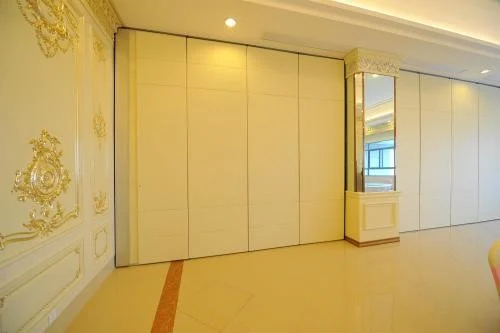
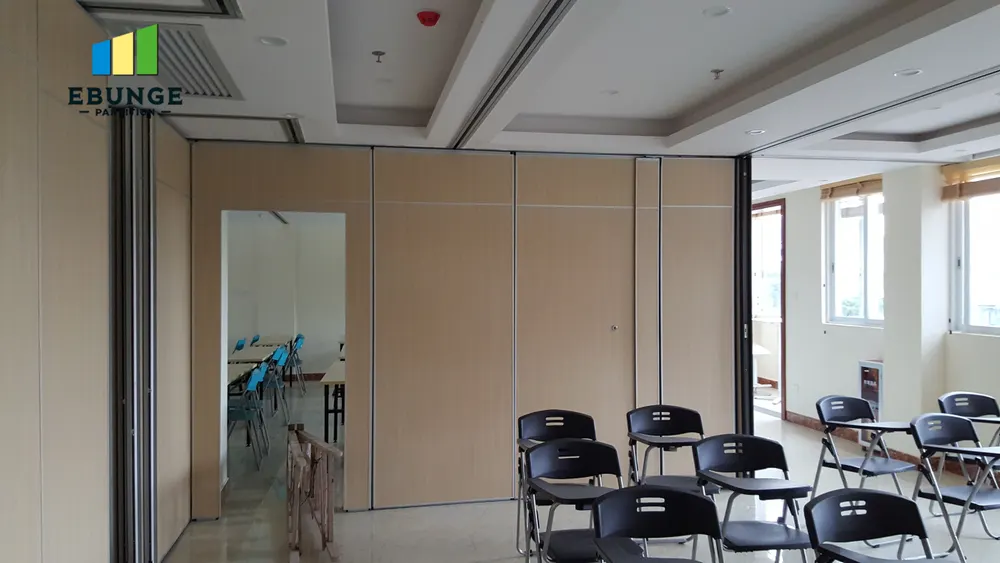
EBUNGE movable wall panels are individually movable and suspended from a top track. They cross the opening without a floor track and park at a planned stacking position. That clear-floor behaviour removes one common obstruction along the partition line, but it does not by itself guarantee a clear turning circle at a junction. The pocket, the stack and the surrounding walls do that work together.
What a Turning Circle Review Actually Checks
A turning circle review is a drawing exercise, not a performance test. It overlays the expected movement envelope of corridor users onto the junction layout in both the open and closed partition states. The review then asks whether the parked panels, pocket walls and any adjacent fixed elements intrude into that envelope.
Open, closed and in-transit conditions
Review three states separately: wall closed, wall fully parked, and panels part-way through their route. The third state is often overlooked. A stack that looks acceptable when complete may still sweep through the junction while panels are being moved into place.
Routes, not just dimensions
Straight, turning and stacking routes should be reviewed from the layout. A route that turns immediately outside a pocket is a different case from a straight run past it. Ask the supplier to confirm the route logic against your drawings rather than assuming a standard arrangement.
A Step-by-Step Coordination Sequence
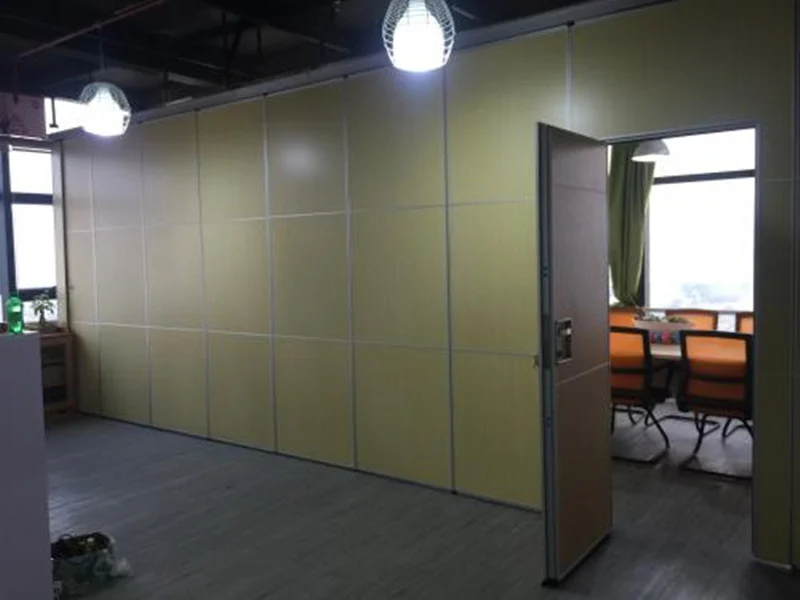
- Fix the junction geometry first. Confirm corridor widths, wall centrelines and any fixed obstructions before discussing pocket size.
- Mark the planned stacking position. Show the parked stack footprint on the plan, including the space needed to reach it.
- Overlay the turning envelope. Check the junction in open, closed and in-transit states.
- Trace the full route. Confirm the straight, turning and stacking routes are continuous and connected overhead.
- Record the finish and pass-door intent. Note laminate, melamine, fabric, leather, glass or other approved surfaces, and whether a pass door is required.
- Issue the drawing for review. Ask for written confirmation of the layout assumptions before tender or fabrication.
This sequence keeps the conversation on visible, checkable information. It also gives the whole project team — architect, contractor, interior designer and owner — a shared drawing to comment on. See the movable wall product overview for the maintained product context behind these steps.
Evidence Boundaries You Should State in the Review
Evidence note: a clear-floor, top-hung system tells you how panels are supported and moved. It does not tell you the clear turning circle at your junction. That figure comes from your coordinated layout, your pocket design and your confirmed route — and it must be verified on project drawings.
Be equally careful with acoustic language. The suitability of each route and parking arrangement depends on the approved layout, circulation, ceiling interfaces and operating sequence. Seals and acoustic concepts can be explained generically, but any acoustic expectation for your junction, pocket or pass door needs project-specific confirmation.
The exact overhead route and support arrangement must be confirmed by the responsible project team from coordinated drawings. Those items belong to the engineering review of your specific layout.
Compact Comparison: What Each Drawing Shows
| Drawing or document | What it can show | What it cannot confirm alone |
|---|---|---|
| Architectural floor plan | Junction geometry, corridor widths, planned stack location | Panel route feasibility or support conditions |
| Supplier layout review | Straight, turning and stacking route logic | Final clear turning circle without your dimensions |
| Finish schedule | Laminate, melamine, fabric, leather, glass or other approved surfaces | Acoustic, fire or durability performance |
| Pass-door requirement note | Whether a pass door is needed and where | Clearance at the junction unless drawn |
Use the table as a checklist at each design stage. Where a cell is blank, that is the item to raise with the supplier and the design team. More general planning material is available in the EBUNGE resources section.
Common Review Gaps at Corridor Junctions
The pocket is drawn, the stack is not
A pocket shown as a void on plan does not describe the parked panel footprint. Ask for the stacking position to be drawn explicitly, including how panels are expected to arrive there.
The route crosses an unsupported gap
The exact route, junction arrangement, continuous overhead path and parking position must be confirmed from the coordinated project drawings. Every proposed movement path requires a continuous connected overhead route and project-specific support review. Flag any discontinuity at the junction early.
Finishes and pass doors are decided late
Finish choices and pass-door requirements can affect the layout conversation. Raise them while the junction is still flexible, not after the pocket is fixed.
FAQ: Stacking Pockets and Corridor Junctions
Does a top-hung movable wall automatically keep a junction clear?
No. Top-hung panels move without a floor track along the partition line, but the parked stack and pocket still occupy space. The clear turning circle must be checked on your layout.
Who should carry out the turning circle review?
The design team should lead it, with supplier input on route logic and stacking. The review should be documented on coordinated drawings and shared with the contractor and owner.
Can the stacking position be changed to suit the junction?
Parking style is customized to the customer layout and project requirements, and compact stacking may be possible when the coordinated design permits it. Confirm options against your drawings.
Do I need to specify a pass door at the junction?
Pass-door requirements depend on how the space is used. Discuss them with the supplier and record the decision in the project documentation.
Can acoustic performance be confirmed from the layout drawing?
No. Acoustic expectations need project-specific confirmation.
What should be issued for supplier review?
Send the junction plan, corridor dimensions, planned stacking position, route intent, finish schedule and pass-door notes. Ask for written confirmation of assumptions before fabrication.
Conclusion: Review the Parked Condition as Carefully as the Closed One
A stacking pocket corridor junction turning circle review succeeds when it treats the parked panel stack as part of the circulation layout. Confirm the junction geometry, draw the stack, trace the routes and record every assumption. Named venues and room types are examples only; movable partitions can be considered wherever flexible spatial division, combination or reconfiguration is required.
To take the review forward, share your junction drawings and route intent with the EBUNGE team through the contact page. Project-specific support, acoustic and dimensional requirements should be confirmed in writing for your layout before any commitment.