
Quick answer: corridor junction accessibility review
Review focus: corridor junction accessibility review.
A stacking pocket corridor junction accessibility review is a drawing-based exercise: you test how a top-hung movable partition, its parking position, and the remaining circulation space interact at one of the busiest points in a building. Because EBUNGE panels are individually movable, suspended from a top track, and cross the opening without a floor track, the review focuses on overhead routes, clear floor width, and the planned stacking position rather than on floor hardware. This article sets out a coordination framework for contractors, architects, designers, owners, and construction teams. It does not replace project-specific support, acoustic, or dimensional confirmation.
Why the Corridor Junction Changes the Review
Project review term: corridor junction accessibility review.
A corridor junction concentrates movement. People arrive from more than one direction, may be carrying equipment, and may need to pause or turn. When a stacking pocket sits there, the parked panels and the pocket opening become part of that junction geometry. The review therefore asks a simple question: after the panels have been moved and parked, does the remaining route still work for the people who use it?
This is not a question that can be answered from a catalogue image. It depends on the coordinated layout, the selected parking style, and the dimensions confirmed for the project. Treat any statement about clear width, turning space, or route capacity as project-specific until the drawings and supporting information say otherwise.
Start With the Movement Routes, Not the Panel
Coordination scope: corridor junction accessibility review.
EBUNGE panels travel along a continuous connected overhead route. Straight, turning, and stacking routes are reviewed from the layout. At a corridor junction, that route may pass close to a wall return, a door, or a change of direction. The accessibility review should trace the full path from the closed position to the parking position and back.
Route questions for the drawing review
- Where does each panel begin and end its travel?
- Does the overhead route remain continuous through every turn?
- Is the stacking position reachable without crossing an untracked gap?
- Does the parked panel group sit clear of the main walking line?
- Can the route be understood by someone seeing the space for the first time?
These questions are about coordination, not performance. The exact overhead route and support arrangement must be confirmed by the responsible project team from coordinated drawings.
Parking Position and Clear Circulation
Checklist focus: corridor junction accessibility review.
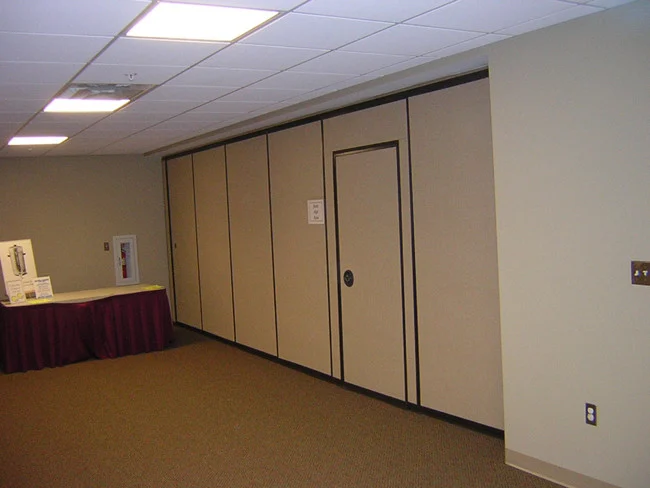
Parking style is customized to the customer layout and project requirements, and may support compact stacking when the coordinated design permits it. At a corridor junction, compactness matters because the pocket competes with circulation space. The review should show the parked condition, not only the open condition.
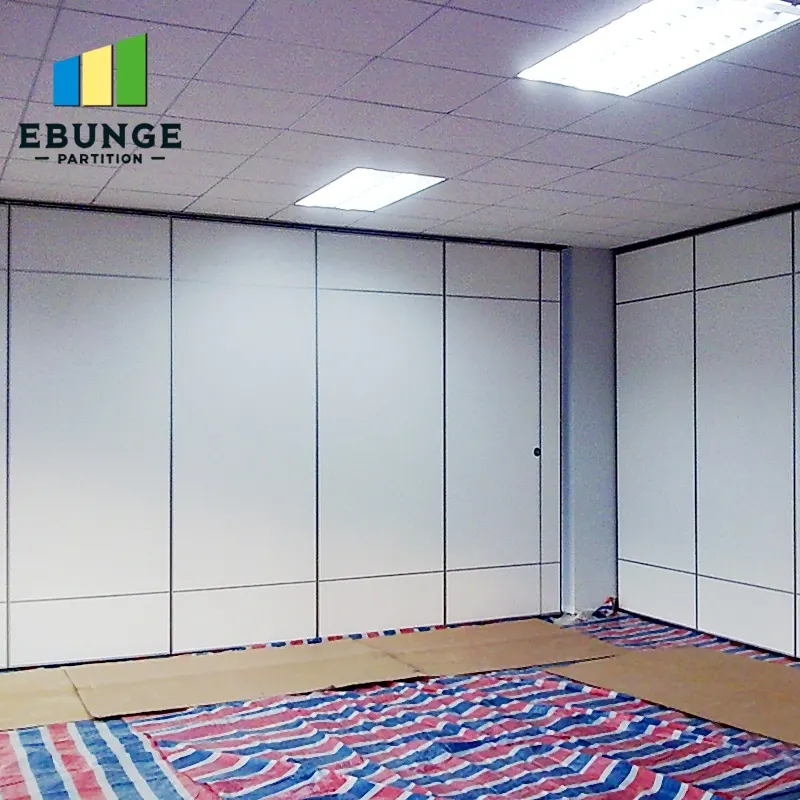
The exact route, junction arrangement, continuous overhead path and parking position must be confirmed from the coordinated project drawings. That conclusion requires dimensional confirmation against the applicable accessibility requirements and the actual layout. Ask for the parked-state drawing and check it against the route people will use.
What to confirm with the project team
- Confirm the parking position and its relationship to the junction.
- Confirm the clear route in both the open and parked states.
- Confirm how the pocket opening is finished and protected.
- Confirm pass-door requirements, if a pass door is needed.
- Confirm the project documentation set that records these decisions.
Seals, Acoustics, and What the Review Can and Cannot Say
Review focus: corridor junction accessibility review.
Movable partitions often include seals at panel edges and junctions. Generically, seals are intended to close gaps between panels and between panels and adjacent surfaces. The suitability of each route and parking arrangement depends on the approved layout, circulation, ceiling interfaces and operating sequence. This article does not claim any specific acoustic result for any configuration.
If acoustic separation matters at the corridor junction, the project team should confirm the required rating and the supporting evidence for the proposed assembly. Visible references can support layout discussion but do not verify hidden construction or performance. The accessibility review and the acoustic review are separate exercises that must both be coordinated with the same layout.
Finish Choices and Their Place in the Review
Project review term: corridor junction accessibility review.
Confirmed finish options include laminate, melamine, fabric, leather, glass, and other approved surfaces. Finish selection affects appearance, maintenance expectations, and how the pocket reads in the corridor.
| Review item | What the drawing can show | What still needs confirmation |
|---|---|---|
| Parking position | Location and footprint of the stack | Dimensional fit and route clearance |
| Overhead route | Path from closed to parked | Support and connection details |
| Finish | Selected surface category | Project-specific suitability |
| Pass door | Proposed location | Requirement and coordination |
Coordination Sequence for Project Teams
The aim is to keep decisions visible and to avoid unsupported assumptions passing from one discipline to another.
A practical sequence
- Issue the current architectural layout showing the corridor junction.
- Mark the proposed stacking pocket and parking position.
- Trace the straight, turning, and stacking routes on the drawing.
- Review the parked state for clear circulation and turning.
- Record pass-door and documentation requirements.
- Confirm support, acoustic, and dimensional requirements with the responsible parties.
- Update the drawing set and repeat the review after changes.
This sequence does not produce a performance conclusion. It produces a coordinated question list that the project team can resolve with the right evidence.
Evidence Boundaries Buyers Should Expect
An accessibility review should be honest about what it can and cannot establish. Visible geometry can show a proposed route. Those conclusions require matching project evidence.
When a supplier or contractor makes a comparative, absolute, or causal claim about a stacking pocket at a corridor junction, ask for the corresponding evidence. If the evidence is not available, the claim should be removed or restated as a project-specific confirmation item. This discipline protects the owner, the design team, and the installer.
Frequently Asked Questions
What is a stacking pocket corridor junction accessibility review?
It is a drawing-based review of how a top-hung movable partition, its parking position, and the remaining circulation space work together where a corridor meets a junction. It focuses on routes, clear space, and coordination rather than on unsupported performance claims.
Do EBUNGE movable partitions need a floor track at the junction?
No. EBUNGE panels are top-hung and move without a continuous floor running track or floor hardware along the partition line. The review therefore concentrates on the overhead route and the parked position.
Can the panels travel across an untracked gap?
No. Every proposed movement path requires a continuous connected overhead route and project-specific support review. If a drawing shows a gap in the route, that condition needs to be resolved before the layout is treated as coordinated.
Does a compact stack prove the corridor remains accessible?
No. A compact stack may help, but accessibility depends on the confirmed dimensions and the applicable requirements. The parked-state drawing should be checked against the route people will actually use.
How should acoustic requirements be handled in this review?
Acoustic requirements should be confirmed separately with the project team and supported by matching evidence.
What documentation should be requested?
Request the current layout, the parking position, the route drawings, pass-door requirements if applicable, and the project documentation set. Confirm support, acoustic, and dimensional requirements with the responsible parties before proceeding.
Conclusion and Next Step
A stacking pocket at a corridor junction deserves an accessibility review that stays within evidence. Trace the routes, show the parked state, record the open questions, and confirm support, acoustic, and dimensional requirements for the specific project.
To discuss your layout, pass-door requirements, or project documentation, contact the EBUNGE team. You can also review the movable wall product context and the project resources before your next coordination meeting.