
Quick answer: corridor handrail circulation audit
Review focus: corridor handrail circulation audit.
A stacking pocket corridor handrail circulation audit is a drawing-based review that checks whether a top-hung movable partition can travel, turn and park without conflicting with an existing or proposed corridor handrail. The suitability of each route and parking arrangement depends on the approved layout, circulation, ceiling interfaces and operating sequence. It is a coordination exercise: the project team compares the intended movement route, the parking position and the corridor clearances on the same set of coordinated drawings.
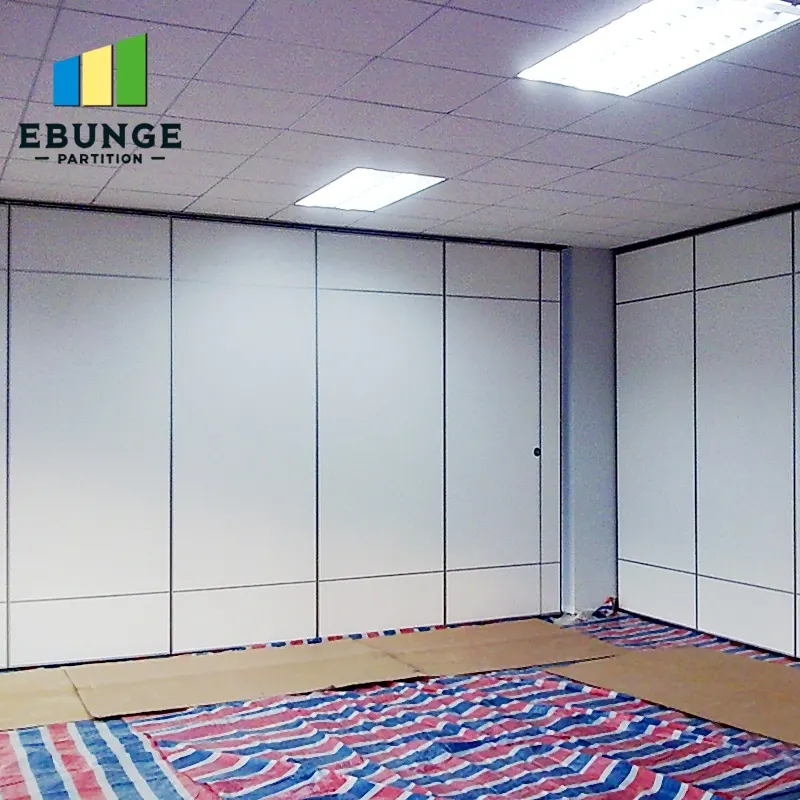
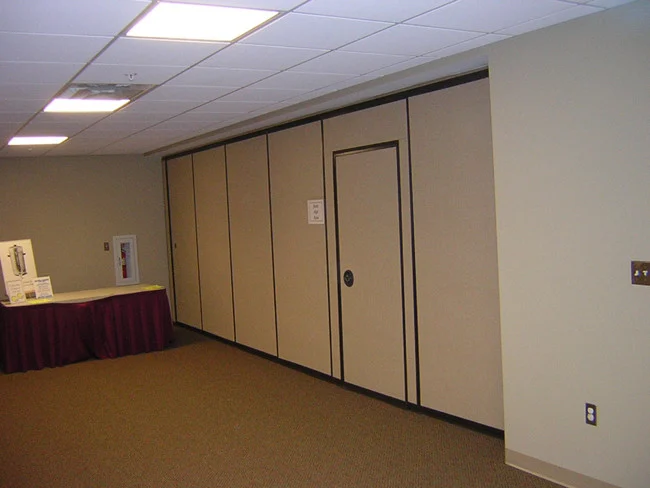
EBUNGE movable wall panels are individually movable, suspended from a top track, cross the opening without a floor track, and park at a planned stacking position. Those maintained facts define the review scope. The exact overhead route and support arrangement must be confirmed by the responsible project team from coordinated drawings.
Why the handrail and the stacking pocket interact
Project review term: corridor handrail circulation audit.
A corridor handrail is usually a continuous element fixed to the wall or to a supporting structure. A stacking pocket is a planned parking zone where panels gather when the opening is clear. When the two sit on the same corridor elevation, the audit question is simple: does the panel route, the pocket opening and the handrail line occupy the same space at the same time?
If they do, the conflict is a coordination problem, not a product defect. The exact route, junction arrangement, continuous overhead path and parking position must be confirmed from the coordinated project drawings. The audit should record which option the design team accepts and what evidence supports it.
What the audit can and cannot show
The audit can show whether the drawn route is continuous, whether the parking zone is reachable and whether the handrail line crosses the route. Those require separate, project-specific confirmation.
Information to collect before the review
Coordination scope: corridor handrail circulation audit.
Start with the coordinated plan, not with a product selection. The review is only as reliable as the drawings behind it.
- Architectural plan showing the corridor, the opening and the proposed stacking pocket.
- Reflected ceiling plan or overhead coordination drawing showing the top track route.
- Handrail location, extent and fixing strategy as currently designed.
- Intended panel parking arrangement and the space reserved for it.
- Turning points where the route changes direction between the opening and the pocket.
- Any pass-door requirement and how it affects the route or the parked position.
Where a drawing is missing, mark it as an open item rather than assuming a value. An audit that fills gaps with assumptions is not an audit.
A step-by-step circulation audit process
Checklist focus: corridor handrail circulation audit.
The sequence below keeps the review tied to visible drawing evidence. It does not replace engineering review or code consultation.
- Overlay the panel route, the top track and the handrail on one coordinated plan.
- Trace the route from the closed position to the parking position, including every turn.
- Mark any point where the handrail line, its supports or its clearance zone meets the route.
- Check that the parking pocket can receive the panels in the drawn arrangement.
- Record each conflict with a drawing reference, not a verbal note.
- List the resolution options and the evidence each option still needs.
- Confirm the revised route with the design team before the drawings are fixed.
Reading the route, not just the opening
Many reviews focus on the clear opening and stop there. The route matters just as much. A panel that crosses the opening cleanly may still need a turning path and a parking approach. If the handrail sits inside that path, the conflict appears only when the route is traced end to end.
Evidence boundaries for the audit report
An audit report should separate what the drawings show from what still needs confirmation.
| Statement type | Can the audit support it? | What is needed instead |
|---|---|---|
| Drawn route crosses the handrail line | Yes, if the coordinated drawings show it | Nothing further for the observation itself |
| Panels will park within the pocket | Only as a drawn arrangement | Project-specific dimensional confirmation |
| Acoustic separation meets a target | No | Project-specific acoustic review |
| Handrail fixing is adequate | No | Structural and fixing confirmation |
| Route complies with accessibility rules | No | Local code review by the responsible party |
Coordination points for the wider team
The audit sits between several disciplines. Each one needs a clear question, not a general instruction to coordinate.
Architect and interior designer
Confirm the corridor geometry, the handrail intent and the parking zone on the same drawing set. If the handrail is decorative or intermittent, say so; the audit should not treat it as continuous unless the drawings show it that way.
Contractor and renovation team
Confirm what exists on site and what is proposed. Existing handrails, wall build-ups and ceiling conditions can change the route. Record site observations as observations, not as verified performance.
Owner and operator
Confirm how the space is expected to be used and whether the parking position is acceptable in daily operation. Operational preference is a design input, not a performance claim.
Common audit gaps and how to close them
Most circulation problems are found late because one drawing was not overlaid. The gaps below are recurring and can be closed with a short checklist.
- Handrail shown on the architectural plan but not on the overhead coordination drawing.
- Parking pocket dimensioned on one drawing and described differently on another.
- Pass-door requirement raised after the route was fixed.
- Support and acoustic requirements left as verbal assumptions.
Closing these gaps early is usually cheaper than resolving them after fabrication or installation planning has advanced. The audit does not promise a cost outcome; it simply reduces the number of unresolved drawing conflicts.
FAQ: stacking pocket and corridor handrail reviews
What is a stacking pocket corridor handrail circulation audit?
It is a drawing-based review that checks whether a top-hung movable partition can travel, turn and park without conflicting with a corridor handrail. It records conflicts and open items; it does not verify performance.
Do EBUNGE panels need a floor track along the corridor?
No. EBUNGE movable wall panels are top-hung and cross the opening without a floor track. The route still needs a continuous connected overhead track and project-specific support review.
Can the audit confirm acoustic performance?
No.
What if the handrail cannot be moved?
Each option needs its own drawing and project-specific confirmation.
Which drawings should be used for the review?
Use the coordinated architectural plan, the overhead or ceiling coordination drawing, and the handrail layout together. A single drawing is rarely enough to trace the full route.
When should the audit happen?
Before the route, pocket and handrail are fixed in the construction set. Early review gives the team more room to resolve conflicts without reworking later stages.
Conclusion and next step
A stacking pocket corridor handrail circulation audit is most useful when it stays close to the drawings. Trace the route, mark the conflicts, separate observations from unconfirmed performance, and record what each discipline still needs to confirm. That approach keeps the review honest and the coordination practical.
For project-specific support, acoustic and dimensional requirements, confirm them with the responsible parties before the design is fixed. To discuss pass-door requirements, finish options or project documentation, contact the EBUNGE team. You can also review movable wall panels and the wider project planning resources for background.