
Quick project answer
Review focus: corner turn circulation review.
A stacking pocket corner turn circulation review is the drawing-stage discipline of checking how individually movable, top-hung panels travel from a closed position, cross the opening without a floor track, turn a corner if required, and arrive at a planned parking position. It is not a performance calculation. It is a coordination exercise that exposes conflicts early, while the layout can still be adjusted.
This article is written for contractors, architects, interior designers, owners, renovation teams and distributors who need a shared vocabulary before specification. Every recommendation here is bounded by maintained product facts and by what a drawing can and cannot show. The exact overhead route and support arrangement must be confirmed by the responsible project team from coordinated drawings.
Why a Corner Turn Changes the Review
Project review term: corner turn circulation review.
A straight run is comparatively easy to read on a plan. A corner turn introduces a change of direction that affects how the overhead route is understood, how the parking pocket relates to adjacent rooms, and how the stacking position interacts with circulation to exits, services and furniture zones.
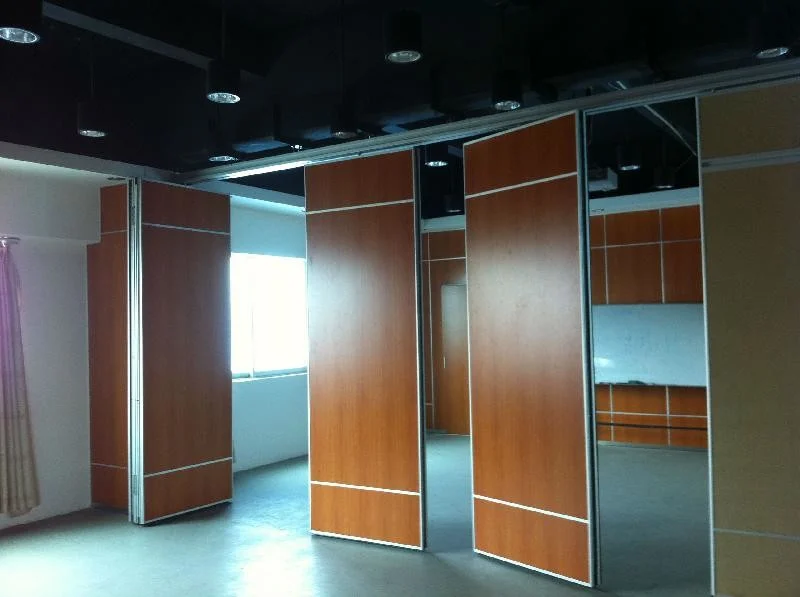
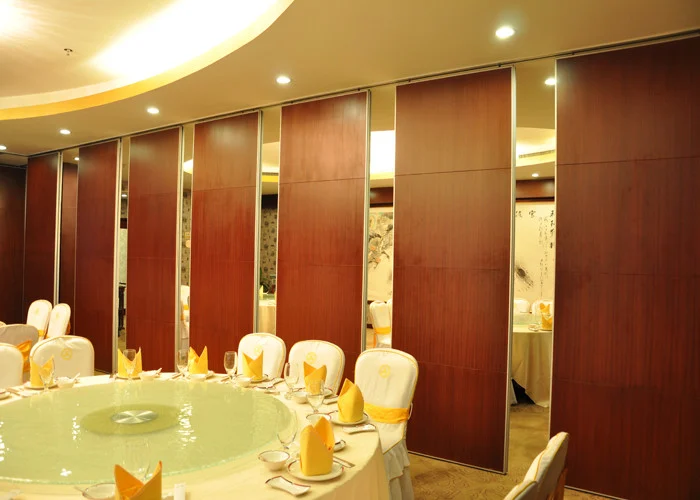
EBUNGE movable wall panels are individually movable and suspended from a top track. They cross the opening without a floor track, and they park at a planned stacking position. Straight, turning and stacking routes are reviewed from the layout. That is the factual basis for this review. It does not tell us how any particular corner will perform; it tells us what must be drawn and confirmed.
What the drawing can show
A layout can show the intended route, the location of the turn, the proposed pocket, and the relationship between the parked panels and nearby doors, corridors or fixed elements. It can show whether the route appears continuous in plan.
What the drawing cannot show
Visible references can support layout discussion but do not verify hidden construction or performance. Those depend on project-specific evidence. Treat visible geometry as a coordination tool, not as proof of hidden performance.
Route Continuity From Opening to Pocket
Coordination scope: corner turn circulation review.
The first question in any stacking pocket corner turn circulation review is whether the intended movement path is continuous and connected. The exact route, junction arrangement, continuous overhead path and parking position must be confirmed from the coordinated project drawings. Every proposed movement path requires a continuous connected overhead route and project-specific support review.
When a corner is involved, the team should trace the route in both directions: from the closed position to the pocket, and from the pocket back to the closed position. Panel handling and the operating sequence must be confirmed for the selected layout and project conditions. It is a check that the plan reflects a single, connected path rather than two unrelated segments.

- Mark the closed partition line and the opening it serves.
- Mark the proposed turn point and the geometry of the corner.
- Mark the stacking pocket and the parking position of the panels.
- Trace the route as one continuous path and note any interruption.
- Record which items require project-specific confirmation before specification.
Turning geometry and adjacent elements
Corners are often shared with columns, service risers, door swings, glazing or fixed joinery. The review should identify what sits inside the turning zone and whether the layout leaves a readable route. Where the route is unclear, the drawing should be revised rather than assumed.
Stacking pocket position
Parking style is customized to the customer layout and project requirements and may support compact stacking when the coordinated design permits it. The pocket position therefore belongs in the same conversation as the turn, not in a separate document.
Drawing Coordination Across Disciplines
Checklist focus: corner turn circulation review.
A corner turn rarely belongs to one trade. The overhead route, the pocket, the adjacent ceiling, the floor finish and the surrounding circulation all appear on different drawings. The circulation review is where those drawings are compared.
| Review item | What to compare | Confirmation boundary |
|---|---|---|
| Overhead route | Architectural plan and reflected ceiling plan | Support and fixing require project-specific review |
| Corner turn | Plan geometry and adjacent fixed elements | Turning feasibility is confirmed from the coordinated layout |
| Stacking pocket | Pocket location and surrounding circulation | Parking style is customized to the layout |
| Finish interfaces | Panel finish schedule and adjacent surfaces | Finish selection does not imply performance |
This table is a coordination aid, not a compliance checklist. Each row still needs the project team to confirm the relevant requirement against its own documentation.
Finish, Pass-Door and Interface Questions
Confirmed finish options include laminate, melamine, fabric, leather, glass and other approved surfaces. Finish choice affects appearance and interface detailing, but it should not be read as evidence of acoustic, fire, durability or cleaning performance.
Pass-door requirements and project documentation can be discussed with the supplier. Where a pass door is proposed near a corner turn or pocket, the review should show how it relates to the route and to adjacent circulation.
Questions to raise early
- Does the finish schedule align with the coordinated layout?
- Is a pass door required, and where does it sit relative to the turn?
- Which documentation is needed for the project record?
- Which items remain open pending project-specific confirmation?
Acoustic Concepts Without Invented Numbers
The suitability of each route and parking arrangement depends on the approved layout, circulation, ceiling interfaces and operating sequence.
Seals and acoustic concepts can be explained generically, but the actual requirement depends on the project. Where acoustic separation matters, the team should confirm the requirement with the supplier and against the project documentation.
Evidence note: this article uses maintained EBUNGE product facts and the approved topic research receipt. It does not infer performance, structure, installation, maintenance, cost or engineering outcomes from drawings or finishes.
Common Coordination Gaps to Avoid
Most corner-turn problems are not dramatic. They are small omissions that become expensive when the layout is fixed. The following gaps appear repeatedly in early reviews.
- Treating the turn and the pocket as separate design tasks.
- Assuming a route is continuous without tracing it in plan.
- Leaving the pocket position until after adjacent circulation is set.
- Reading a finish or a drawing as proof of hidden performance.
- Deferring pass-door and documentation questions too late.
None of these gaps requires a performance claim to resolve. They require a coordinated drawing and a clear list of items to confirm.
FAQ: Stacking Pocket Corner Turn Circulation Review
What is a stacking pocket corner turn circulation review?
It is a drawing-stage check of how top-hung, individually movable panels travel from the closed position, turn a corner if required, and arrive at a planned stacking pocket. It focuses on route continuity, pocket position and coordination, not on performance claims.
Do movable partitions need a floor track?
EBUNGE movable wall panels are suspended from a top track and cross the opening without a floor track. The route still requires a continuous connected overhead path and project-specific support review.
Can panels travel across a gap at a corner?
No. The exact route, junction arrangement, continuous overhead path and parking position must be confirmed from the coordinated project drawings. Every proposed movement path requires a continuous connected overhead route, and the corner geometry must be reviewed from the coordinated layout.
How is the stacking pocket position decided?
Parking style is customized to the customer layout and project requirements and may support compact stacking when the coordinated design permits it. The pocket should be reviewed together with the turn and surrounding circulation.
Which finishes can be considered?
Confirmed finish options include laminate, melamine, fabric, leather, glass and other approved surfaces. Finish selection should be confirmed against the project schedule and does not by itself establish acoustic or other performance.
What should be confirmed before specification?
Project-specific support, acoustic and dimensional requirements should be confirmed with the supplier and against the project documentation. Pass-door requirements and project documentation can also be discussed.
Conclusion and Next Step
A stacking pocket corner turn circulation review is most useful before the layout is frozen. It keeps the route, the turn and the pocket in one conversation, and it separates what a drawing can show from what still needs project-specific confirmation.
To take the next step, review the movable walls product context, consult the resources library, and contact the team with your layout questions. Confirm project-specific support, acoustic and dimensional requirements before specification.