
Room Scheduling Rules That Decide When a Partition Changeover Starts
Quick answer: partition changeover
Review focus: partition changeover.
Most scheduling disputes about flexible rooms are not really about the calendar. They are about the moment a room stops being one space and becomes another. Clear room scheduling partition changeover start rules define that moment in writing, so bookings, housekeeping and facilities teams work from the same assumption instead of negotiating at the door.
This guide sets out a framework for building those rules. It stays within what can be confirmed from maintained product information and project drawings, and it flags where a project team must obtain its own evidence before committing to a schedule.
Why the Start Moment Needs a Written Rule
Project review term: partition changeover.
A movable partition is not a door. Panels are individually movable, suspended from a top track, and cross the opening without a floor track. They park at a planned stacking position. Because the panels travel as separate elements along a defined route, the changeover is a sequence of physical steps, not a single action.
If the schedule treats the changeover as instantaneous, two bookings can overlap in the same room without anyone noticing on paper. A written start rule converts that hidden overlap into a visible block of time that the booking system can protect.
Separate the room from the route
The room booking and the movement route are different resources. A room may be free while the route to the stacking position is obstructed by stored furniture, a service trolley or a temporary display. Scheduling rules should name who confirms route clearance before the changeover is treated as ready to begin.
Name the responsible role, not a person
Rules survive staff changes when they refer to roles: room owner, facilities coordinator, housekeeping lead, event manager. Avoid naming individuals in the published rule, and keep an escalation contact in the project documentation instead.
Inputs a Changeover Rule Should Reference
Coordination scope: partition changeover.
Every rule should point to a controlled document rather than describing geometry from memory. The layout drawing is the reference for straight, turning and stacking routes, and it should be reviewed whenever the room’s furniture plan changes.
- Layout drawing: the reviewed plan showing panel travel and the planned stacking position.
- Booking record: the room, the configuration required and the adjacent booking.
- Route clearance confirmation: who checks the path and when.
- Stacking position status: whether the parking area is free and reserved for panels.
- Pass-door requirements: whether access through the closed partition is needed during the event.
- Finish protection notes: handling guidance agreed for the specified surfaces.
Treat finishes as a scheduling factor

Confirmed finish options include laminate, melamine, fabric, leather, glass and other approved surfaces. Different surfaces may call for different handling care during movement, so the rule should reference the agreed handling notes rather than assume one routine fits every room.
A Numbered Process for Setting the Start Rule
Checklist focus: partition changeover.
- List every configuration the room must support and the bookings that require each one.
- Mark the planned stacking position on the reviewed layout and confirm it is reserved, not shared with storage.
- Walk the straight, turning and stacking routes with the facilities and housekeeping leads.
- Agree which checks must be complete before the changeover is declared started.
- Define the buffer that separates one booking from the next in the scheduling system.
- Record the rule in the room’s operating note and link it to the project documentation.
- Review the rule after any furniture, layout or booking-pattern change.
Booking Buffers and the Evidence Boundary
Review focus: partition changeover.
Teams often ask for a standard changeover duration to load into a booking system. That number depends on the specific layout, route length, stacking arrangement and the operating routine the owner adopts. It is a project-specific decision, not a catalogue value.
What can be stated is the principle: the buffer must cover the full sequence from route clearance to the panels reaching the stacking position, plus the reverse when the room is restored. The actual duration should be agreed with the parties who will carry out the work and recorded as a project assumption, not presented as a product specification.
Evidence note: Do not convert a visible layout, a finish sample or a photograph into a claim about acoustic performance, structural capacity or changeover time. Those require matching project evidence and, where relevant, review of the specific drawings.
Acoustic Expectations and Scheduling Language
The suitability of each route and parking arrangement depends on the approved layout, circulation, ceiling interfaces and operating sequence. They are not a promise about how a particular room will perform on site, because the installed result depends on the whole construction, including junctions and adjacent elements.
Scheduling rules should therefore avoid language that implies a guaranteed quiet room. Instead, state what the project has confirmed and refer enquiries to the project documentation. Visible references can support layout discussion but do not verify hidden construction or performance.
Seals explained generically
Movable systems commonly use sealing concepts at panel edges and junctions to limit air paths. The specific seal arrangement belongs to the project specification. Scheduling teams should not infer acoustic outcomes from the presence of a seal, and should confirm requirements with the project team.
Coordination Between Operations and Facility Planning
A changeover rule that ignores cleaning will fail on the first busy morning.

| Rule element | Owner | What it prevents |
|---|---|---|
| Route clearance check | Facilities coordinator | Changeover starting with an obstructed path |
| Stacking position reservation | Room owner | Panels arriving at an occupied parking area |
| Booking buffer | Operations scheduler | Overlapping configurations in one room |
| Handling notes by finish | Housekeeping lead | Inconsistent care across rooms |
| Documentation review | Project team | Rules drifting from the reviewed layout |
Documentation to Keep With the Rule
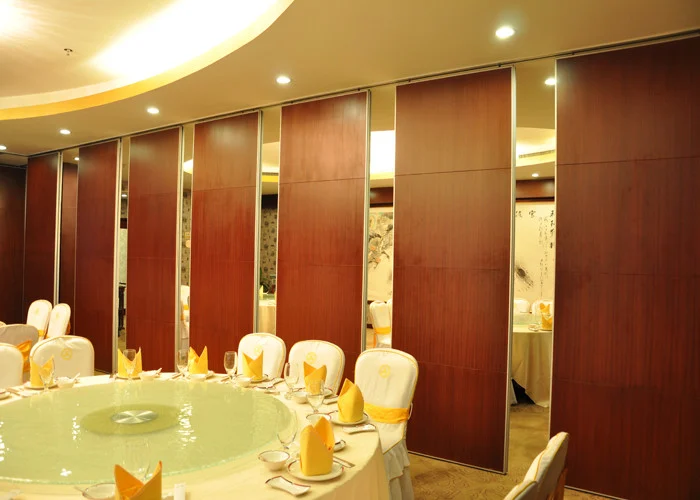
The rule should live beside the reviewed layout, the agreed finish schedule and any pass-door requirements discussed for the project. Where a pass door is needed, that requirement affects how the closed configuration is used and should be settled before the room is published as bookable.
Project documentation can be discussed with the supplier so that the operating note reflects the configuration actually supplied. Review the movable wall systems overview and the planning resources before drafting the final rule, and confirm project-specific support, acoustic and dimensional requirements with the project team.
Frequently Asked Questions
When exactly does a partition changeover start?
It starts when the agreed pre-checks are complete and the route to the stacking position is confirmed clear. The rule should name those checks rather than relying on a verbal signal.
Can we use one standard buffer for every room?
Only if the layouts, routes and operating routines are genuinely comparable. Otherwise each room needs its own agreed assumption, recorded in the project documentation.
Do the panels need a floor track along the opening?
No. The panels are suspended from a top track and cross the opening without a floor track. The overhead route must still be continuous and supported as reviewed for the project.
Does a finish choice change the scheduling rule?
It can change the handling notes. Laminate, melamine, fabric, leather, glass and other approved surfaces may need different care during movement, so reference the agreed notes.
Can the rule promise a quiet room?
No. Confirm acoustic requirements through project-specific review and avoid absolute claims in scheduling documents.
Who should approve the final rule?
The room owner, facilities and operations should sign off together, with the project team confirming that the rule matches the reviewed layout and documentation.
Conclusion
Good changeover rules are short, specific and tied to reviewed drawings. They protect bookings by making the physical sequence visible, and they stay honest by separating confirmed product facts from project-specific assumptions. Start with the layout, agree the checks, record the buffer, and review whenever the room changes.
To discuss pass-door requirements, finishes or project documentation for your rooms, contact the EBUNGE team and share your layout for review.