
Quick project answer
Review focus: room booking rules.
A room booking rules changeover policy conflict appears when the calendar says one thing and the space plan says another. A booking system may allow back-to-back reservations, while the changeover policy assumes a buffer for reconfiguration. For contractors, architects, designers and owners, the useful question is not who wins the argument. It is what the drawings, the booking logic and the movable partition layout each require before anyone commits to a configuration.
This article treats the named room type as an example only. The same coordination logic applies wherever flexible division, combination or reconfiguration is planned. Every project-specific support, acoustic and dimensional requirement still needs confirmation against the actual layout.
Why the Conflict Appears in Facility Operations Planning
Project review term: room booking rules.
Booking rules usually describe time. Changeover policies describe sequence. A calendar can show a 09:00 handover and a 09:15 start, but the room may need to move from one arrangement to another between those moments. If the booking rule does not recognise the sequence, operations staff inherit an impossible instruction.
Facility Operations Planning coordination brings those two languages together. The booking rule should reflect how the space is actually reconfigured, and the changeover policy should reflect what the booking system permits. Neither document can be written in isolation from the partition layout.
Time-based rules versus route-based reality
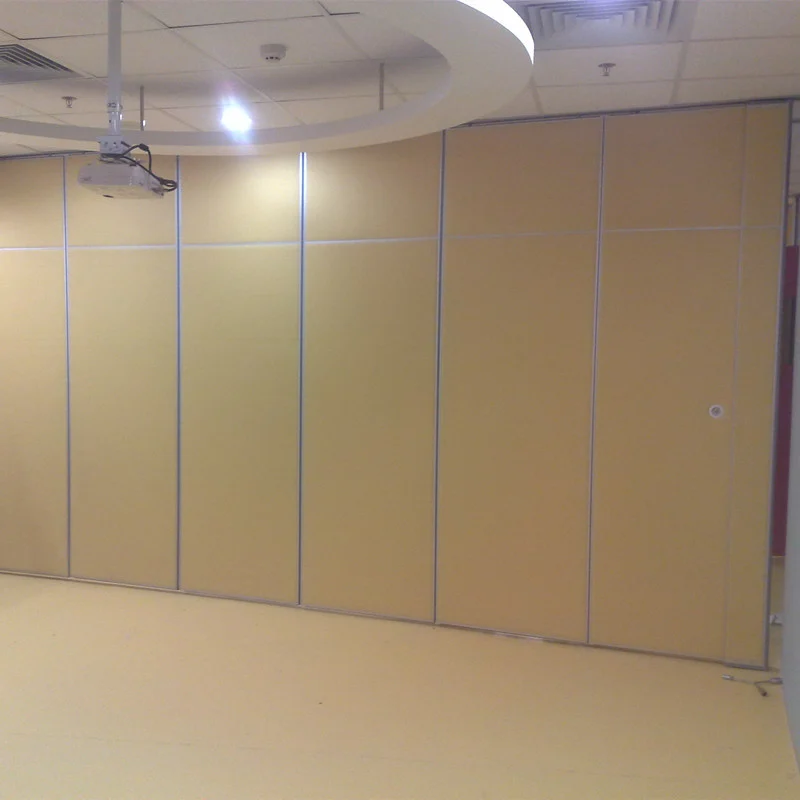
Movable wall panels are individually movable, suspended from a top track, cross the opening without a floor track, and park at a planned stacking position. That means the changeover is a route, not just a duration. Straight, turning and stacking routes are reviewed from the layout. A booking rule that ignores the route may create conflicts that no amount of scheduling discipline can remove.
Where the conflict becomes visible
Conflicts often surface during commissioning, when staff try to follow both documents at once. They may also appear during design review, when the booking system is specified before the partition layout is fixed. Catching the mismatch early is cheaper than rewriting operational rules after handover.
Map the Changeover Route Before Rewriting the Rules
Coordination scope: room booking rules.
Start with the drawing, not the calendar. The layout shows where panels travel, where they park and how the opening is cleared. The booking rule should then be written around that physical sequence.
- Mark the opening and the planned stacking position on the layout.
- Trace the straight, turning and stacking routes that panels follow.
- Identify any route that depends on furniture, equipment or temporary items being moved first.
- Confirm the overhead route is continuous and supported for the proposed movement path.
- Record the sequence as an operational instruction, not only as a time allowance.
- Review the booking rule against that sequence before publication.

This process does not produce a performance figure. It produces a shared understanding of what the room must do between bookings. That understanding is what allows the booking rule and the changeover policy to agree.
Evidence Boundaries for Booking and Changeover Claims
Checklist focus: room booking rules.
Project teams often want a single number that proves the changeover will work. That number rarely exists in isolation. The suitability of each route and parking arrangement depends on the approved layout, circulation, ceiling interfaces and operating sequence. The exact overhead route and support arrangement must be confirmed by the responsible project team from coordinated drawings.
Evidence note: a visible finish, photograph or drawing does not prove acoustic, fire, structural or commercial performance. Comparative, absolute and causal statements require corresponding evidence or an explicit project-specific confirmation boundary.
Finish options include laminate, melamine, fabric, leather, glass and other approved surfaces. Pass-door requirements and project documentation can be discussed with the supplier, but the resulting specification still belongs to the project.
Aligning Booking Rules with Partition Layout
Review focus: room booking rules.
The booking rule should describe the room as it will actually be used. If the layout supports a compact stacking position, the rule can reflect that. If the route requires a longer sequence, the rule should not promise a shorter one.
| Booking rule element | Layout question to confirm | Evidence boundary |
|---|---|---|
| Back-to-back bookings | Does the changeover sequence fit between them? | Sequence is project-specific |
| Room combination | Which panels move, and where do they park? | Route review required |
| Buffer time | What operational steps occur before the room is ready? | No universal duration |
| Acoustic expectation | What rating concept applies to the opening? | Confirm with project evidence |
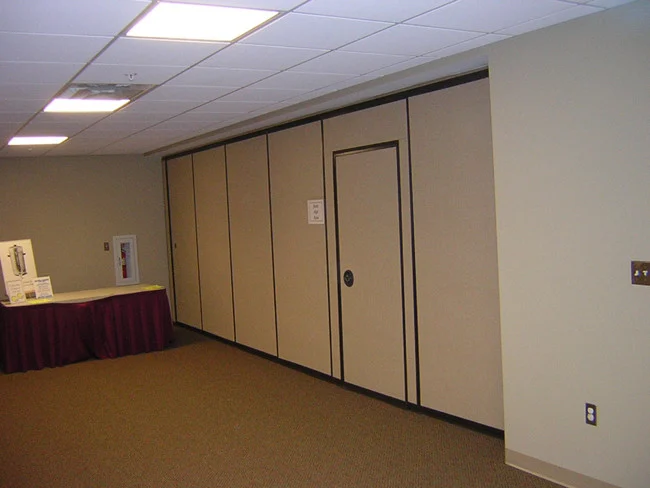
Use this table as a coordination checklist, not as a specification. Each row points to a question that the project team must answer with its own drawings and confirmed requirements.
Coordination Steps for Contractors and Designers
Contractors and designers can reduce conflict by sequencing decisions. The partition layout, the booking logic and the changeover policy should be reviewed together, not handed off in separate packages.
- Share the partition layout with the operations team before booking rules are finalised.
- Ask the supplier to review straight, turning and stacking routes from the layout.
- Confirm pass-door requirements and project documentation early.
- Record any assumption that depends on furniture or equipment being moved.
- Keep acoustic and dimensional requirements as project-specific confirmations.
- Revisit the booking rule whenever the layout changes.
These steps do not guarantee an outcome. They create a traceable decision path, which is what an evidence-bounded review requires.
What to Confirm Before Publication
Before a booking rule or changeover policy is published, confirm the support, acoustic and dimensional requirements for the specific project. Confirm that the overhead route is continuous and supported for every proposed movement path. Confirm that the parking position is coordinated with the layout. Confirm that any performance statement has matching evidence.
Where evidence is missing, state the boundary rather than filling the gap with an assumption. That discipline protects the project team from promising something the drawings do not support.
FAQ: Room Booking Rules and Changeover Policy
What causes a room booking rules changeover policy conflict?
It usually appears when time-based booking rules are written without reference to the physical changeover sequence. The booking system permits a schedule that the layout cannot support without a defined route and parking position.
Can movable partitions remove the need for buffer time?
No universal answer applies. The required sequence depends on the layout, the route and the project-specific requirements. Buffer time should be confirmed against the actual changeover steps, not assumed.
Do panels need a floor track for the changeover?
EBUNGE movable partition panels are top-hung and move without a continuous floor running track or floor hardware along the partition line. The overhead route still requires a continuous connected path and project-specific support review.
How should acoustic expectations be written into a booking rule?
Any acoustic requirement should be confirmed with project-specific evidence and should not be inferred from a finish or drawing.
When should the operations team join the coordination process?
As early as possible. Operations staff can identify scheduling assumptions that conflict with the layout before the booking rules are finalised, which reduces rework later.
What documentation should be reviewed?
Review the partition layout, the proposed booking logic, the changeover sequence and any project-specific support, acoustic and dimensional requirements. Pass-door requirements and project documentation can be discussed with the supplier.
Conclusion: Make the Rule Follow the Room
A room booking rules changeover policy conflict is rarely solved by choosing one document over the other. It is solved by making both documents describe the same physical sequence. Start with the layout, trace the routes, confirm the parking position and state the evidence boundaries clearly.
For project teams evaluating movable walls, the next step is a drawing review. Review the movable walls product context, check the planning resources and then contact the team to discuss pass-door requirements, project documentation and the specific support, acoustic and dimensional confirmations your project needs.