
Quick project answer
Review focus: track fixing point tolerancing responsibility.
On overseas projects, the movable partition track fixing point tolerancing responsibility matrix is often left implicit until the ceiling grid is already installed. The suitability of each route and parking arrangement depends on the approved layout, circulation, ceiling interfaces and operating sequence. This article explains how to allocate tolerancing responsibility before installation begins, using maintained product facts and project-specific drawing review.
Why Track Fixing Point Tolerancing Needs an Explicit Matrix
Project review term: track fixing point tolerancing responsibility.
EBUNGE movable partition panels are individually movable, suspended from a top track, cross the opening without a floor track, and park at a planned stacking position. Because the panels hang from above, the track fixing points must align with a continuous connected overhead route.
A tolerancing responsibility matrix is a coordination document, not a performance claim. It records who sets out each fixing point, who checks it, and what evidence is required before the next trade covers the work. The matrix should reference project drawings, not generic assumptions.
What the matrix should record
- Responsible trade for each fixing point set-out.
- Datum and reference line used for that set-out.
- Inspection point before ceiling closure.
- Documented deviation and approval route.
- Interface with straight, turning and stacking routes.
Structural Trade Responsibilities Before Partition Installation
Do not infer support capacity, fixing type or load values from a visible slab or from a generic detail. The matrix only allocates who checks and who approves the set-out.
Evidence note
Before installation begins, confirm the structural datum, the fixing point coordinates and the inspection record with the responsible engineer. EBUNGE does not provide structural design for your project unless separately agreed in writing.
Ceiling Trade Responsibilities and Interface with the Track Route
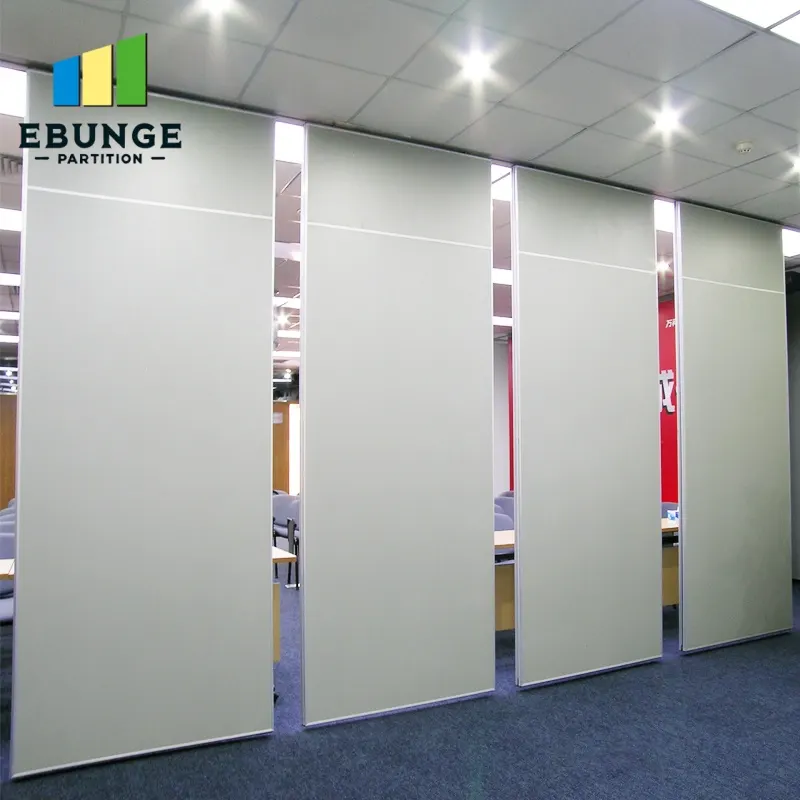
The ceiling trade often installs framing, hangers and finishes that surround the track. If the ceiling grid is set out independently, it can obstruct the continuous overhead route or hide fixing points before inspection. The matrix should define the sequence: track fixing points inspected and approved before ceiling closure.
Where a turning or stacking route is planned, the ceiling trade must coordinate the opening and any soffit conditions with the partition layout. The layout review should confirm that straight, turning and stacking routes are connected overhead. The exact route, junction arrangement, continuous overhead path and parking position must be confirmed from the coordinated project drawings.
Coordination checkpoint
- Issue the partition layout showing straight, turning and stacking routes.
- Mark all track fixing points on the ceiling coordination drawing.
- Inspect fixing points before ceiling closure.
- Record approval before partition panels are hung.
Partition Trade Responsibilities and Setting-Out Accuracy
The partition trade installs the top track and hangs the panels. Its responsibility in the matrix is to set out from the approved datum and to report any deviation before panels are installed.
Finish options such as laminate, melamine, fabric, leather, glass and other approved surfaces do not change the track fixing point tolerancing responsibility. Finish selection is separate from the setting-out matrix.
Compact comparison: responsibility by trade
| Trade | Primary responsibility | Evidence required |
|---|---|---|
| Structural | Confirm supporting datum and fixing positions | Signed structural set-out or approval |
| Ceiling | Coordinate ceiling framing with track route | Ceiling coordination drawing |
| Partition | Install track from approved datum | Inspection record before panel hang |

How to Run the Tolerancing Responsibility Matrix Meeting
Hold a coordination meeting before any track fixing point is drilled. The agenda should cover the datum, the fixing point schedule, the inspection sequence and the deviation approval route.
Use the meeting to confirm pass-door requirements and project documentation. EBUNGE can discuss pass-door requirements and project documentation, but the final matrix must reflect the project’s own drawings and approvals.
Decision checklist for the meeting
- Is the continuous overhead route confirmed on the layout?
- Are straight, turning and stacking routes reviewed?
- Is the datum agreed by all three trades?
- Is the inspection point scheduled before ceiling closure?
- Is the deviation approval route documented?
- Are pass-door and documentation requirements listed?
Evidence Boundaries and Project-Specific Confirmation
Visible references can support layout discussion but do not verify hidden construction or performance.
Every project must confirm support, acoustic and dimensional requirements with the responsible engineer and the EBUNGE project team. The matrix is a coordination tool, not a substitute for that confirmation.
FAQ: Track Fixing Point Tolerancing Responsibility

Who owns the track fixing point tolerancing responsibility matrix?
The project manager or general contractor usually owns the matrix, but each trade must sign off on its own set-out and inspection responsibilities. The matrix should be issued before installation begins.
Can the partition contractor set out from the ceiling grid?
Provide the current layout, opening dimensions, ceiling information, intended room use, and relevant project drawings for review. The exact overhead route and support arrangement must be confirmed by the responsible project team from coordinated drawings.
What happens if fixing points deviate after ceiling closure?
Document the deviation, stop work in that area, and route it through the approval process. Do not cover or correct deviations without a written instruction.
Does the finish affect track fixing point tolerancing?
No. Laminate, melamine, fabric, leather, glass and other approved surfaces are finish choices. They do not change the setting-out responsibility for track fixing points.
How are turning and stacking routes included in the matrix?
The layout review should show straight, turning and stacking routes as a continuous connected overhead path. Each route’s fixing points should be listed in the matrix and inspected before closure.
Can EBUNGE confirm support or acoustic values for my project?
This article does not provide those values.
Conclusion and Next Steps
A movable partition track fixing point tolerancing responsibility matrix reduces rework by making set-out, inspection and approval explicit before installation begins. Keep the matrix tied to project drawings, confirm the continuous overhead route, and record every deviation. For product information, review the movable walls product page and the resources library. To discuss pass-door requirements and project documentation, contact the EBUNGE team.