
Quick answer: track envelope service clearance hold
Review focus: track envelope service clearance hold.
Movable partition track envelope service clearance hold-point release is a sequencing discipline: it defines when ceiling services may be closed in and when the overhead route for a top-hung partition is ready to be fixed. Because EBUNGE movable wall panels are individually movable, suspended from a top track, cross the opening without a floor track, and park at a planned stacking position, the ceiling zone above the opening becomes a shared interface. This article offers an evidence-bounded planning framework for overseas project teams. The suitability of each route and parking arrangement depends on the approved layout, circulation, ceiling interfaces and operating sequence.
Why the Track Envelope Is a Shared Ceiling Interface
Project review term: track envelope service clearance hold.
The track envelope is the volume reserved for the top track, its support interface and the route the panels follow. It is not a single product dimension; it is a coordination zone that must remain clear of ceiling services. Ducts, conduits, sprinkler mains, lighting tracks and access panels often occupy the same ceiling void. If those services are fixed before the partition route is agreed, later adjustment can become disruptive.
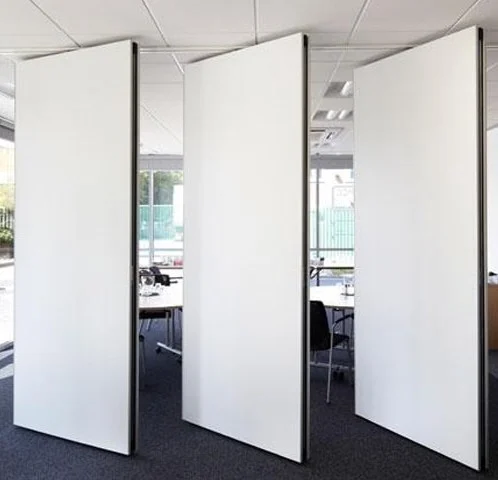
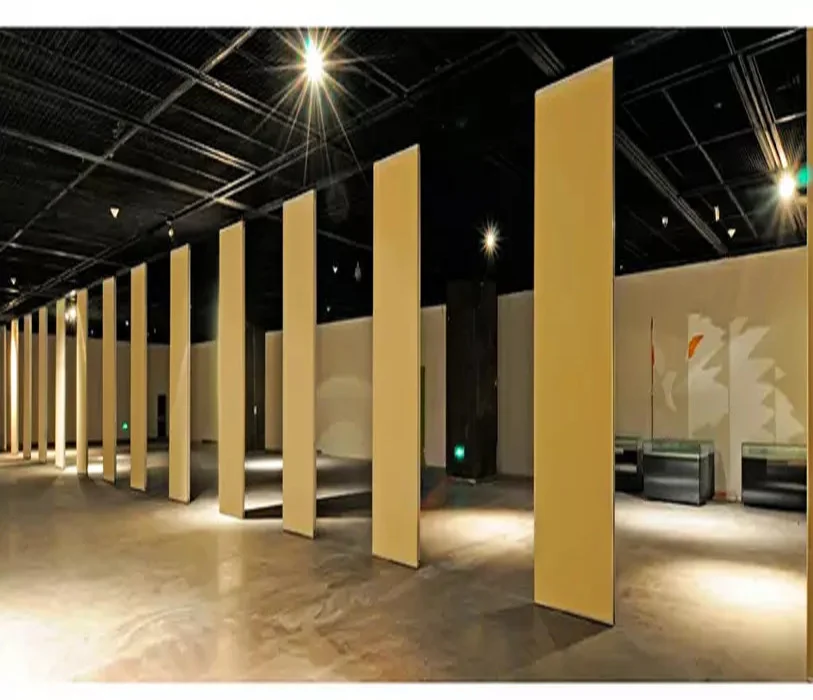
For a top-hung system, the panels travel beneath a continuous overhead route. The exact route, junction arrangement, continuous overhead path and parking position must be confirmed from the coordinated project drawings. The track envelope therefore needs to be reviewed as a path, not only as a point above the opening.
What the Hold-Point Release Schedule Should Contain
Coordination scope: track envelope service clearance hold.
A hold-point release schedule is a simple table that names each ceiling rough-in activity, the evidence needed before it proceeds, and the person who releases it. It is not a substitute for construction drawings; it is a coordination tool that makes dependencies visible.
| Hold point | Ceiling activity | Release evidence |
|---|---|---|
| HP-1 | Service route zoning | Reviewed partition layout showing straight, turning and stacking routes |
| HP-2 | Track envelope reservation | Coordinated ceiling plan with reserved clear zone |
| HP-3 | Support interface review | Project-specific structural review by the responsible engineer |
| HP-4 | Ceiling closure | Confirmed track fixing readiness and access strategy |
Each release should be recorded against a drawing revision. When a service moves, the schedule should show which hold point reopens. This prevents informal changes from silently consuming the track envelope.
Sequencing Ceiling Rough-In Before Partition Fixing
Checklist focus: track envelope service clearance hold.
The practical sequence is to zone first, reserve second, review support third, and close the ceiling last. Zoning means marking the partition routes on the ceiling plan before service trades set out their mains. Reserving means keeping the track envelope free of fixed services. Reviewing support means confirming that the overhead route can be supported in the specific project condition. Closing means installing ceiling finishes only when the track fixing interface is ready.
Early coordination actions
- Issue the partition layout to ceiling and MEP trades before rough-in begins.
- Mark straight, turning and stacking routes on the same ceiling plan.
- Identify service crossings that would enter the track envelope.
- Agree a named release authority for each hold point.
- Record the drawing revision used for each release.
Evidence limits to state openly
Visible references can support layout discussion but do not verify hidden construction or performance. Those require project-specific confirmation. Do not infer hidden performance from a visible ceiling detail or a finish sample. Where a claim matters, ask for the matching evidence.
Service Clearance and Acoustic Concepts
Review focus: track envelope service clearance hold.
Service clearance is the free space needed so that ceiling services do not obstruct the track envelope or the panel route. Site performance depends on the full assembly, including the ceiling interface, and requires project-specific review.
Seals and acoustic treatments can be discussed generically, but their materials and performance are not confirmed here. The correct approach is to define the acoustic requirement with the responsible acoustic consultant and then confirm how the ceiling interface supports it.
Finish and Pass-Door Coordination at the Ceiling Line
Project review term: track envelope service clearance hold.
Confirmed finish options include laminate, melamine, fabric, leather, glass and other approved surfaces. Finish selection can affect edge details and sightlines at the ceiling line, so it should be coordinated with the track envelope review. Pass-door requirements can also be discussed; a pass door introduces an additional panel or leaf condition that must be planned within the same route and stacking logic.
Those remain project-specific questions.
Common Coordination Failures and How to Avoid Them
Most failures come from late information, not from complex geometry. A ceiling access panel placed inside the track envelope can obstruct fixing. A stacking position chosen without checking the ceiling zone can conflict with lighting or diffusers.
Evidence note: a hold-point release confirms that the agreed drawing revision was reviewed. It does not certify structural capacity, acoustic performance or dimensional fit. Those require separate project-specific confirmation.
To avoid these failures, keep one coordinated ceiling plan, update it when services move, and re-release affected hold points. Use the movable walls product page for maintained product context and the resources page for planning material.
Frequently Asked Questions
What is a track envelope hold-point release?
It is a recorded decision that confirms the ceiling rough-in stage may proceed because the partition route and reserved zone have been reviewed against an agreed drawing revision.
Can ceiling services be installed before the partition track is fixed?
Yes, provided the track envelope remains clear and the support interface is reviewed. Services that enter the reserved zone should be rerouted or the hold point reopened.
Does a top-hung partition need a floor track?
No. EBUNGE movable partition panels are top-hung and move without a continuous floor running track or floor hardware along the partition line.
How are straight, turning and stacking routes reviewed?
They are reviewed from the layout. Every proposed movement path requires a continuous connected overhead route and project-specific support review.
Can acoustic performance be confirmed from the ceiling detail?
No.
What information should be ready before contacting EBUNGE?
Prepare the partition layout, ceiling plan, service routes, stacking position and any pass-door requirements. Project-specific support, acoustic and dimensional requirements should be confirmed with the responsible consultants.
Conclusion and Next Steps
Ceiling interface coordination succeeds when the track envelope is treated as a shared, sequenced zone. Use hold-point releases to connect ceiling rough-in with partition fixing, keep one coordinated drawing, and state evidence limits openly. Confirm project-specific support, acoustic and dimensional requirements before work proceeds.
To discuss your layout, finishes, pass-door requirements and project documentation, contact the EBUNGE team.