
Quick answer: out datum chain
Review focus: out datum chain.
Movable partition track anchor setting-out datum chain crew release is a coordination problem before it is an installation problem. EBUNGE movable partition panels are individually movable, suspended from a top track, cross the opening without a floor track, and park at a planned stacking position. The suitability of each route and parking arrangement depends on the approved layout, circulation, ceiling interfaces and operating sequence.
Why the Datum Chain Matters More Than Any Single Anchor
Project review term: out datum chain.
An anchor is only as reliable as the line that located it. Those offsets accumulate silently. By the time the track is offered up, the error may sit in the wrong place to correct cheaply.
A datum chain is the deliberate, recorded sequence of those transfers. Each link is measured from the previous verified link, not from a convenient nearby object.
Establishing the Structural-to-Track Datum Chain
Coordination scope: out datum chain.
Step 1: Confirm the primary structural reference
Record them on a single coordination drawing. Do not allow two trades to work from different primary references.
Step 2: Transfer to a ceiling-level control line
Project the primary reference to the ceiling zone using the project’s agreed method. Mark and protect the control line. This becomes the parent of every subsequent track setting-out dimension.
Step 3: Set out the track centreline and anchor points
From the control line, set out the track centreline and the anchor positions shown on the coordinated layout. Each anchor point should carry a dimension traceable back through the chain.
Step 4: Record and verify before release
Survey or measure the set-out, record deviations, and obtain sign-off from the parties who will rely on it. Only then is the datum considered handed over.
Coordinating Structural, Ceiling and Partition Trades
Checklist focus: out datum chain.
Three trades typically touch the same anchor zone. The ceiling trade controls the void, services and access. The partition trade controls the track line and panel route. None of them can finalise the anchor alone.
A useful coordination habit is to treat the anchor zone as a shared interface with one owner at a time. The owner changes at defined handover points, and each handover is recorded. This prevents the common failure where each trade assumes another has checked the line.
Route Review Before Any Setting-Out Is Fixed

Straight, turning and stacking routes are reviewed from the layout. The setting-out must reflect the actual route, not an assumed one. A track that is correctly anchored but follows the wrong route still fails the opening.
- Confirm the straight run and its end conditions.
- The exact route, junction arrangement, continuous overhead path and parking position must be confirmed from the coordinated project drawings.
- Confirm the planned stacking position and the space reserved for it.
- Confirm that every proposed movement path has a continuous connected overhead route.
- Confirm pass-door requirements, if any, against the layout.
Every movement path needs a continuous connected overhead route, and the support condition along that route requires project-specific review.
Crew Release Sequence Against Verified Handover Points
Crew release should follow evidence, not the calendar alone. A crew released to a datum that is still moving will either wait, rework, or install to the wrong line. The sequence below keeps release tied to verified handover.
- Ceiling-level control line transferred, marked and protected.
- Track centreline and anchor points set out from the control line.
- Set-out measured, deviations recorded, and handover signed.
- Ceiling void and services coordinated around the anchor zone.
- Partition crew released to install against the verified datum.
If any step is incomplete, the next crew should not be released. Waiting is cheaper than correcting a track installed to an unverified line.
Evidence Boundaries and What Still Needs Project Confirmation
This framework describes coordination logic, not engineering outcomes. Those depend on the project’s structure, ceiling build-up, layout and local requirements.
Confirm project-specific support, acoustic and dimensional requirements with the responsible design and engineering parties before fixing any setting-out or releasing any crew.
Where acoustic separation matters, the requirement must be defined and verified for the specific assembly and project conditions.
Finish options that can be discussed include laminate, melamine, fabric, leather, glass and other approved surfaces. Pass-door requirements and project documentation can be discussed with the EBUNGE team through the contact page.
Practical Checklist for the Site Team

| Check | Evidence needed | Release condition |
|---|---|---|
| Primary structural reference | Recorded grid or slab reference | Agreed by structural trade |
| Ceiling control line | Marked and protected transfer | Verified against primary reference |
| Track centreline and anchors | Dimensioned setting-out from control line | Measured and recorded |
| Route and stacking | Reviewed layout showing straight, turning and stacking routes | Continuous overhead route confirmed |
| Handover | Signed record of datum and deviations | Partition crew released |
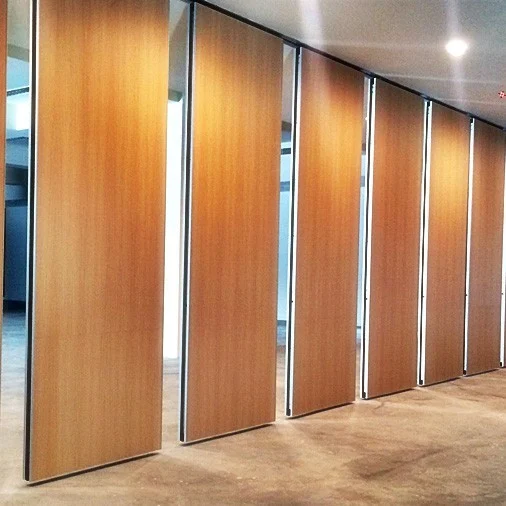
Use the movable partition wall product page to review the maintained product context, and the resources page for further planning material. Neither replaces project-specific drawing review.
Frequently Asked Questions
What is a setting-out datum chain for movable partition tracks?
Each link is measured from the previous verified link so the final setting-out can be traced back to its origin.
Why should crew release wait for datum verification?
Because a crew installing to an unverified line may have to remove and reinstall work. Release against a signed handover point keeps installation tied to a stable reference.
Which trades need to coordinate at the track anchor zone?
Each controls part of the interface, so the anchor zone should have one owner at a time with recorded handovers.
Does this framework confirm support capacity or anchor spacing?
No. The exact overhead route and support arrangement must be confirmed by the responsible project team from coordinated drawings.
Can panels move across a gap without an overhead route?
No. Every proposed movement path requires a continuous connected overhead route, and the support condition along that route needs project-specific review.
What information should be ready before contacting EBUNGE?
Provide the current layout, opening dimensions, ceiling information, intended room use, and relevant project drawings for review. The exact overhead route and support arrangement must be confirmed by the responsible project team from coordinated drawings.
Conclusion and Next Step
A movable partition track anchor setting-out datum chain crew release framework is not a substitute for engineering. It is a coordination discipline that keeps three trades working from one verified line and releases crews only when that line is stable. Confirm project-specific support, acoustic and dimensional requirements before fixing setting-out or releasing installation crews.
To discuss pass-door requirements, finish options such as laminate, melamine, fabric, leather, glass and other approved surfaces, or project documentation, contact the EBUNGE team with your layout and coordination drawings.