
Quick answer: movable partition subdivision state evacuation route overlap audit
Review focus: movable partition subdivision state evacuation route overlap audit.
A movable partition subdivision state evacuation route overlap audit is a drawing-based review that compares how people would leave a space in each configuration the partition can create. It matters because a room is not one room. It is a set of subdivision states: open, partly divided, fully divided, and the parked-panel state in which panels rest at a planned stacking position. Each state can change where an ambulant escape path and an everyday circulation route overlap, run parallel, or diverge.
This article sets out an evidence-bounded way to run that review. It does not replace a fire strategy, an accessibility assessment, or a code review by the responsible professional. The suitability of each route and parking arrangement depends on the approved layout, circulation, ceiling interfaces and operating sequence.
Why the parked-panel state deserves its own review
Project review term: movable partition subdivision state evacuation route overlap audit.
Most layout discussions focus on the divided condition, because that is when the partition is doing its visible job. The parked condition is often treated as a storage detail. In practice, parking is a spatial event.
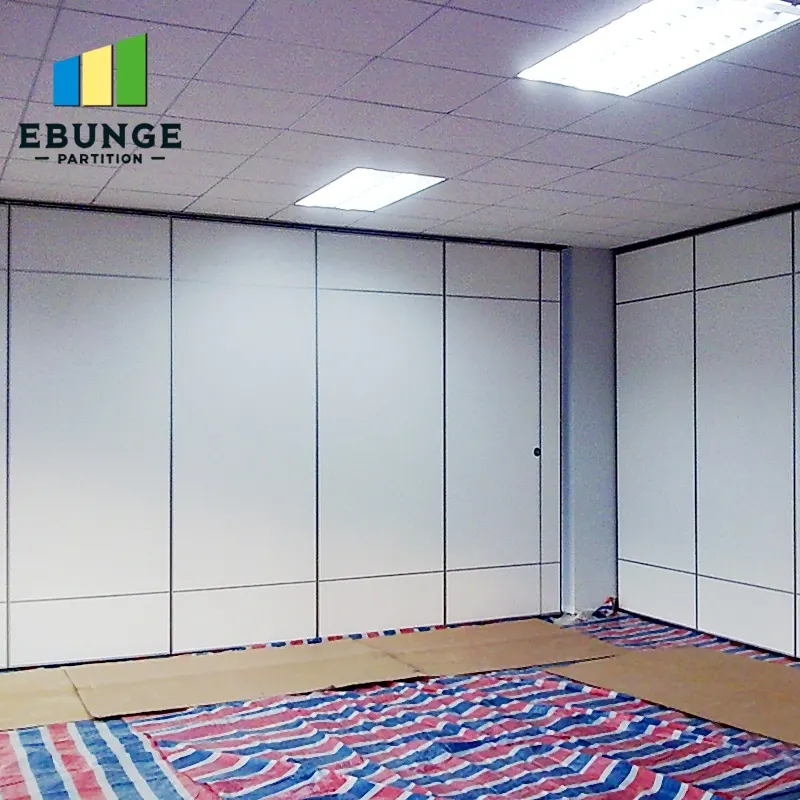
EBUNGE movable wall panels are individually movable, suspended from a top track, cross the opening without a floor track, and park at a planned stacking position. That combination is useful for flexible rooms, but it means the audit must follow the panels to their resting place, not stop at the partition line.
Subdivision states to name explicitly
Give every state a label and a drawing. At minimum, list the fully open state, each partial subdivision the layout is intended to create, the fully divided state, and the parked state for each panel group. If a state is not drawn, it cannot be audited.
What the overlap audit actually compares
Coordination scope: movable partition subdivision state evacuation route overlap audit.
The audit compares two route families in the same state. The first is the ambulant escape path: the route a person who can walk would be expected to take toward an exit, as defined by the project’s fire strategy.
Overlap is not automatically a problem. A shared route can be efficient. The audit’s purpose is to identify where the two families diverge, where they conflict, and where one depends on the other being clear. Those findings then feed the project-specific review.
Straight, turning and stacking routes
Straight, turning and stacking routes are reviewed from the layout. The exact route, junction arrangement, continuous overhead path and parking position must be confirmed from the coordinated project drawings.
A six-step audit sequence for project teams
Checklist focus: movable partition subdivision state evacuation route overlap audit.
- Collect the current layout set. Confirm which drawings are current and which are superseded before marking anything.
- List the subdivision states. Name each open, partial, divided and parked condition the project intends to use.
- Overlay the escape paths. Use the escape routes defined by the project’s fire strategy, not routes inferred from the plan.
- Overlay everyday circulation. Include entry, service, cleaning and movement between zones.
- Mark divergence and conflict points. Note where routes separate, cross, or rely on the same clear width.
- Record open questions. Send each unresolved point to the responsible professional with the drawing reference.
This sequence produces a question list, not a verdict. It is deliberately modest, because the audit cannot certify a route.
Evidence boundaries: what drawings can and cannot show
Review focus: movable partition subdivision state evacuation route overlap audit.
A drawing can show geometry, adjacency and intended movement. Those require matching project-specific evidence and the judgement of the responsible professional.
If acoustics matter to a subdivision state, treat them as a separate project-specific question.
Evidence note: a visible finish, a photograph, or a clean drawing does not prove acoustic, fire, durability, load or compliance performance. Ask for the specific document that covers the specific claim.
Finish options and the audit
Confirmed finish options include laminate, melamine, fabric, leather, glass and other approved surfaces. Finish choice affects appearance and may affect how a space reads, but it does not by itself answer an escape route question. Keep finish selection and circulation review as parallel conversations.
Coordination points that reduce rework
Project review term: movable partition subdivision state evacuation route overlap audit.
A parked group that is fine on the partition drawing may sit inside a route that another consultant has already claimed.
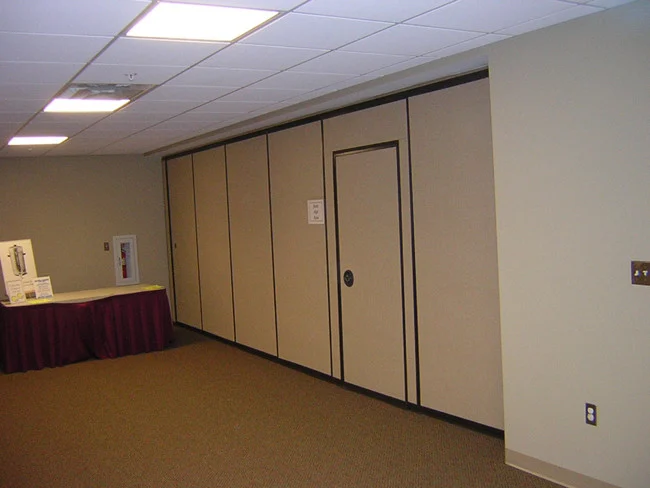
Pass-door requirements and project documentation can be discussed with the supplier. Where a pass door is proposed, its position and swing should appear in every subdivision state, including the parked state, so the audit can see whether it changes a route.
Compact comparison: route families by state
| State | Escape path question | Everyday circulation question |
|---|---|---|
| Fully open | Is the route continuous across the former opening? | Does open space invite movement across the escape path? |
| Partially divided | Does each zone retain a route to an exit? | Do users cross zones to reach services or seats? |
| Fully divided | Are routes within each room still legible? | Do doors and furniture narrow the usable route? |
| Parked | Does the stacking position sit inside or beside a route? | Does parked storage change how people enter or serve the room? |
The table is a prompt, not a compliance matrix. Each row must be answered with the project’s own drawings and strategy.
Documentation to request before sign-off
Ask for the current layout set, the subdivision state list, the parking position for each panel group, and the route drawings used by the fire strategy. Confirm who owns each drawing and who is responsible for the final route decision.
Where information is missing, record it as an open item rather than filling the gap with an assumption. Panel handling and the operating sequence must be confirmed for the selected layout and project conditions.
Decision checklist for the review meeting
- Are all subdivision states named and drawn?
- Is the parked-panel condition included in the route review?
- Are straight, turning and stacking routes traced on the same drawing?
- Are escape paths taken from the project’s fire strategy?
- Are everyday circulation routes described, not assumed?
- Are divergence and conflict points listed with drawing references?
- Are open questions assigned to a named responsible party?
Frequently asked questions
What is a movable partition subdivision state evacuation route overlap audit?
It is a drawing-based review that compares ambulant escape paths and everyday circulation routes in each configuration a movable partition can create, including the state in which panels are parked at their stacking position.
Does the audit certify that a layout is compliant?
No. It identifies overlaps, divergences and open questions. Compliance decisions belong to the responsible professional using the project’s fire strategy, accessibility requirements and applicable codes.
Why include the parked-panel state?
Because parking occupies floor area. A stacking position that is acceptable in one state may sit inside a route in another, so the parked condition needs the same review as the divided condition.
Can the audit confirm acoustic performance?
No.
What information should be ready before the review?
Current layout drawings, the list of subdivision states, parking positions for each panel group, the escape routes defined by the fire strategy, and the everyday circulation routes the project expects to use.
How should pass doors be handled in the audit?
Pass-door requirements and project documentation can be discussed with the supplier. Any proposed pass door should appear in every subdivision state so its effect on routes can be reviewed.
Conclusion: audit the states, not just the partition
A movable partition adds flexibility, and flexibility multiplies the number of spatial conditions a project must review. The subdivision-state evacuation route overlap audit gives teams a disciplined way to compare ambulant escape paths with everyday circulation in each condition, including the parked state.
Keep the review evidence-bounded. Confirm project-specific support, acoustic and dimensional requirements with the responsible professionals and with the supplier before decisions are fixed. Where a claim cannot be supported by a document, leave it open rather than assuming an outcome.
To discuss layout review, parking positions, finishes or pass-door documentation for a specific project, contact the EBUNGE team. You can also review the movable wall product information and the planning resources before the next coordination meeting.