
Quick answer: movable partition stacking pocket swept path ambulant route turning template
Review focus: movable partition stacking pocket swept path ambulant route turning template.
Use this movable partition stacking pocket swept path ambulant route turning template to compare two envelopes on the same drawing: where panels park, and where people turn. The review is a planning exercise, not a performance claim. EBUNGE movable partition panels are individually movable, suspended from a top track, cross the opening without a floor track, and park at a planned stacking position. Straight, turning and stacking routes are reviewed from the layout. Confirm project-specific support, acoustic and dimensional requirements with the project team before the layout is fixed.
Why the Two Envelopes Must Be Drawn Together
Project review term: movable partition stacking pocket swept path ambulant route turning template.
Parking panels and ambulant turning movements are often drawn by different people at different times. The stacking pocket appears on a partition layout; the turning zone appears on an accessibility or circulation plan. The suitability of each route and parking arrangement depends on the approved layout, circulation, ceiling interfaces and operating sequence.
The overlay matters because both envelopes occupy floor area at the same level. A parked panel group is a physical object with a footprint. A turning movement is a swept area that a person needs clear. Neither can be assumed to yield to the other without a deliberate decision recorded on the drawing.
Confirmed Product Facts That Bound the Review
Coordination scope: movable partition stacking pocket swept path ambulant route turning template.
Start from maintained facts, not assumptions. EBUNGE panels are top-hung and move without a continuous floor running track or floor hardware along the partition line. Parking style is customized to the customer layout and project requirements, and may support compact stacking when the coordinated design permits it.
Two boundaries follow. The exact route, junction arrangement, continuous overhead path and parking position must be confirmed from the coordinated project drawings. Visible references can support layout discussion but do not verify hidden construction or performance.
What the Review Can and Cannot Decide
This template helps a project team locate and compare envelopes. It does not certify accessibility compliance, structural capacity, acoustic performance or code approval. Those outcomes require project-specific evidence and the responsible local professionals.
Step-by-Step Overlay Process
Checklist focus: movable partition stacking pocket swept path ambulant route turning template.
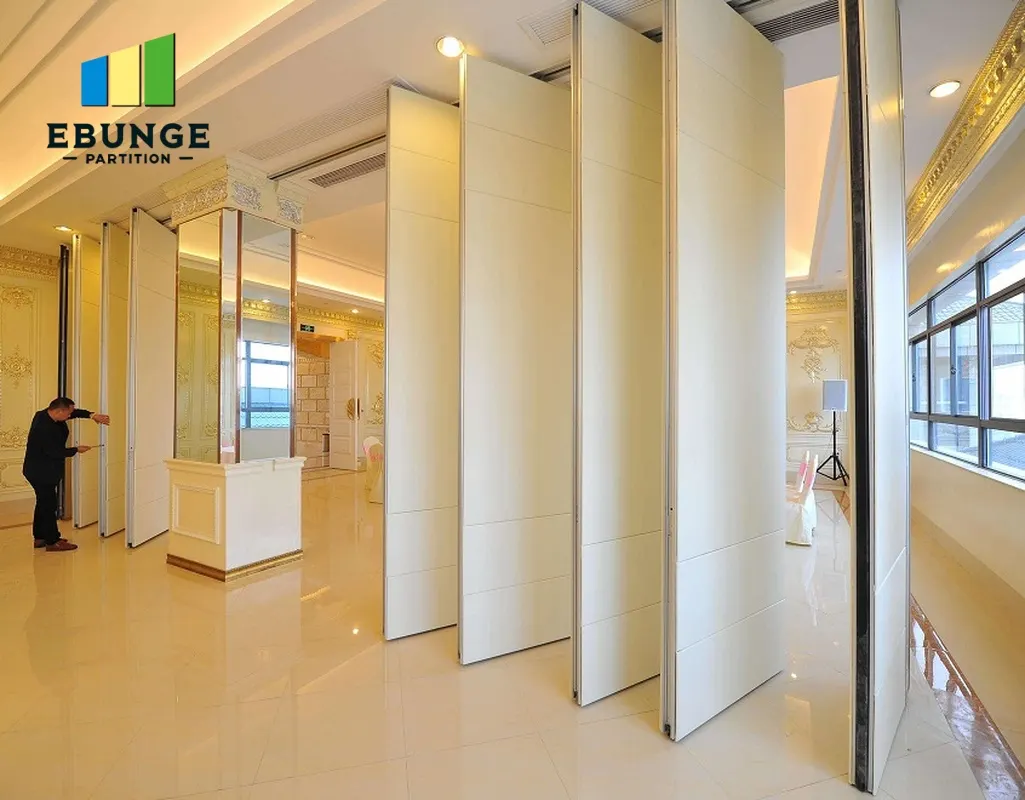
- Print or isolate the partition layout at the same scale as the circulation plan.
- Mark the planned stacking position and the parked panel envelope as a hatched zone.
- Mark the ambulant route and each turning zone as a separate hatched zone.
- Overlay the two hatches and list every area where they touch or overlap.
- For each overlap, record whether the conflict is resolved by moving the pocket, moving the route, or confirming a project-specific dimensional decision.
- Re-issue the overlay after any layout change and keep the marked-up sheet in the coordination file.
Keep the overlay sheet simple enough that a reviewer can see the conflict without reading a report. A clear hatch is more useful than a long description.
Stacking Pocket Swept-Path Envelope Checklist
Review focus: movable partition stacking pocket swept path ambulant route turning template.
Use this checklist when reviewing the parking side of the overlay. It is a prompt list, not a substitute for project-specific dimensional confirmation.
- Is the stacking position shown on the same drawing as the opening it serves?
- Is the parked panel envelope drawn as an occupied zone rather than a line?
- Is the route from the opening to the stacking position continuous and connected overhead?
- Does the envelope avoid blocking a door leaf, escape route or service access point?
- Is the parking style confirmed against the customer layout and project requirements?
- Are finish selections recorded separately from the circulation review?
Ambulant Route Turning Template
Project review term: movable partition stacking pocket swept path ambulant route turning template.
Turning movements are the part of circulation most often squeezed by furniture, columns and parked panels. The template below separates the route into three review bands so each can be checked against the overlay.
| Review band | What to mark | Coordination question |
|---|---|---|
| Approach | Clear route leading to the turning point | Does the approach stay clear when panels are parked? |
| Turning zone | Swept area of the change of direction | Does the turning zone overlap the parked panel envelope? |
| Exit | Clear route leaving the turning point | Is the exit still usable after the partition is closed? |
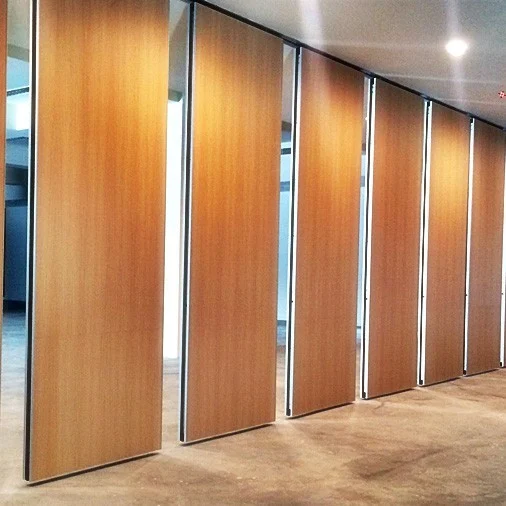
Where a turning aid is proposed, show it on the overlay as a fixed object. A turning aid that sits inside the parked panel envelope creates a conflict even if each item is acceptable on its own drawing.
Evidence Notes for Reviewers
Coordination scope: movable partition stacking pocket swept path ambulant route turning template.
Record what is known and what still needs confirmation.
- Confirmed: top-hung movement, no continuous floor track along the partition line, planned stacking position.
- Confirmed: finish options include laminate, melamine, fabric, leather, glass and other approved surfaces.
- To confirm: project-specific support, acoustic and dimensional requirements.
- To confirm: pass-door requirements and project documentation needs.
Confirm the applicable requirement for the specific project rather than transferring a value from another layout.
Common Coordination Conflicts and How to Frame Them
Pocket versus turning zone
The most frequent conflict is a stacking pocket placed where a turning movement needs clear floor. Frame the decision as a layout choice: shift the pocket, shift the route, or confirm a project-specific dimensional solution. Do not resolve it by assuming panels can park somewhere unsupported.
Pocket versus door swing
A parked panel envelope and a door swing can occupy the same corner. Mark both and decide which yields. This is a drawing decision, not a product limitation.
Route versus finish transition
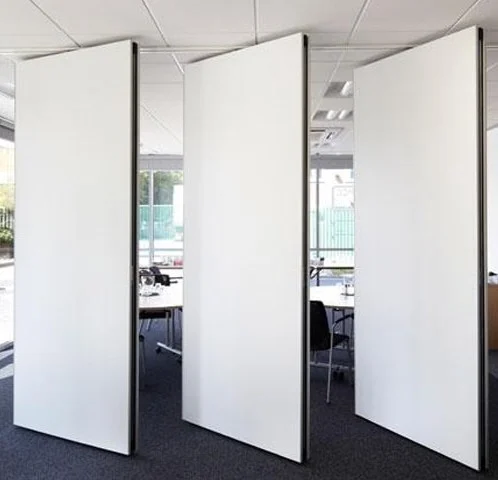
Finish options are confirmed separately from circulation. A change of finish along a route is a visual and specification matter; it does not by itself resolve or create a swept-path conflict.
FAQ
What is a stacking pocket swept-path envelope?
It is the floor area occupied by panels when they are parked at the planned stacking position, drawn as a zone rather than a line so it can be compared with other uses of the same floor area.
Can parked panels and an ambulant turning zone share the same floor area?
They can be reviewed together on one overlay, but whether they can coexist without conflict depends on the project-specific layout, dimensions and support conditions. Confirm those requirements before fixing the layout.
Do movable partitions need a floor track along the opening?
EBUNGE movable partition panels are top-hung and move without a continuous floor running track or floor hardware along the partition line. Every proposed movement path still requires a continuous connected overhead route and project-specific support review.
Does this template confirm accessibility compliance?
No. It is a planning and coordination aid.
What information should be ready before the review?
Bring the partition layout, the circulation plan, the planned stacking position, any turning aid locations, and the project-specific support, acoustic and dimensional requirements. Pass-door requirements and project documentation can be discussed with the EBUNGE team.
Where can I find more planning resources?
Review the movable wall product information and the planning resources, then contact the team with your drawings for a project-specific discussion.
Conclusion
Draw the parked panel envelope and the ambulant turning zone on one sheet, mark every overlap, and record how each conflict is resolved. Keep the review bounded by confirmed product facts and project-specific confirmation.
Send your layout and circulation drawings to the EBUNGE team through the contact page to discuss support, acoustic and dimensional requirements, pass-door needs and project documentation.