
Quick answer: movable partition stacking pocket approach sightline wayfinding continuity audit
Review focus: movable partition stacking pocket approach sightline wayfinding continuity audit.
A movable partition stacking pocket approach sightline wayfinding continuity audit is a drawing-led review that asks one question: when panels are parked, does the remaining route still make sense to someone walking through the space? The audit does not test acoustics or structure. It checks whether the proposed stacking position, the approach path and the visible route work together. EBUNGE movable wall panels are individually movable, suspended from a top track, cross the opening without a floor track, and park at a planned stacking position. Those maintained facts give the review a clear starting point, but every project still needs its own layout, support and dimensional confirmation.
Why the Stacking Pocket Drives the Whole Review
Project review term: movable partition stacking pocket approach sightline wayfinding continuity audit.
The stacking pocket is not a storage afterthought. It is the destination of every panel movement and the place where the open-plan route is most likely to narrow. If the pocket is placed without checking the approach, the parked panels can interrupt the very circulation the flexible layout was meant to protect.
Review the pocket in plan, not in isolation. Ask where panels travel from, where they gather, and what remains visible and walkable once they are parked. The exact route, junction arrangement, continuous overhead path and parking position must be confirmed from the coordinated project drawings.
What the audit can and cannot confirm
The audit can confirm that the drawings show a coherent approach, a defined parking position and an unobstructed ambulant route. The suitability of each route and parking arrangement depends on the approved layout, circulation, ceiling interfaces and operating sequence. Treat the audit as a coordination tool, not a performance certificate.
Reading the Approach Sightline from the Entry Point
Coordination scope: movable partition stacking pocket approach sightline wayfinding continuity audit.
Sightlines matter because people navigate by what they can see. Stand at the main entry in the drawing and trace what a first-time visitor would see: the opening, the parked panels, the remaining corridor and the next decision point.
A stacking pocket that sits directly behind the entry can hide the route beyond it. A pocket placed to one side may preserve a clearer view.
Three sightline questions for the drawing review
- From the primary entry, is the continuation of the ambulant route visible before the visitor reaches the parked panels?
- Do the parked panels obscure a change of direction, a door, or a level change?
- Is the approach to the pocket itself visible enough that a person does not walk into a dead end?
Ambulant Route Continuity When Panels Are Parked
Checklist focus: movable partition stacking pocket approach sightline wayfinding continuity audit.
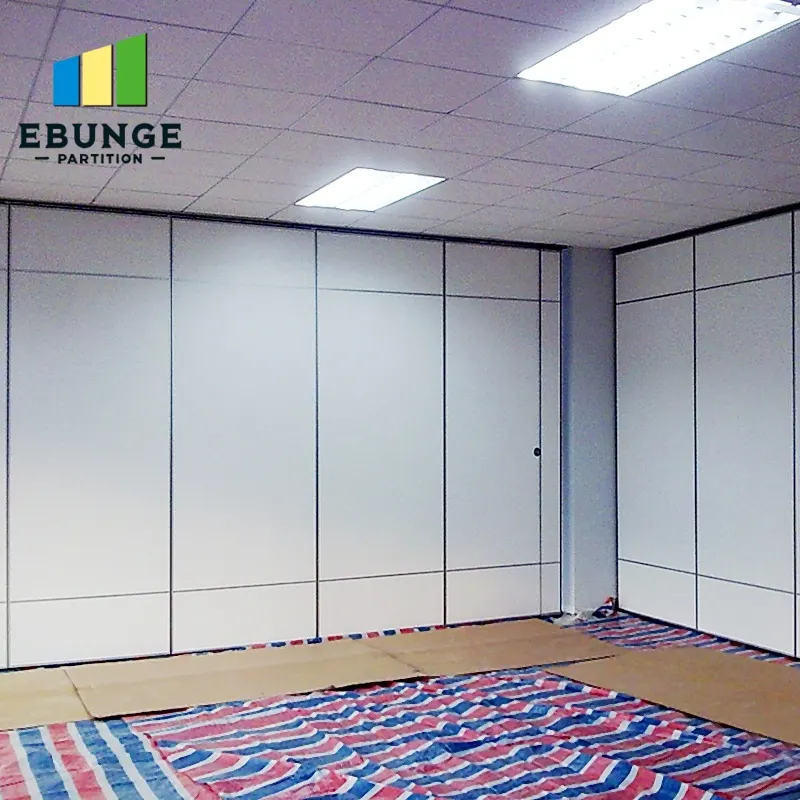
Ambulant route continuity means the path a person walks remains legible and usable after the partition is opened. The review should follow the route from entry to destination, not just around the partition line.
Check the width and clarity of the route at three moments: when panels are fully open, when they are partly deployed, and when they are fully parked. The parked condition is often the tightest because the panels occupy the pocket area.
Coordination points for contractors and designers
Contractors should confirm that the overhead route, the pocket location and the finished floor layout are coordinated on the same drawing set. Designers should confirm that wayfinding elements such as signage, floor finishes or lighting do not conflict with the parked panel position. Owners should confirm that the intended use of the subdivided space matches the circulation assumptions in the drawings.
A Practical Audit Sequence for Project Teams
Review focus: movable partition stacking pocket approach sightline wayfinding continuity audit.
The steps below are a coordination framework, not a substitute for project-specific engineering.
- Mark the opening, the top track route and the planned stacking position on the layout.
- Trace the ambulant route from each main entry to each main destination in the open, partly deployed and parked conditions.
- Check the approach sightline at each entry and at each change of direction.
- Confirm that the pocket location does not block a required route, door or visible wayfinding cue.
- Record any unresolved item as a project-specific question for the design team.
Evidence Boundaries and Specification Language
Project review term: movable partition stacking pocket approach sightline wayfinding continuity audit.
Specification language should separate what is known from what must be confirmed. Maintained EBUNGE facts cover top-hung movement, no continuous floor track along the partition line, and customized parking based on the customer layout. The exact overhead route and support arrangement must be confirmed by the responsible project team from coordinated drawings.
Seals and acoustic concepts can be discussed generically, but the actual performance of a specific assembly requires project-specific confirmation.
Evidence note for reviewers
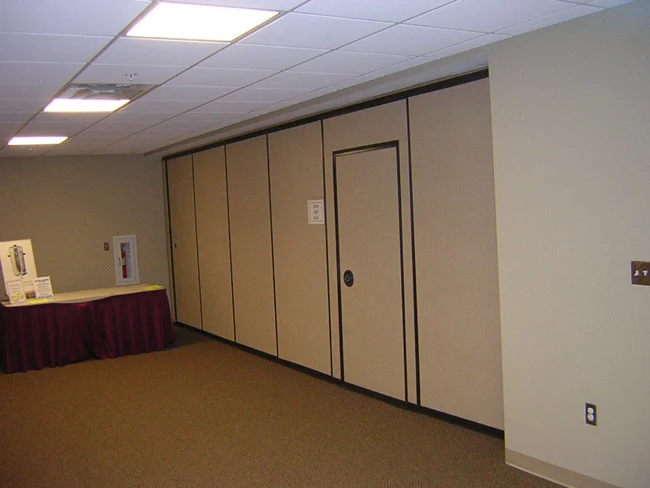
If a drawing shows a parking position but no coordinated overhead route, the audit should record an open question rather than infer that panels can travel across an untracked gap. If a finish is shown, do not infer cleaning compatibility, structural capacity or acoustic performance from the finish alone.
Wayfinding Continuity in Subdivided Spaces
Wayfinding continuity is about more than signs. It is the sequence of visible cues that helps a person understand where to go. When a movable partition subdivides a space, those cues can change with every configuration.
Review the cues that remain stable across configurations: the main entry, the primary corridor, the location of stairs or lifts, and any permanent signage. Then check whether the parked panels interfere with those cues. If they do, the pocket position or the wayfinding strategy may need adjustment.
Questions to bring to the design team
- Which wayfinding cues must remain visible in every partition configuration?
- Does the stacking pocket approach create a confusing dead end or a hidden turn?
- Are there alternative routes if the primary ambulant route is narrowed by parked panels?
Documentation and Project-Specific Confirmation
Good documentation makes the audit useful after the meeting. Record the layout version, the parking position, the route assumptions and any unresolved items. Pass-door requirements and project documentation can be discussed with the EBUNGE team, but the final configuration depends on the project drawings and the confirmed support and dimensional requirements.
For a broader set of planning references, see the EBUNGE resources. For product context, review the movable walls page. When the layout is ready for review, contact EBUNGE to discuss the project documentation.
Frequently Asked Questions
What is a movable partition stacking pocket approach sightline wayfinding continuity audit?
It is a drawing review that checks whether the parked panel position, the approach path and the visible route remain coherent for people walking through the space.
Does the audit confirm acoustic performance?
No.
Can panels move across a gap without a track?
No. Every proposed movement path requires a continuous connected overhead route and project-specific support review. A drawing that shows a gap should be treated as an open question, not as a valid travel path.
Which finishes can be considered?
Confirmed finish options include laminate, melamine, fabric, leather, glass and other approved surfaces.
Who should be involved in the review?
Contractors, architects, interior designers, owners and renovation teams should coordinate the layout, the overhead route and the wayfinding strategy together.
When should the audit happen?
It should happen during layout coordination, before the stacking position and route are fixed. Early review reduces the risk of discovering a circulation conflict after the drawings are issued.
Conclusion
A stacking pocket approach sightline and wayfinding continuity audit keeps the focus on how people actually move through a subdivided space. By reviewing the pocket location, the approach sightline and the ambulant route together, project teams can identify coordination questions early and resolve them with the right evidence.
Confirm project-specific support, acoustic and dimensional requirements before finalising any configuration. To discuss pass-door requirements, documentation or layout review, contact EBUNGE.