
Quick project answer
Review focus: changeover cost baseline.
Facility and operations managers often inherit flexible rooms without a reliable way to compare one reconfiguration against another. A movable partition changeover cost baseline gives you a repeatable reference for labor, downtime and disruption, so budget variance reviews become evidence-based rather than anecdotal. This framework applies to conference rooms, training spaces, coworking areas and other flexible rooms where panels are individually movable, suspended from a top track, cross the opening without a floor track, and park at a planned stacking position.
The baseline is not a price list. It is a structured record of the assumptions behind each changeover, the route the panels follow, and the operational conditions that affect the work. Because straight, turning and stacking routes are reviewed from the layout, the baseline must be tied to project drawings and confirmed requirements rather than generic estimates.
Why a Changeover Cost Baseline Matters for Flexible Rooms
Project review term: changeover cost baseline.
Without a baseline, every changeover is judged by memory. One event feels slow, another feels smooth, and no one can explain why. A baseline converts those impressions into comparable categories: preparation, movement, parking, reset and downtime. It also exposes where layout decisions create recurring operational friction.
The baseline supports capital planning because it links space design to ongoing operating effort. If a room is reconfigured frequently, small route or parking decisions can compound over time. The baseline does not promise savings or returns; it simply makes the operational pattern visible so owners, architects and facility teams can discuss trade-offs with shared facts.
What the Baseline Should and Should Not Include
Coordination scope: changeover cost baseline.
Include only what you can observe or confirm. A defensible baseline records the room, the panel configuration, the approved movement route, the parking position, the sequence of tasks and the duration of each phase. It should also note who performed the work and under what conditions, because labor and downtime variances are meaningless without context.
The suitability of each route and parking arrangement depends on the approved layout, circulation, ceiling interfaces and operating sequence. The exact route, junction arrangement, continuous overhead path and parking position must be confirmed from the coordinated project drawings.
Evidence note: what requires project-specific confirmation
Support points, overhead route continuity, parking space dimensions, finish selection, pass-door requirements and acoustic expectations must be confirmed against the project layout and approved documentation. A generic finish or application example is not evidence of cleaning compatibility, structural capacity or acoustic performance.
A Six-Step Process to Establish the Baseline
Checklist focus: changeover cost baseline.
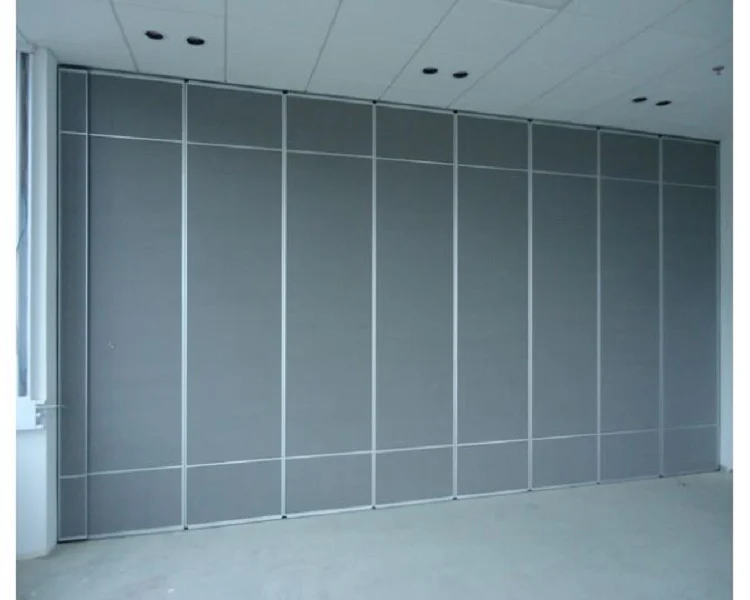
- Define the changeover event. Record the starting room configuration, the required end configuration and the operational reason for the change.
- Map the movement route. Confirm the straight, turning and stacking path from the layout. Every proposed path needs a continuous connected overhead route and project-specific support review.
- Document the parking plan. Parking style is customized to the layout and project requirements, and may support compact stacking when the coordinated design permits it.
- Break the work into phases. Separate preparation, panel movement, parking, reset and handover. Time each phase consistently across events.
- Record downtime separately. Downtime is the period the room cannot serve its intended function.
- Set a review cadence. Compare actual durations against the baseline at a fixed interval, and document the reasons for every variance.
Tracking Labor and Downtime Variances
A changeover that runs long may reflect a route obstruction, a parking position that requires extra handling, a room reset that was not planned, or a schedule conflict. Label each variance with a cause code so patterns emerge across multiple events.
Labor variance should be expressed in time and task terms, not in unsupported productivity claims. Downtime variance should be expressed as the difference between planned and actual room unavailability. Both measures feed directly into space planning because they show which configurations are operationally expensive to maintain.
Compact comparison: baseline categories and review questions
| Category | What to record | Review question |
|---|---|---|
| Route | Straight, turning and stacking path from the layout | Did the actual path match the approved route? |
| Parking | Planned stacking position and access | Did parking require unexpected handling? |
| Labor | Phases, sequence and task duration | Which phase caused the largest variance? |
| Downtime | Planned versus actual room unavailability | Did downtime affect adjacent bookings? |
| Documentation | Drawings, approvals and pass-door requirements | Was any required information missing? |

Feeding Findings Back into Space Planning
If a route repeatedly creates friction, revisit the layout with the project team. If parking access is awkward, review the stacking position against the room’s furniture and circulation. If downtime is consistently underestimated, adjust the operating schedule or reconsider how often the room is reconfigured.
Finish choices also affect operations. Confirmed finish options include laminate, melamine, fabric, leather, glass and other approved surfaces. Each option should be reviewed for the room’s actual use pattern, and any cleaning or durability expectation must be confirmed rather than assumed from a sample or photograph.
Use the baseline to support conversations with architects, contractors and owners. The goal is not to prove a design wrong, but to show where operational reality differs from planning assumptions.
Common Pitfalls in Changeover Budget Reviews
One common pitfall is treating the baseline as a fixed number. It should evolve as the room, the schedule and the layout change. Another is comparing changeovers of different scope without normalizing the starting and ending configurations. A third is ignoring downtime because it does not appear on an invoice.
Teams also run into trouble when they rely on undocumented assumptions about support, acoustics or dimensions. Confirm project-specific support, acoustic and dimensional requirements before committing to a baseline. If a requirement cannot be confirmed, mark it as an open item rather than filling the gap with an estimate.
Decision checklist for baseline reviews
- Is the changeover event clearly defined with start and end configurations?
- Is the movement route documented and consistent with the approved layout?
- Is the parking position confirmed for the actual room condition?
- Are labor phases and downtime recorded separately?
- Are variances labeled with a cause code?
- Are open items assigned to a responsible party with a review date?
- Are pass-door requirements and project documentation discussed with the supplier?
FAQ: Movable Partition Changeover Cost Baseline
What is a movable partition changeover cost baseline?
It is a structured record of the assumptions, route, parking plan, labor phases and downtime associated with reconfiguring a movable partition room. It provides a consistent reference for comparing actual performance against planned expectations.
How often should the baseline be reviewed?
Review frequency depends on how often the room is reconfigured and how much the layout changes. A fixed cadence, such as after a set number of changeovers or at a scheduled operations review, helps keep the baseline relevant.
Can the baseline predict acoustic performance?
No. Confirm acoustic requirements with the project team.
What information is needed from the layout drawing?
The drawing should show the straight, turning and stacking routes, the parking position, the opening dimensions and any pass-door requirements.
Does every changeover need the same baseline?
No. Different rooms, configurations and operational schedules may require separate baselines. Normalize scope before comparing events, and document any change that affects the route, parking or downtime.
How does the baseline support budget variance reviews?
It gives reviewers a common set of categories and definitions. Variances can then be attributed to specific causes, such as route friction, parking access or schedule conflicts, rather than treated as unexplained overruns.
Conclusion: Turn Changeover Data into Better Space Decisions
A movable partition changeover cost baseline is a practical operations tool. It helps facility teams record what actually happens during reconfiguration, compare that against planning assumptions, and feed the findings back into layout, scheduling and specification decisions. The framework stays credible when it is limited to confirmed facts and project-specific documentation.
Start with one room, define the changeover event, map the route and parking plan, and record labor and downtime separately. Confirm project-specific support, acoustic and dimensional requirements before finalizing any baseline.
To discuss pass-door requirements, project documentation or movable wall options for your layout, contact the EBUNGE team. You can also review movable wall products and browse planning resources for further guidance.