
Quick answer: point release register
Review focus: point release register.
A movable partition ceiling track zone hold-point release register is a simple control document that prevents the most common ceiling-interface rework: fixing a track zone before ceiling services are finished. Because EBUNGE movable partition panels are individually movable, suspended from a top track, cross the opening without a floor track and park at a planned stacking position, the overhead route is the critical coordination surface. This register does not replace drawings or engineering review; it sequences them.
Why the Ceiling Track Zone Needs Its Own Release Gate
Project review term: point release register.
On many projects, ceiling rough-in and partition track fixing are managed by different trades with different programmes. If the track zone is released too early, later service installation can force removal, re-drilling or re-coordination. If it is released too late, the partition programme slips and the stacking position may be blocked by unfinished ceiling work.
A hold-point release register creates one agreed moment: the track zone is released only when the ceiling service rough-in within that zone is confirmed complete against the current coordinated drawings. The register records who confirmed it, what was checked and what remains open. It is a coordination tool, not a performance claim.
What the Register Should Contain
Keep the register short enough to be used on site. Each row should cover one track zone or one continuous overhead route segment. The columns below are a starting structure; project teams should adapt them to the contract, drawing set and inspection regime.

| Register field | Purpose | Evidence to attach |
|---|---|---|
| Zone reference | Links the row to the coordinated ceiling and partition layout | Marked-up drawing extract |
| Route type | Identifies straight, turning or stacking route reviewed from the layout | Layout review note |
| Ceiling services in zone | Lists services that must be complete before release | Trade completion sign-off |
| Support coordination status | Confirms the overhead support condition has been reviewed for the project | Project-specific structural or support review |
| Release decision | Records hold, release or release with conditions | Signed release entry |
| Open items | Keeps unresolved interfaces visible | Action list with owner |
Visible references can support layout discussion but do not verify hidden construction or performance. Those require project-specific confirmation.
A Numbered Release Process for Project Teams
- Issue the current coordinated ceiling and partition layout, including the planned stacking position.
- Identify each track zone and mark the straight, turning and stacking routes that need review.
- The exact overhead route and support arrangement must be confirmed by the responsible project team from coordinated drawings.
- Confirm the overhead support condition for the project with the responsible design party.
- Inspect the zone and record completion of ceiling service rough-in against the drawing.
- Record the release decision, conditions and open items in the register.
- Only then allow track fixing to proceed in that zone.
- Re-check the register whenever a ceiling service change affects a released zone.
This sequence keeps the partition track zone tied to the actual ceiling condition rather than to a programme date alone.
Coordination Points That Commonly Cause Rework
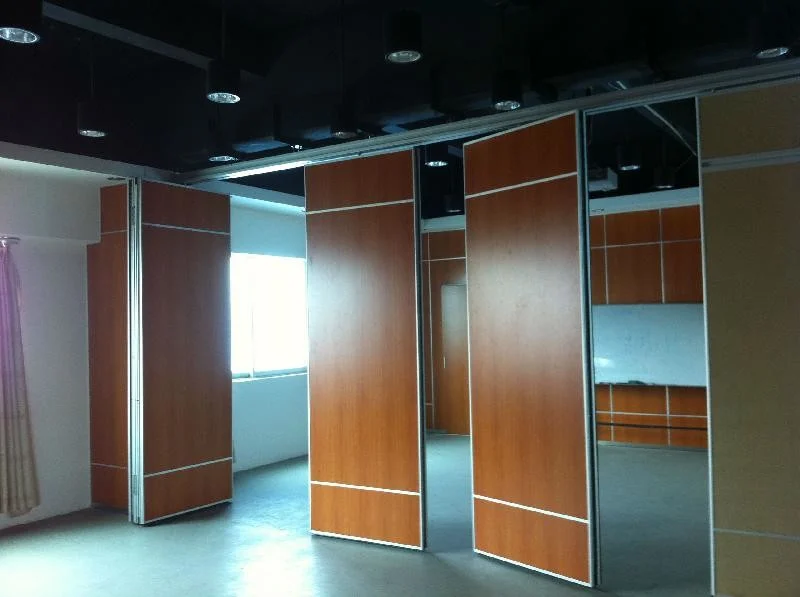
Stacking position and ceiling services
The parking area is part of the route, not an afterthought. If ceiling services or access panels occupy the planned stacking position, the released zone may need to be reopened. Review the stacking position on the layout before releasing the adjacent track zone.
Turning routes and continuous overhead support
The exact route, junction arrangement, continuous overhead path and parking position must be confirmed from the coordinated project drawings.
Pass doors and adjacent finishes
Pass-door requirements and project documentation can be discussed with the supplier, but the ceiling zone release should still confirm that adjacent finishes and service penetrations are coordinated. A released track zone does not automatically release the surrounding ceiling.
Evidence Boundaries for the Register
Release the track zone only against confirmed project information: current drawings, completed ceiling service rough-in, reviewed support condition and agreed dimensional requirements. Do not infer hidden performance from a finish, photograph or generic example.
The suitability of each route and parking arrangement depends on the approved layout, circulation, ceiling interfaces and operating sequence. Where acoustic separation matters, confirm the project-specific requirement and the matching documentation with the responsible parties. EBUNGE can discuss pass-door requirements and project documentation, but performance, support and dimensional outcomes remain project-specific.
Using the Register With Finishes and Layout Decisions
Confirmed finish options include laminate, melamine, fabric, leather, glass and other approved surfaces. Finish selection does not release the ceiling track zone. The register should remain focused on the overhead interface, while finish and layout decisions are tracked separately.

For teams comparing options, the movable wall product overview and the project resources provide maintained context. Use them alongside, not instead of, the coordinated drawings and project-specific reviews.
Frequently Asked Questions
What is a movable partition ceiling track zone hold-point release register?
It is a control document that records when a defined ceiling track zone is released for partition track fixing, based on confirmed completion of ceiling service rough-in and the relevant project reviews.
Does the register replace structural or acoustic review?
No. It sequences coordination.
When should a track zone be released?
Only after the ceiling services in that zone are confirmed complete against the current coordinated drawings and the overhead support condition has been reviewed for the project.
How does the register handle turning and stacking routes?
Each route is listed separately. Turning and stacking routes are reviewed from the layout, and any incomplete overhead route or support review is recorded as an open item.
Can the register be used on renovation projects?
Yes, provided the existing ceiling condition, services and support are surveyed and the register is updated to reflect the actual site condition before release.
What should happen if a ceiling service changes after release?
Reopen the affected register row, re-inspect the zone and record a new release decision before further track fixing proceeds.
Conclusion and Next Step
A track zone hold-point release register gives ceiling and partition trades one shared gate. It keeps the top track route, stacking position and ceiling services coordinated without inventing performance or engineering conclusions. Start with the current layout, define the zones, and release each one only against confirmed project information.
To discuss pass-door requirements, project documentation or layout coordination for your project, contact the EBUNGE team.