
When outfitting a recording studio, the acoustic environment is non-negotiable. For overseas contractors and commercial project owners, specifying a movable partition wall that can adapt to changing studio layouts without compromising sound isolation is a complex decision. This application guide focuses on evidence-based commercial research, helping you evaluate movable partition wall systems for recording studios, avoid specification errors, and coordinate with suppliers effectively. Whether you are renovating an existing facility or building from scratch, understanding the technical nuances of movable partition walls for office or studio use is critical to project success.
Direct answer: For a recording studio, the most reliable movable partition wall system is a top-hung, floor-rail-free design with dense acoustic cores and perimeter sealing. Prioritize systems that allow custom project coordination, including finishes and installation drawings, and verify all acoustic performance data against independent test reports before specification.
Why Recording Studios Demand a Different Approach to Movable Partition Walls
Unlike typical office spaces, recording studios have stringent acoustic requirements. Sound transmission class (STC) ratings, flanking paths, and vibration isolation are critical. A movable partition wall for office use may not meet studio standards. The key is to select a system designed for high acoustic performance, with minimal gaps and robust seals. Additionally, the partition must be operable frequently, requiring smooth operation and durability. For overseas projects, the challenge is ensuring that the specified system meets local building codes and acoustic expectations.
Recording studios often need flexible spaces: a single large room can be divided into control room and live room, or multiple isolation booths. A movable partition wall system allows this flexibility without permanent construction. However, the acoustic integrity of the partition is only as good as its installation. Therefore, working with a supplier that provides detailed drawings and installation guidance is essential.
Need help turning the movable partition wall requirements into a practical project layout?
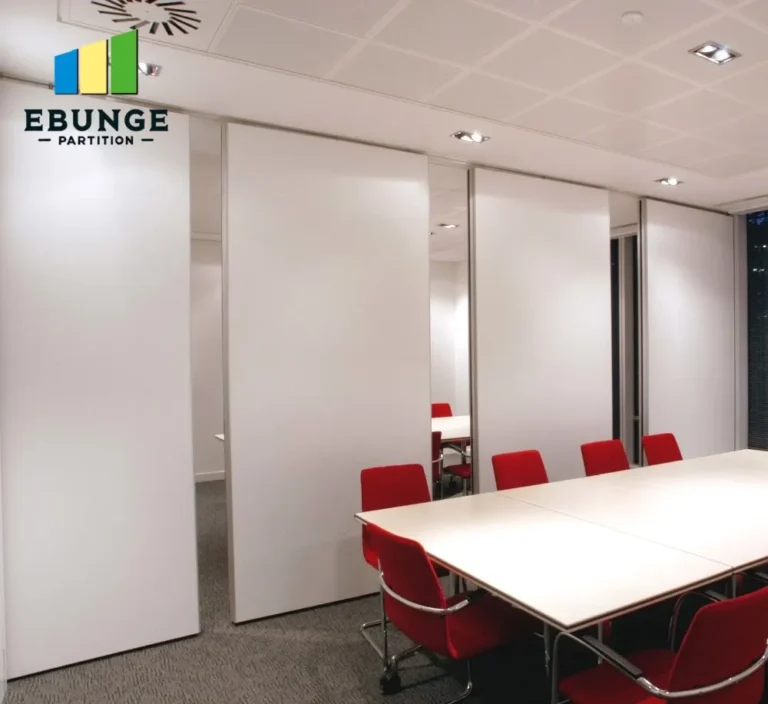
Evaluating Movable Partition Wall Systems: Key Technical Parameters
When researching movable partition walls for a recording studio, focus on these parameters:
- Acoustic Performance: Look for STC ratings of 50 or higher. Verify with ASTM E90 or ISO 10140 test reports. Do not rely on marketing claims.
- Track System: Top-hung tracks without floor rails are preferable for studios to avoid floor obstructions and improve sound sealing at the bottom.
- Panel Construction: Steel or aluminum frames with multiple layers of gypsum board and acoustic insulation (e.g., mineral wool) provide mass and damping.
- Perimeter Seals: Automatic drop seals at the bottom and compression seals at vertical joints are crucial for sound isolation.
- Operation: Manual or motorized? For studios, motorized systems reduce physical effort and ensure consistent sealing.
Remember, the acoustic performance of a movable partition wall system is not just about the panel itself. The surrounding structure—walls, ceiling, floor—must be designed to prevent flanking. This is where supplier expertise becomes invaluable.
Acoustic Considerations: Soundproofing and Sound Isolation
The term “movable partition wall soundproof” is often used, but technically, we aim for sound isolation, not soundproofing. In a recording studio, you need to prevent sound from traveling between spaces and external noise from entering. The partition’s STC rating indicates its ability to reduce airborne sound. For music recording, an STC of 50-60 is typical. However, low-frequency sounds (bass) are harder to isolate. Consider the partition’s mass and damping properties.
Also, consider the ceiling and floor interfaces. A top-hung track system allows the partition to be suspended, with a perimeter seal at the top. The bottom seal should be a drop seal that creates a tight contact with the floor. Any gaps can significantly reduce performance. Always request detailed section drawings from the supplier to ensure proper installation.
Design Flexibility: Movable Partition Wall Design for Studio Layouts
Movable partition wall design for recording studios must balance acoustics with aesthetics and functionality. Studios often require soundproof doors, windows, and cable pass-throughs. Customization is key. A reputable supplier offers bespoke panel sizes, finishes (e.g., fabric, wood veneer, acoustic panels), and integrated glass sections. For control rooms, a large observation window is common. Ensure the glass is double-glazed with different thicknesses to avoid resonance.
Also, think about cable management. The partition may need to accommodate microphone, instrument, and data cables. Pre-wired panels or cable pass-through ports can be incorporated. This is where a movable partition wall system with a flexible design is beneficial.
Supplier Coordination for Overseas Projects: Best Practices
For overseas contractors, coordinating with a movable partition wall supplier involves clear communication and documentation. Here are best practices:
- Share detailed architectural drawings: Include floor plans, elevations, and sections. The supplier can then provide a tailored solution.
- Request acoustic test reports: Ask for independent test data, not just in-house ratings.
- Clarify installation responsibilities: Will the supplier provide installation guidance or full installation? For overseas projects, often the local contractor installs under remote supervision.
- Discuss lead times and shipping: Plan for customs and logistics. A reliable supplier will have export experience.
Effective coordination reduces risks of mis-specification and installation errors. Always confirm exact values (e.g., dimensions, weights, acoustic ratings) from project drawings and official quotations.
Share the opening, drawings, finish direction, and privacy target for a project-specific review.
Cost Considerations: Budgeting for Movable Partition Walls
Cost is a significant factor in any project. Movable partition wall costs vary widely based on materials, size, acoustic performance, and custom features. For a recording studio, expect higher costs due to acoustic requirements. It’s essential to get detailed quotations from multiple suppliers. When comparing, ensure the quotes are for comparable specifications. Also, consider the total cost of ownership: maintenance, durability, and potential reconfiguration costs.
For a better understanding of cost factors, refer to our movable partition cost guide. This resource provides insights into pricing structures and what to look for in a quote.
Case Study Approach: Learning from Real Projects
While we cannot share specific client cases, we can outline a typical evaluation process used by successful contractors. Start by identifying the acoustic requirements (e.g., STC 55). Then, shortlist suppliers who can provide test reports and custom solutions. Review their installation manuals and after-sales support. Finally, conduct a mock-up test if possible, to verify acoustic performance and operation. This evidence-based approach minimizes risks.
Frequently Asked Questions
What is the typical STC rating for a movable partition wall in a recording studio?
For recording studios, an STC rating of 50 to 60 is common. However, the exact requirement depends on the type of recording (e.g., voice vs. music) and the adjacent spaces. Always verify with acoustic consultants.
Can a movable partition wall be installed without a floor rail?
Yes, top-hung track systems are designed without floor rails. They are suspended from overhead tracks, with a bottom drop seal that closes onto the floor. This is ideal for studios to maintain a clear floor surface and improve sealing.
How do I ensure the acoustic performance is as claimed?
Request independent acoustic test reports (e.g., ASTM E90) from the supplier. Also, ensure proper installation by following the supplier’s detailed drawings and guidance. A site test after installation is the ultimate verification.
What is the lead time for a custom movable partition wall?
Lead times vary by manufacturer and project complexity. Custom sizes, finishes, and acoustic features can extend lead times. Confirm with the supplier early and plan your project schedule accordingly.
Can I get installation support for an overseas project?
Reputable suppliers offer installation drawings, remote guidance, and sometimes on-site supervision. For overseas projects, it’s common to have local contractors install under the supplier’s instructions. Clarify this in your contract.
Practical Checklist for Specifying a Movable Partition Wall for a Recording Studio
Use this checklist to guide your project:
- Define acoustic requirements (STC, sound transmission class) with your consultant.
- Measure the opening dimensions and ceiling height.
- Determine the number of panels and stacking space.
- Select a top-hung track system without floor rail.
- Request acoustic test reports and verify with independent sources.
- Discuss customization: finishes, glass, cable pass-throughs.
- Obtain detailed quotations and compare on equal specifications.
- Clarify installation support and delivery terms.
- Review the supplier’s portfolio and references.
- Plan for a mock-up test if feasible.
By following this checklist, you can reduce risks and ensure a successful installation.
Conclusion: Making an Informed Decision
Selecting the right movable partition wall for a recording studio requires careful research and supplier coordination. Focus on acoustic performance, system design, and installation support. Remember that a movable partition wall system is an investment in flexibility and functionality. For further guidance, explore our movable partition wall solutions and industry insights. If you have specific project needs, contact our team for expert advice. Always validate all technical data with official documentation before making commitments.
Send the opening size and drawings to discuss a differentiated movable partition wall solution.