
Quick answer: movable partition track zone above-ceiling reserved envelope vacancy confirmation
Review focus: movable partition track zone above-ceiling reserved envelope vacancy confirmation.
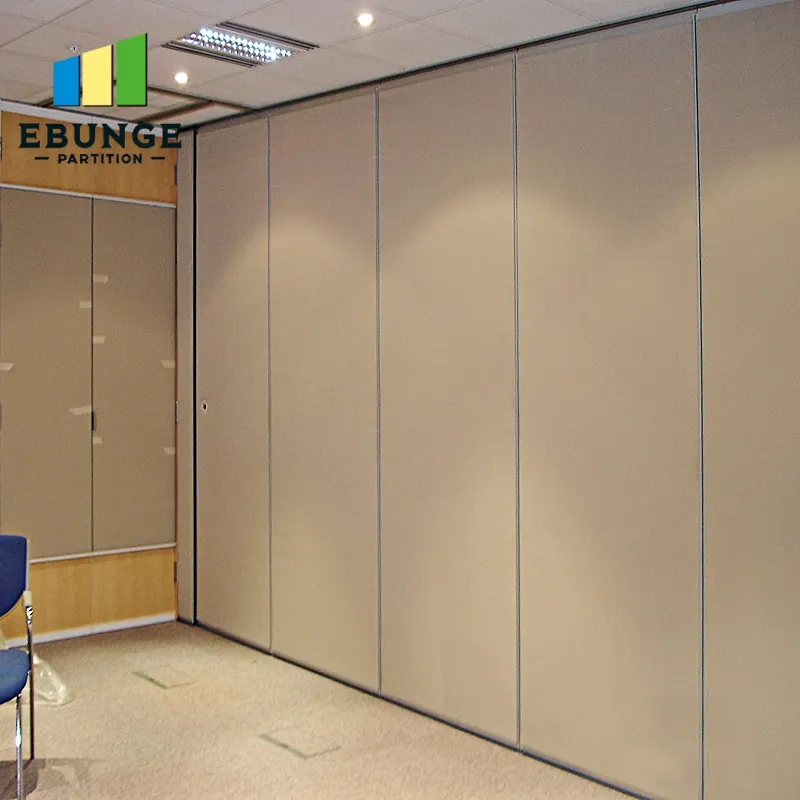
Movable partition track zone above-ceiling reserved envelope vacancy confirmation is a coordination step, not a construction shortcut. It asks a simple question before track fixing begins: have the other service trades formally left the reserved overhead corridor? EBUNGE movable partition panels are individually movable, suspended from a top track, cross the opening without a floor track, and park at a planned stacking position. Because the panels depend on a continuous connected overhead route, the space above the ceiling must be coordinated with the same discipline as the visible partition line.
This article provides a method for overseas project teams to confirm vacancy and record trade exits before track fixing. The suitability of each route and parking arrangement depends on the approved layout, circulation, ceiling interfaces and operating sequence. Every recommendation below should be checked against the current coordinated drawings and the project’s own inspection process.
Why the Above-Ceiling Track Zone Needs Its Own Coordination Gate
Project review term: movable partition track zone above-ceiling reserved envelope vacancy confirmation.
Ceiling voids are shared territory. Ductwork, cable trays, pipework, fire stopping and ceiling suspension systems may all occupy the same horizontal band that a movable partition track needs. If those trades are still active when track fixing starts, the partition installer may be asked to work around incomplete or unverified conditions.
A coordination gate separates two different questions. The first is whether the reserved envelope is dimensionally suitable for the proposed track route. The second is whether other trades have actually vacated that envelope. Both questions require evidence, and neither can be answered by looking at a single photograph.
What the reserved envelope means in practice
The reserved envelope is the three-dimensional zone identified in the coordinated drawings for the track, its supports and the movement route. It is not a generic ceiling void. It is a defined corridor that follows the straight, turning and stacking routes reviewed from the layout.
What vacancy confirmation does not prove
It only records that named trades have exited the reserved zone at a given time. Those other questions remain subject to project-specific review.
Drawing Review Before Any Vacancy Confirmation
Coordination scope: movable partition track zone above-ceiling reserved envelope vacancy confirmation.
Start with the coordinated layout. The partition route should be traceable from the opening line through any turns to the planned stacking position. The exact route, junction arrangement, continuous overhead path and parking position must be confirmed from the coordinated project drawings.
Compare the partition drawings with the ceiling services drawings. Mark every service that crosses or runs parallel to the reserved envelope. The purpose is not to solve every clash at this stage, but to identify which trades must confirm exit before track fixing.
Information to collect from the project team
- Current coordinated ceiling and services drawings, with revision dates.
- The proposed track route, including straight, turning and stacking sections.
- The planned stacking position and its relationship to ceiling features.
- Any pass-door requirements, which can be discussed with the project team.
- Confirmation of who has authority to sign a trade exit record.
Evidence limits of drawings
Drawings show intent, not as-built condition. A drawing may show a duct diverted, while the installed duct remains in the reserved envelope. Treat drawings as the basis for inspection, not as proof of vacancy.
The Service Trade Exit Register: A Simple Coordination Record
Checklist focus: movable partition track zone above-ceiling reserved envelope vacancy confirmation.
A trade exit register is a controlled list of services that must leave the reserved envelope before track fixing. It is not a performance certificate. It is a coordination record that helps the project team avoid starting track work in a zone that is still occupied.
| Register field | Purpose | Evidence to attach |
|---|---|---|
| Service trade name | Identifies who must confirm exit | Trade contact and company name |
| Reserved envelope section | Locates the affected track route | Marked-up drawing extract |
| Exit status | Records whether the trade has vacated | Signed exit note or inspection record |
| Date and time | Establishes the confirmation point | Date-stamped record |
| Outstanding items | Lists anything still inside the envelope | Photograph or written note |
The register should be reviewed at the pre-track-fixing inspection. If any trade has not exited, track fixing should not proceed in that section until the outstanding item is resolved and recorded.
Vacancy Confirmation Checklist Before Track Fixing

Review focus: movable partition track zone above-ceiling reserved envelope vacancy confirmation.
Use a checklist to make the confirmation repeatable. The following sequence is a coordination method, not a substitute for the project’s own quality process.
- Confirm the current coordinated drawing revision is the one being inspected.
- Walk the reserved envelope and compare visible services with the drawing.
- Identify every trade with equipment, supports or cabling inside the envelope.
- Record each trade’s exit status in the register.
- Mark any remaining obstruction and notify the responsible trade.
- Re-inspect after the obstruction is removed.
- Obtain the required sign-off before track fixing begins.
- File the register with the project’s installation records.
Visible evidence and its limits
A photograph can show that a cable tray has moved. Use photographs as supporting evidence, and rely on the project’s inspection and sign-off process for the final confirmation.
Interface Points With Ceiling and Partition Trades
Project review term: movable partition track zone above-ceiling reserved envelope vacancy confirmation.
The ceiling contractor, services trades and partition installer all have an interest in the reserved envelope. Coordination is most effective when each party knows what the others need before work begins.
Ceiling suspension points should not be assumed to support partition track loads. The partition installer should receive confirmation that the overhead route is clear and that support conditions have been reviewed by the responsible party.
Acoustic concepts at the ceiling interface
At the ceiling interface, the continuity of the construction and the treatment of junctions can matter, but the actual acoustic requirement must be confirmed for the specific project.
Finish and pass-door coordination
Confirmed finish options include laminate, melamine, fabric, leather, glass and other approved surfaces. Finish selection should be coordinated with the ceiling interface so that visible junctions are planned. Pass-door requirements can also be discussed with the project team as part of the layout review.
Documentation and Sign-Off Boundaries
Coordination scope: movable partition track zone above-ceiling reserved envelope vacancy confirmation.

Project documentation can be discussed with the EBUNGE team, but the final vacancy confirmation belongs to the project’s own coordination process. The register should identify who inspected, what was seen, what remained outstanding and when the area was released for track fixing.
It records trade exit only. Other performance questions require their own project-specific evidence.
Frequently Asked Questions
What is movable partition track zone above-ceiling reserved envelope vacancy confirmation?
It is a coordination step that confirms named service trades have vacated the overhead zone reserved for the movable partition track before track fixing begins. It is recorded through a trade exit register and project inspection.
Does vacancy confirmation guarantee acoustic performance?
No. Vacancy confirmation only records that the reserved envelope is clear of other trades.
Can track fixing start while one service trade is still working above the ceiling?
Track fixing should not proceed in a section where a trade has not exited the reserved envelope. The outstanding item should be resolved and recorded before that section is released.
What evidence should be attached to the trade exit register?
Useful evidence includes marked-up drawing extracts, signed exit notes, date-stamped inspection records and photographs. These support the record but do not replace the project’s own sign-off process.
Who should sign the vacancy confirmation?
The project team should identify the responsible person or party in advance. This may vary by contract and site organization, so the authority to sign should be confirmed in the project’s coordination plan.
How does the stacking position affect the reserved envelope?
The stacking position is part of the movement route reviewed from the layout. The reserved envelope should follow the straight, turning and stacking routes so that the overhead route remains continuous and connected.
Conclusion: Confirm Vacancy, Then Fix the Track
Ceiling interface coordination is most reliable when vacancy confirmation is treated as a formal gate. Review the coordinated drawings, identify every trade in the reserved envelope, record exits in a register, and resolve outstanding items before track fixing. This method keeps the partition route continuous and connected while respecting the evidence limits of drawings and photographs.
To discuss layout review, finish options, pass-door requirements or project documentation, contact the EBUNGE team. You can also review the movable wall product range and the project resources for further planning context.