
Quick project answer
Review focus: track fixing assumptions.
A bidder track fixing assumptions tender review is one of the most revealing parts of evaluating a movable partition package. Long before panels are discussed, the way a bidder describes the overhead track, its support and its route tells reviewers whether the submission is grounded in the actual building or in a generic template. Because EBUNGE movable partitions are individually movable, suspended from a top track, cross the opening without a floor track and park at a planned stacking position, the track is not a minor accessory. It is the element that makes the whole system work, and its fixing assumptions deserve close reading.
Why Track Fixing Assumptions Matter More Than Panel Descriptions
Project review term: track fixing assumptions.
Panel descriptions are often copied from a catalogue. The exact route, junction arrangement, continuous overhead path and parking position must be confirmed from the coordinated project drawings. A bidder who has studied the layout will usually describe the track as a continuous supported path. The suitability of each route and parking arrangement depends on the approved layout, circulation, ceiling interfaces and operating sequence.
During tender review, this difference is a useful signal. It does not prove competence or incompetence on its own, but it shows where clarification is needed before the package can be compared fairly with others.
What a Complete Track Fixing Statement Usually Addresses
Coordination scope: track fixing assumptions.
A useful submission explains how the track relates to the building, not just what the track is. Reviewers should look for a clear statement of the route, the support condition and the interface with adjacent construction. Where any of these are missing, the bidder may be assuming a condition that has not been confirmed.
Route and continuity
The track must follow a continuous connected overhead route. Straight, turning and stacking routes should be reviewed from the layout. If a bidder describes panels moving across a gap with no overhead route, that assumption needs immediate correction because it does not match how a top-hung system operates.
Support and structure
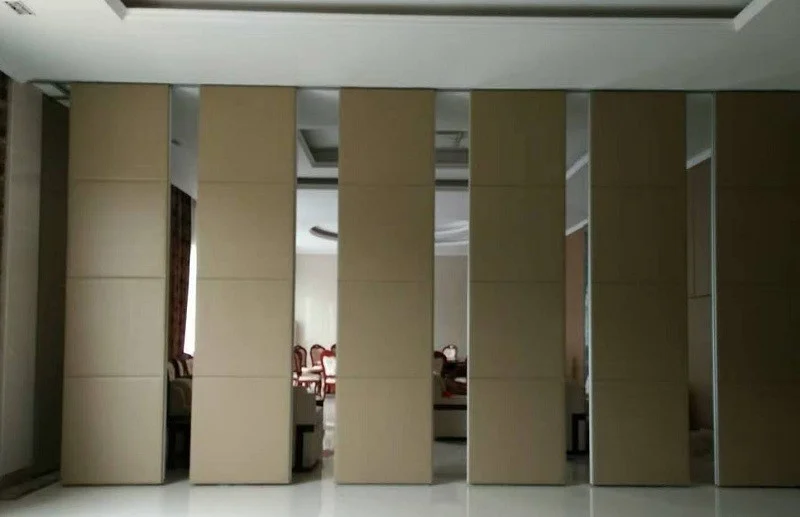
The structure above the opening carries the track. A bidder may assume a suitable support exists without confirming it.
Reading the Bidder’s Language for Hidden Assumptions
Checklist focus: track fixing assumptions.
Certain phrases in a tender return should prompt a follow-up question. They are not necessarily wrong, but they often indicate that a condition has been assumed rather than verified.
- “Standard fixing” — ask what the standard fixing is designed to attach to in this specific structure.
- “Track by others” — clarify who is responsible for the overhead route and its support.
- “As per drawing” — confirm which drawing revision the bidder priced.
- “Suitable support assumed” — ask for the basis of that assumption and who will verify it.
- “No floor track required” — this is consistent with a top-hung system, but it should be paired with a clear overhead route description.
A Practical Tender Review Checklist
Use the following checklist to compare submissions on a consistent basis. It is a review aid, not a substitute for project-specific engineering advice.
- Does the bidder identify the full track route, including turns and the stacking position?
- Does the submission state what the track will be fixed to, or flag that support is to be confirmed?
- Is the parking arrangement described in relation to the coordinated layout?
- Are pass-door requirements addressed where the project needs them?
- Are finish options listed consistently with the approved schedule?
- Does the bidder reference the correct drawing revision and any project documentation?
- Are acoustic and dimensional requirements flagged for project-specific confirmation?
Where Acoustic and Dimensional Claims Need Care
If a bidder quotes a rating, reviewers should ask what configuration and what test basis it refers to, and whether it applies to the actual opening, seals and adjacent construction.
Dimensions deserve the same discipline. Opening width, height, stacking space and turning clearances all interact. A bidder who assumes a stacking position without checking the coordinated layout may create a conflict that only appears later. Confirm project-specific support, acoustic and dimensional requirements before treating any figure as final.
How to Turn Assumptions into Clarification Questions
The goal of tender review is not to catch bidders out. It is to convert assumptions into shared, documented understanding. A short clarification round is usually more productive than scoring submissions on incomplete information.
Questions worth asking every bidder
Ask each bidder to confirm the track route, the support condition, the stacking position and the drawing revision used. Ask how pass-door requirements and project documentation have been addressed. Ask which finish options have been priced and whether any acoustic or dimensional figure is subject to project-specific confirmation.
Recording the answers
Keep the answers alongside the tender return. When assumptions are written down and confirmed, they become part of the project record rather than hidden risk. This is also where a supplier’s willingness to engage with drawings becomes visible.
Evidence Notes for Reviewers
Track fixing assumptions are not proof of structural capacity, acoustic performance or installation outcome. They are statements to be verified against the project’s own drawings, structure and coordinated layout.
Reviewers should treat visible shapes, finishes and drawings as information, not as evidence of hidden performance. A track line on a plan does not confirm what it is fixed to. A finish sample does not confirm cleaning compatibility or acoustic behaviour. Where a claim matters, ask for the matching project-specific confirmation.
Frequently Asked Questions

What does a bidder’s track fixing assumption tell me in tender review?
It shows how far the bidder has engaged with the actual building.
Should a movable partition track have a floor track?
EBUNGE movable partitions are top-hung and cross the opening without a floor track.
Can I compare acoustic ratings directly between bidders?
Only with care.
What if a bidder says support is by others?
That may be legitimate, but it must be coordinated. Clarify who designs and verifies the support, and make sure the responsibility is recorded in the tender comparison.
How should stacking position be reviewed?
Review it against the coordinated layout. Parking style is customized to the customer layout and project requirements, and compact stacking depends on the coordinated design. Confirm the position does not conflict with other building elements.
Which finish options should be priced?
Confirmed finish options include laminate, melamine, fabric, leather, glass and other approved surfaces. The tender should reflect the approved schedule, and any substitution should be clarified.
Conclusion: Use Assumptions as a Starting Point, Not a Verdict
A bidder track fixing assumptions tender review is most useful when it turns vague statements into specific questions. The track is central to a top-hung movable partition system, and the assumptions around it reveal how carefully a bidder has read the project.
To discuss your project documentation and track fixing coordination, contact EBUNGE. You can also review the movable wall product range and browse further planning resources for tender teams.