
When planning an office meeting room, one of the most uncertain decisions is how to achieve reliable sound privacy without committing to permanent construction. Movable acoustic partitions are a flexible solution, but their performance depends on careful specification. As a project contractor, you need to know what to ask, what to measure, and what to verify before you send a quotation. This article walks you through the key technical and commercial considerations, so you can prepare a precise brief and avoid costly surprises during installation.
Direct answer: To assess movable acoustic partitions for an office meeting room, you must evaluate the acoustic performance (measured as Rw or STC), the track system’s durability and compatibility with your ceiling, the partition’s ease of operation, and the supplier’s ability to provide drawings, lead times, and after-sales support. Always request a detailed specification and confirm exact values from project documentation.
Movable Acoustic Partitions: Why Acoustic Certainty Matters in Meeting Rooms
Meeting rooms are where confidential discussions happen. If sound leaks, it undermines trust and productivity. For a contractor, this means the acoustic performance of a movable partition is not just a nice-to-have; it is a contractual requirement. You need to know the partition will achieve the sound insulation level promised in the spec. This is why you must ask for the acoustic rating (Rw or STC) and understand what it means in practice. A rating is only useful if it is measured under standard conditions and if the installation follows the manufacturer’s guidelines.
Need help turning the movable acoustic partitions requirements into a practical project layout?
Key Technical Specifications to Request
When evaluating a movable acoustic partition, you should request a full technical datasheet. Look for these specifications:
- Acoustic rating: Rw (in dB) or STC. Higher values mean better sound insulation. For meeting rooms, an Rw of 45-50 dB is common, but your project may require more.
- Panel dimensions and weight: This affects handling and ceiling load.
- Sealing system: Perimeter seals are critical for acoustic performance. Check if they are automatic or manual.
- Fire rating: If required by local codes, ask for the fire resistance class.
- Materials and finish: Confirm the panel surface is suitable for your design and durable for daily use.
Remember, these values must be confirmed in writing. Do not rely on verbal promises.
Track System Durability and Ceiling Compatibility
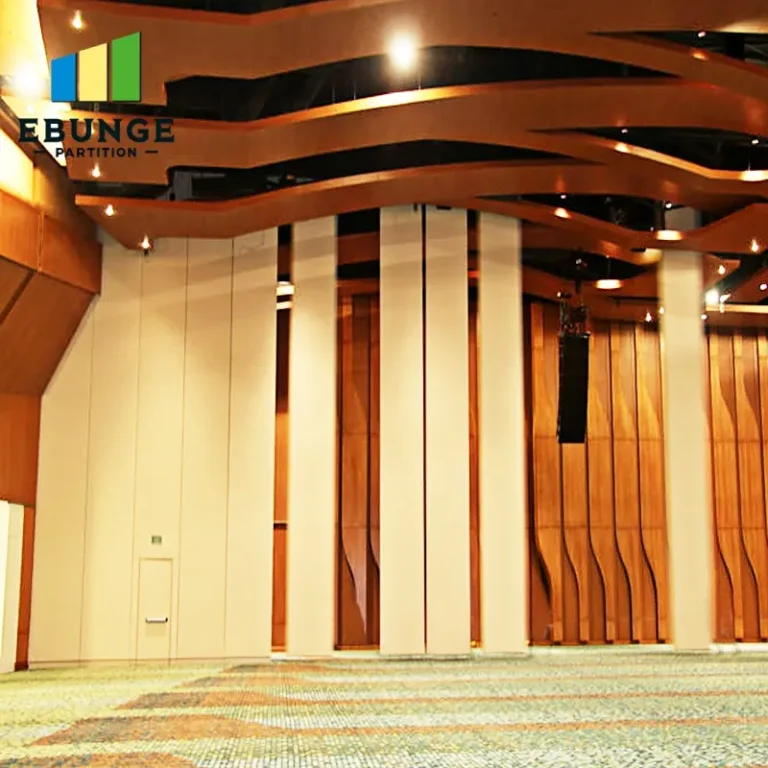
The track system is the backbone of a movable partition. A top-hung track system, where the partition hangs from an overhead track without a floor rail, is preferred for office meeting rooms because it leaves the floor clear. But you must check that the ceiling structure can support the weight and that the track is robust enough for frequent use. Ask about the track material (usually aluminum or steel), the type of rollers, and the maximum panel weight per meter. Also, confirm that the track can be integrated with your existing ceiling grid or suspended ceiling. A supplier should provide a structural drawing showing the required fixings and clearances.
Ease of Operation and Maintenance
A movable partition is only useful if it is easy to operate. Consider how often the partition will be moved. If daily, you need a system with smooth gliding and a simple locking mechanism. Ask about the force required to move the panels and whether the system has a self-locking feature. Maintenance is another factor: what parts wear out, and how easy are they to replace? A good supplier will provide a maintenance guide and recommend a service schedule. You should also check the warranty terms – what is covered and for how long.
Compliance with Building Codes and Standards
Your project must comply with local building codes, especially regarding fire safety and accessibility. Confirm that the movable partition meets the necessary standards, such as fire resistance, smoke control, and disabled access (if applicable). Ask the supplier for certificates or test reports. If the partition is custom-made, ensure the design complies with relevant codes. Also, check if the partition affects the building’s HVAC or lighting layout – you may need to coordinate with other trades.
What to Ask Before Requesting a Quotation
To get an accurate quotation, you need to provide the supplier with complete information. Use this checklist:
- Opening size: Width and height of the opening to be closed.
- Drawings: Architectural or structural drawings showing the ceiling, floor, and wall connections.
- Acoustic target: The required Rw or STC value for the meeting room.
- Finish preference: Color, material (e.g., fabric, laminate, glass), and any branding requirements.
- Project location: This affects delivery times and installation logistics.
- Usage frequency: How often the partition will be moved.
- Number of panels and stacking space: Where the partition will rest when open.
Providing this information upfront helps the supplier give you a precise quotation and reduces the risk of change orders later.
Share the opening, drawings, finish direction, and privacy target for a project-specific review.
Comparing Movable Acoustic Partition Options
When comparing different suppliers or models, create a comparison table to evaluate them side by side. Here is an example of what to include:
| Feature | Option A | Option B |
|---|---|---|
| Acoustic rating (Rw) | 47 dB | 50 dB |
| Track system | Top-hung, manual | Top-hung, motorized |
| Panel weight (kg/m²) | 35 | 40 |
| Ceiling load requirement | 50 kg/m | 60 kg/m |
| Lead time | 4 weeks | 6 weeks |
| Warranty | 2 years | 5 years |
This table is an example; you must fill in actual values from supplier datasheets. Do not assume that a higher rating is always better – consider cost and installation complexity.
Lead Time, Warranty, and After-Sales Support
Lead time is critical for project scheduling. Ask the supplier for a clear timeline from order to delivery and installation. Also, clarify what is included in the warranty – parts, labor, or both? What is the response time for service calls? After-sales support is essential for maintenance and repairs. A reliable supplier will provide a dedicated contact and a service hotline. Make sure you get these details in writing.
Common Mistakes to Avoid
Contractors often make these mistakes when specifying movable acoustic partitions:
- Ignoring ceiling load: The ceiling may not be strong enough to support the partition. Always get a structural assessment.
- Overlooking seals: Poor perimeter seals can ruin acoustic performance. Check the seal quality and whether they are automatic.
- Not considering stacking space: When open, the partition panels need a parking area. Ensure there is enough space.
- Assuming all suppliers are the same: Quality varies. Visit a showroom or ask for references.
Preparing for Installation
Before installation, ensure the site is ready. The ceiling must be finished, and the floor area clear. Coordinate with the supplier on the installation schedule. During installation, verify that the partition is installed according to the manufacturer’s instructions, especially the sealing and track alignment. After installation, test the operation and acoustic performance if possible. Keep all documentation, including warranties and maintenance guides.
Conclusion: Make an Informed Decision
Assessing movable acoustic partitions requires a systematic approach. Focus on acoustic performance, track durability, compatibility with your ceiling, and the supplier’s support. Always request detailed specifications and confirm values from project documents. By asking the right questions and preparing a thorough brief, you can select a partition that meets your client’s needs and ensures a successful project.
For more information on movable partition walls, visit our movable partition wall page. Explore our blog for technical insights, or browse our acoustic partition solutions category. If you have specific project requirements, contact us for a consultation.
Frequently Asked Questions
What is the typical acoustic rating for a movable partition in a meeting room?
Typical ratings range from Rw 45 to 50 dB, but the exact requirement depends on the level of privacy needed. Always confirm the target rating with your client and verify the supplier’s test data.
Can a movable partition be installed on an existing ceiling?
Yes, but the ceiling must be able to support the weight of the partition and track. A structural assessment is necessary to ensure safety. The supplier should provide a compatibility check.
How do I maintain a movable acoustic partition?
Regularly inspect the track and seals for wear. Clean the panels according to the manufacturer’s instructions. Schedule periodic maintenance with the supplier to ensure smooth operation.
What information do I need to provide for a quotation?
You need the opening size, drawings, acoustic target, finish preference, project location, and usage frequency. This helps the supplier give an accurate quote and lead time.
Are top-hung track systems better than floor-mounted systems?
Top-hung systems are often preferred because they leave the floor clear, making them easier to clean and safer. However, they require a stronger ceiling structure. The choice depends on your project’s constraints.
Send the opening size and drawings to discuss a differentiated movable acoustic partitions solution.