
Quick answer: partition interface sign
Review focus: partition interface sign.
The architect partition interface sign-off drawing issue cycle is a coordination rhythm, not a single approval event. Movable partitions are top-hung, travel without a continuous floor track, and park at a planned stacking position. Because those conditions touch structure, ceiling, finishes and adjacent trades, sign-off timing should follow the same issue milestones that govern the rest of the package. This article offers an evidence-bounded framework for scheduling interface reviews without inventing performance, engineering or commercial outcomes.
Why Interface Sign-Offs Slip Past Drawing Issues
Project review term: partition interface sign.
Interface sign-off often fails because the partition is treated as a late finish item rather than an early coordination item. The suitability of each route and parking arrangement depends on the approved layout, circulation, ceiling interfaces and operating sequence. If those items are not reviewed before a drawing issue, the issue may freeze assumptions that later need revision.
Another common gap is confusing a visual layout with a coordinated route. A straight, turning or stacking route must be reviewed from the layout, and every proposed movement path requires a continuous connected overhead route with project-specific support review. A drawing that shows panels in a closed position does not, by itself, confirm the route or the parking condition.
What Sign-Off Actually Covers
Sign-off should confirm that the drawing set shows the intended opening, the planned parking position and the interface zones that other trades must respect. Those items require separate project-specific confirmation.
Map Sign-Offs to Your Drawing Issue Milestones
Coordination scope: partition interface sign.
Start by listing the drawing issues already planned for the project. Then attach a partition interface review to each one, with a clear purpose. The goal is not to add approvals for their own sake, but to make sure the right questions are asked before assumptions harden.
- Concept issue: confirm the room division intent, the opening location and the likely parking zone.
- Technical issue: align finish selections, pass-door requirements and project documentation needs.
- Tender or procurement issue: confirm that the specified interface conditions match the layout information being issued.
- Construction issue: verify that support, acoustic and dimensional requirements have been confirmed for the project.
This sequence keeps the partition visible at each milestone without pretending that one review can resolve every interface.
Build a Decision Checklist for Each Review
Checklist focus: partition interface sign.
A short checklist helps reviewers focus on evidence rather than assumptions. Use it before every issue, and record what remains open.
- Does the drawing show the opening and the planned stacking position?
- Is the overhead route continuous and connected for the proposed movement path?
- Are support conditions identified for project-specific review?
- Are finish options such as laminate, melamine, fabric, leather or glass shown where relevant?
- Are pass-door requirements and project documentation items listed for discussion?
- Are acoustic and dimensional requirements marked as project-specific confirmations?
Evidence note: a finish selection or a layout drawing does not confirm acoustic performance, structural capacity, cleaning compatibility or a application reference. Those claims require matching project evidence.
Separate Confirmed Facts from Project-Specific Questions
Review focus: partition interface sign.
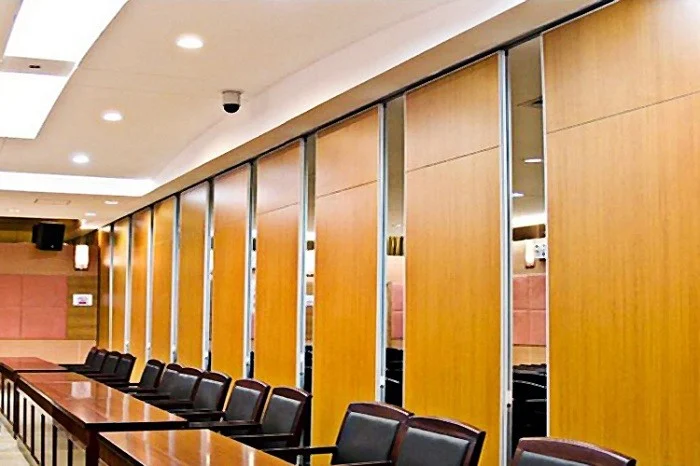
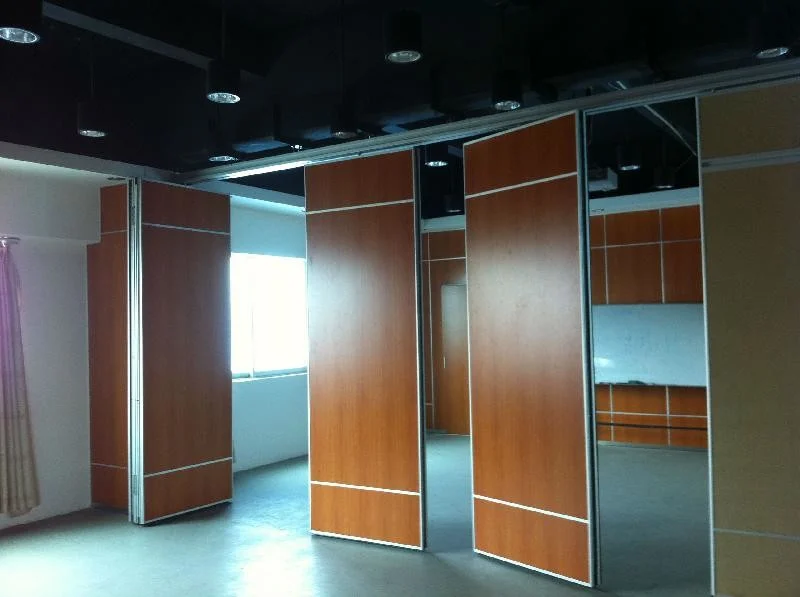
Confirmed product facts are useful because they define what can be stated without further evidence. EBUNGE movable wall panels are individually movable, suspended from a top track, cross the opening without a floor track, and park at a planned stacking position. Straight, turning and stacking routes are reviewed from the layout. Confirmed finish options include laminate, melamine, fabric, leather, glass and other approved surfaces. Pass-door requirements and project documentation can be discussed.
Everything beyond those facts belongs in a project-specific question. Support, acoustic and dimensional requirements should be confirmed for the project rather than inferred from a drawing, a finish sample or a generic application example.
How to Talk About Acoustic Concepts
If acoustic separation matters, treat it as a design requirement to be confirmed through the appropriate project documentation.
Coordinate the Review with Other Trades
Partition interfaces rarely sit in isolation. Invite the relevant trades to the coordination review so that conflicts are visible before the drawing issue.
Use the same review to confirm who will provide support information and who will verify dimensional conditions. The architect does not need to solve every interface alone, but the drawing issue should show that the questions have been assigned and tracked.
Keep a Simple Sign-Off Log
A one-page log can record the issue date, the items reviewed, the open questions and the responsible party. This is not a substitute for project documentation, but it helps the team see whether the partition interface is keeping pace with the drawing cycle.
Common Timing Mistakes to Avoid
One mistake is waiting for a fully resolved design before starting the interface conversation. Another is issuing a drawing with a parking zone that has not been checked against the route. A third is treating a finish approval as an interface approval.
Each of these mistakes pushes unresolved questions into a later stage, where changes are harder to coordinate.
Frequently Asked Questions
When should the first partition interface review happen?
As early as the concept issue, when the room division intent and likely parking zone can be discussed. Early review helps the team identify support and route questions before they affect other trades.
Does a drawing issue approve acoustic performance?
No. A drawing issue can record that acoustic requirements have been identified, but the actual performance must be confirmed for the project through the appropriate documentation.
What finish information should be shown at sign-off?
Show the intended finish option where it is known, such as laminate, melamine, fabric, leather or glass. Confirm that the selected finish is suitable for the project and does not imply performance that has not been verified.
How do pass doors fit into the review?
Pass-door requirements can be discussed as part of the layout and documentation review. They should be listed as a project-specific item so that the drawing issue reflects the intended configuration.
Can the parking position change after sign-off?
Parking style is customized to the customer layout and project requirements. If the layout changes, the parking position and route should be reviewed again against the revised drawing issue.
What should be confirmed before construction issue?
Confirm project-specific support, acoustic and dimensional requirements, and verify that the overhead route is continuous and connected for the proposed movement path. Any remaining open items should be clearly marked.
Conclusion: Make Sign-Off a Repeatable Habit
Timing partition interface sign-offs to the drawing issue cycle is less about adding bureaucracy and more about asking the right questions at the right moment. By attaching a focused review to each issue, using a decision checklist and separating confirmed facts from project-specific questions, architects can reduce late surprises without overstating what the drawings prove.
The exact overhead route and support arrangement must be confirmed by the responsible project team from coordinated drawings. To discuss movable wall interfaces, finishes, pass-door requirements or project documentation, contact EBUNGE. You can also review the movable walls product page and the resources section for further planning context.