
Quick answer: architect coordination interface assumption handover
Review focus: architect coordination interface assumption handover.
The architect coordination interface assumption handover register movable partition is a design-phase control document. It records what the architect has assumed about the top track, the parking or stacking zone, the ceiling void and the surrounding structure, then transfers each assumption to the specialist supplier for review. Without this register, assumptions are inherited silently and reappear later as site conflicts.
This article explains how to build and maintain that register. It stays within confirmed product facts: panels are individually movable, suspended from a top track, cross the opening without a floor track, and park at a planned stacking position. Straight, turning and stacking routes are reviewed from the layout. Finish options include laminate, melamine, fabric, leather, glass and other approved surfaces. Pass-door requirements and project documentation can be discussed.
Why a Handover Register Beats a Drawing Note
Project review term: architect coordination interface assumption handover.
A note on a drawing is easy to miss. A register gives every assumption a row, an owner and a status. It also separates confirmed information from items still awaiting project-specific review.
The register does not replace drawings. It sits alongside them and points to the exact drawing, detail or specification clause that supports each entry. When the specialist supplier receives the package, they can see which assumptions are firm and which are placeholders.
What the register is not
The suitability of each route and parking arrangement depends on the approved layout, circulation, ceiling interfaces and operating sequence. It does not confirm acoustic values, support capacity or installation outcomes. Those require separate project-specific evidence and review.
Core Interface Zones to Record
Coordination scope: architect coordination interface assumption handover.
Three zones generate most design-phase assumptions: the overhead route, the parking position and the ceiling interface. Each needs its own set of register entries.
Overhead route and track zone
Because panels are top-hung and cross the opening without a floor track, the overhead route must be continuous and connected wherever movement is proposed. The exact route, junction arrangement, continuous overhead path and parking position must be confirmed from the coordinated project drawings.
Stacking and parking zone
Record where panels will park, how the stack relates to adjacent walls or columns, and whether the layout supports compact stacking. Parking style is customized to the customer layout and project requirements, so this entry must reference the actual layout rather than a generic assumption.
Ceiling void and surrounding structure
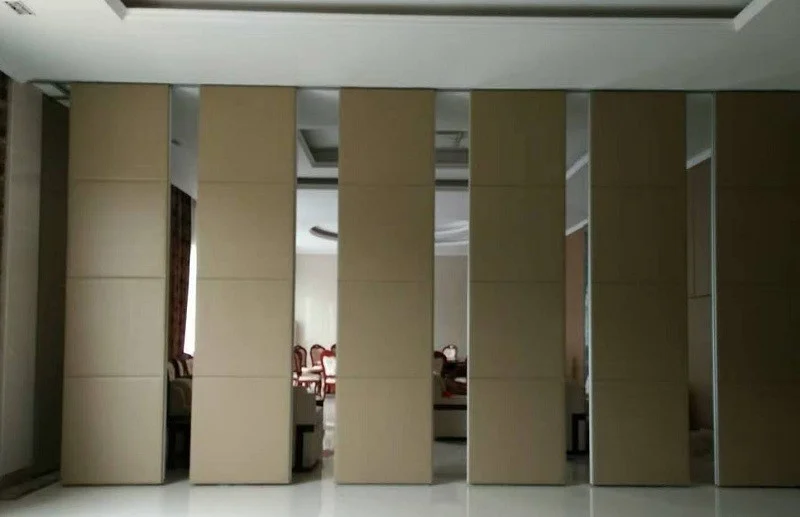
Record the ceiling zone available for the track, the interface with finishes, and any coordination needed with other ceiling services. Support and dimensional requirements must be confirmed for the project.
Register Structure: A Practical Template
Checklist focus: architect coordination interface assumption handover.
Use a simple table that can be issued with the design package and updated as responses arrive. The columns below are a starting structure, not a fixed standard.
| Field | What to record | Status |
|---|---|---|
| Interface zone | Track route, stack zone or ceiling void | Open / Reviewed / Closed |
| Assumption | The design-phase statement being made | Draft / Confirmed |
| Source | Drawing number, detail or specification clause | Reference only |
| Owner | Architect, supplier or other party | Named role |
| Action needed | Review, confirmation or revised drawing | Open / Complete |
| Evidence boundary | What still requires project-specific confirmation | Stated |

Step-by-Step Handover Process
Review focus: architect coordination interface assumption handover.
- Architect issues the register with the design package, marking each assumption as draft or confirmed.
- Specialist supplier reviews track, stack and ceiling entries against the layout and notes any unresolved items.
- The register is updated with responses and reissued before fabrication or installation planning advances.
- Any assumption that cannot be closed is transferred explicitly, with the responsible party named.
This sequence keeps unresolved items visible. It also prevents a design-phase assumption from being treated as a confirmed instruction.
Acoustic and Sealing Concepts: Keep Them Conceptual
Project review term: architect coordination interface assumption handover.
Seals and acoustic concepts can be explained generically, but the register should record only what has been confirmed for the project. Where acoustic requirements exist, they must be reviewed with the specialist supplier and supported by matching documentation.
Evidence note
Every acoustic, structural and dimensional statement in the register must point to project-specific evidence or be marked as requiring confirmation. Visible finishes, photographs and generic examples do not prove performance.
Common Coordination Failures to Avoid
A track route may be drawn without confirming the overhead support condition. A stack zone may be shown without checking the adjacent wall or column. A ceiling void may be assumed to be clear without coordination with other services.
Laminate, melamine, fabric, leather, glass and other approved surfaces are finish options. They do not by themselves confirm performance.

Finally, avoid closing a register entry simply because no objection was raised. Silence is not confirmation. Each entry needs an explicit response from the responsible party.
FAQ: Design-Phase Interface Handover
What is an interface assumption handover register?
It is a structured list of design-phase assumptions about interfaces such as track, stack and ceiling zones, transferred from the architect to the specialist supplier with an owner and status for each item.
Why not simply note assumptions on drawings?
Drawing notes are easily missed and hard to track. A register gives each assumption a row, a source reference and a status, so unresolved items remain visible through the design phase.
Does the register confirm acoustic performance?
No. The register records assumptions and confirmation boundaries, not performance promises.
Can panels move without a floor track?
Confirmed product facts state that panels are top-hung and cross the opening without a floor track. Every proposed movement path still requires a continuous connected overhead route and project-specific support review.
How is the stacking zone decided?
Parking style is customized to the customer layout and project requirements. The register should reference the actual layout and note whether compact stacking is being considered.
When should the register be closed?
Before fabrication or installation planning advances, every entry should be reviewed, responded to and either closed or explicitly transferred with a named responsible party.
Conclusion and Next Step
A handover register turns design-phase assumptions into visible, owned items. It does not replace drawings, calculations or project-specific evidence, but it prevents unresolved assumptions from being inherited silently. Use it to record track, stack and ceiling interfaces, to separate confirmed information from open questions, and to transfer responsibility clearly.
To discuss pass-door requirements, project documentation or finish options for your layout, contact EBUNGE. You can also review the movable wall product range and the project resources before issuing your register.