
When a government or public building project requires a folding partition wall, the decision process rarely ends with a simple product comparison. The real challenge is preparing a quotation that protects the project from long-term maintenance issues, budget overruns, and compliance gaps. This article focuses on how to compare suppliers for a folding partition wall with quotation readiness and project decision risk in mind, ensuring that your office meeting room investment is sound from specification to after-sales service.
Direct answer: To compare folding partition wall suppliers effectively, you must prepare a detailed specification package that includes opening size, acoustic target, finish preference, and drawings. Then, evaluate each supplier’s ability to provide factory direct support, compliance documentation, and a transparent quotation that covers installation, lead times, and after-sales service. Prioritize suppliers who can demonstrate quality consistency and long-term durability without making unsupported claims.
Why Quotation Readiness Determines Supplier Comparison
In public sector projects, a quotation is more than a price list; it is a risk assessment tool. A supplier who asks for minimal information may be underestimating the complexity of your office meeting room. Conversely, a supplier who requests detailed drawings and acoustic targets is likely to deliver a more accurate quote. For a folding partition wall, the quotation should specify materials, track systems, and installation procedures. Without this level of detail, you risk budget overruns and hidden costs.
When comparing suppliers, insist on a quotation that breaks down costs by component: panels, track, hardware, installation, and finishing. This transparency allows you to compare like-for-like and identify where a supplier may be cutting corners. For instance, a lower price might indicate thinner panels or a less durable track system, which could lead to higher maintenance costs over time.
Need help turning the folding partition wall requirements into a practical project layout?
Key Evaluation Criteria for Folding Partition Wall Suppliers
To make a defensible decision, evaluate suppliers against the following criteria, each linked to your project’s long-term needs:
- Quality consistency: Ask for samples and visit a completed installation if possible. Check if the supplier uses standardized manufacturing processes that ensure consistent panel dimensions and acoustic performance.
- Installation downtime: In a public building, minimizing disruption is critical. Ask about the estimated installation time and how they manage site access. A supplier who offers a detailed installation schedule is preferable.
- Compliance with building codes: Verify that the partition wall system meets local fire safety, accessibility, and acoustic regulations. Request documentation such as test reports or certificates, but be cautious of generic claims.
- Long-term durability: Consider the wear and tear of daily use. Ask about the warranty terms and what they cover. A supplier who offers a clear warranty on mechanical parts is a positive sign.
- After-sales service: Determine how the supplier handles spare parts and repairs. In a government project, you need a reliable point of contact for years to come.
These criteria help you move beyond price and focus on the total cost of ownership, which is essential for budget control.
Preparing a Specification Package That Reduces Risk
Before inviting quotations, prepare a specification package that includes:
- Opening size: Exact dimensions of the opening where the partition will be installed.
- Acoustic target: The desired sound insulation rating (e.g., Rw value) based on the room’s use.
- Finish preference: Material and color for panels, such as laminate, veneer, or paint.
- Drawings: Architectural or layout drawings showing the partition’s position and integration with other elements.
- Factory direct support: Indicate your preference for dealing directly with the manufacturer, which can simplify communication and ensure quality control.
This package allows suppliers to provide accurate quotations and reduces the likelihood of change orders later. For example, if the acoustic target is not specified, a supplier might quote for a lower-performance partition that fails to meet your needs, leading to costly modifications.
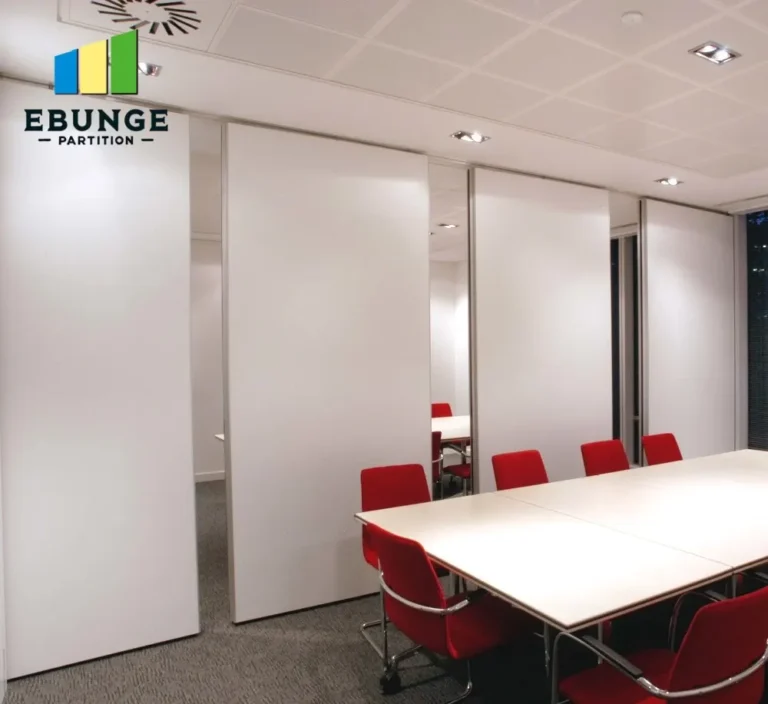
Comparing Quotations: What to Look For
When you receive quotations, compare them systematically. Use a table to list each supplier’s offer against your criteria. Look for:
- Clear breakdown of costs, including delivery and installation.
- Stated lead times for manufacturing and delivery.
- Details on the track system: top-hung vs. floor rail. For office meeting rooms, a top-hung track without floor rail is often preferred for ease of cleaning and accessibility.
- Inclusion of all necessary hardware and accessories.
- Exclusion of hidden fees, such as for site surveys or engineering support.
Beware of quotations that are significantly lower than others; they may indicate a misunderstanding of the project scope or a compromise on quality. Similarly, a quotation that is vague about installation or after-sales service is a red flag.
Assessing Long-Term Maintenance and Durability
For a public building, the folding partition wall will be used frequently, so durability is paramount. Ask suppliers about the expected lifespan of the panels, track, and seals. Inquire about the availability of spare parts and the cost of replacements. A supplier who offers a maintenance plan or training for your facilities team is a valuable partner.
Additionally, consider the ease of repair. Some partition systems require specialized tools or technicians, which can increase downtime and cost. A system that allows for simple adjustments or component replacement is preferable.
Evaluating After-Sales Service and Support
After-sales service is critical for public projects, where accountability is high. Ask each supplier:
- What is your response time for service requests?
- Do you have local service technicians or partners?
- What is the warranty period and what does it cover?
- How do you handle warranty claims?
Suppliers who offer factory direct support are often better positioned to resolve issues quickly, as they have direct access to parts and expertise. This can be a deciding factor in your comparison.
Share the opening, drawings, finish direction, and privacy target for a project-specific review.
Compliance and Documentation: Protecting Your Project
In government projects, compliance with building codes is non-negotiable. Request from each supplier:
- Test reports for acoustic performance, fire resistance, and structural integrity.
- Certificates of compliance with relevant standards (e.g., EN, ASTM).
- Material safety data sheets (MSDS) for any coatings or adhesives used.
Verify that these documents are current and applicable to the specific product offered. If a supplier cannot provide documentation, consider it a risk. Remember that you are responsible for ensuring the final installation meets legal requirements.
Making the Final Decision: A Balanced Approach
After evaluating suppliers based on the above criteria, create a scoring matrix that weighs each factor according to your project’s priorities. For instance, if acoustic performance is critical, give it a higher weight. If budget is tight, cost may weigh more, but do not sacrifice quality for short-term savings.
Schedule a meeting with the top two or three suppliers to discuss your specification package in detail. This allows you to gauge their understanding and commitment. Ask about their experience with similar public projects and request references (but verify them independently).
Finally, trust your judgment. A supplier who communicates clearly, provides detailed documentation, and shows flexibility in meeting your needs is likely to be a reliable partner.
Practical Checklist for Comparing Suppliers
Use this checklist to ensure you have covered all bases:
- □ Specification package includes opening size, acoustic target, finish preference, drawings.
- □ Quotation provides itemized costs for panels, track, installation, and finishing.
- □ Supplier states lead times and installation schedule.
- □ Track system is top-hung without floor rail (if preferred).
- □ Compliance documents are provided and verified.
- □ Warranty terms are clear and cover mechanical parts.
- □ After-sales service includes local support or factory direct.
- □ Supplier has experience with public or commercial projects.
- □ References are checked.
Conclusion
Comparing folding partition wall suppliers for an office meeting room in a public project is a nuanced process. By focusing on quotation readiness and project decision risk, you can select a supplier who not only meets your immediate needs but also ensures long-term performance and value. Remember to prepare a detailed specification package, evaluate quotations systematically, and prioritize suppliers who demonstrate quality consistency, compliance, and robust after-sales support. With a thorough comparison, you can confidently proceed with your partition wall system, knowing that your investment is protected.
Frequently Asked Questions
What information should I provide to get an accurate quotation for a folding partition wall?
How can I verify a supplier’s compliance with building codes?
What are the benefits of a top-hung track without a floor rail?
How do I compare quotations from different suppliers?
What should I consider for long-term maintenance of a folding partition wall?
For more insights on movable partition costs and best practices, explore our movable partition wall resources. If you need assistance with your project, contact our team for expert guidance.
Send the opening size and drawings to discuss a differentiated folding partition wall solution.