
Handover Documentation When Track Zones Were Built to Mixed Revisions
Quick answer: track zone
When a movable wall package is installed across several drawing revisions, the finished track zones may not match any single document set. That is the core challenge of track zone mixed revision handover documentation: proving what was built, against which revision, and what remains unverified. This guide offers an evidence-bounded framework for contractors, architects, designers, owners and renovation teams. The suitability of each route and parking arrangement depends on the approved layout, circulation, ceiling interfaces and operating sequence.
Why Mixed Revisions Create Handover Risk
Track zones rarely change in isolation. A ceiling grid adjustment, a revised stacking position or a late finish substitution can each trigger a new revision affecting only part of the route. Over time, the installed condition becomes a patchwork of instructions rather than a single coordinated design.
The handover risk is not that mixed revisions are inherently wrong. It is that the record may fail to show which revision governs each segment. Without that link, reviewers cannot tell whether a deviation was approved, superseded or simply undocumented.
Start With a Revision Register, Not a Folder of Drawings
A folder of PDFs is not a register. A usable register lists every drawing affecting the track zone, its revision code, its issue date, its status and the physical zone it governs. Superseded sheets stay visible but clearly marked.
- Drawing number and revision code for each sheet touching the track zone.
- Zone identifier linking the sheet to a physical location on site.
- Issue status — for construction, for review, superseded or as-built.
- Change trigger — what prompted the revision, in one line.
Keep the register under document control with a named owner. A register maintained informally in email threads will not survive a handover review.
Verify the Movement Route Against the Built Condition
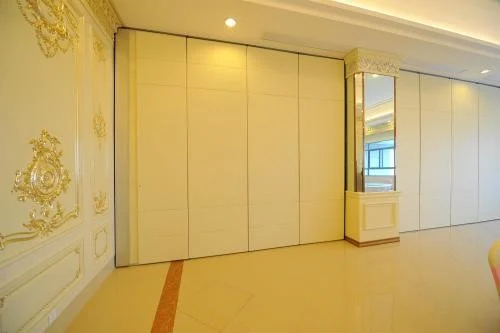
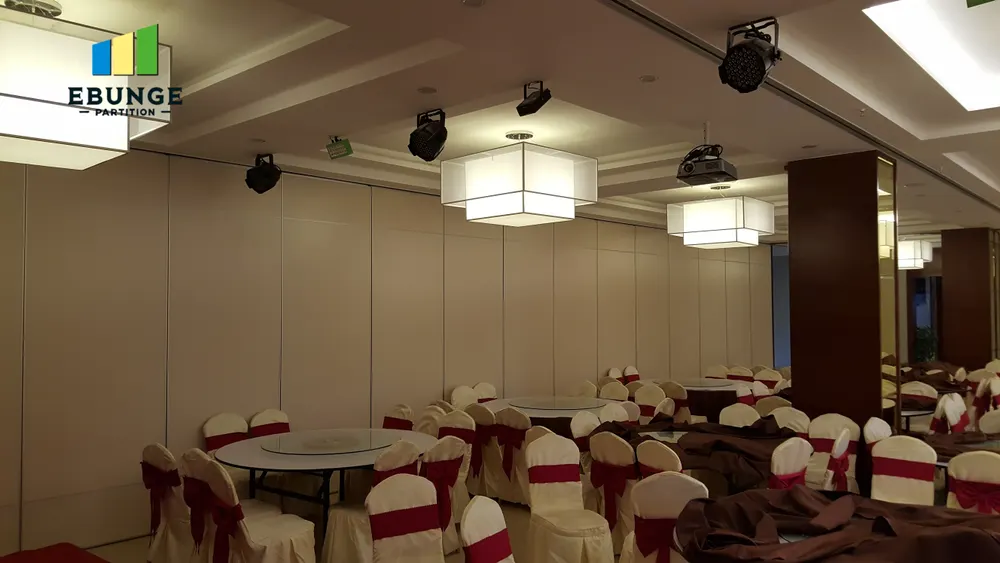
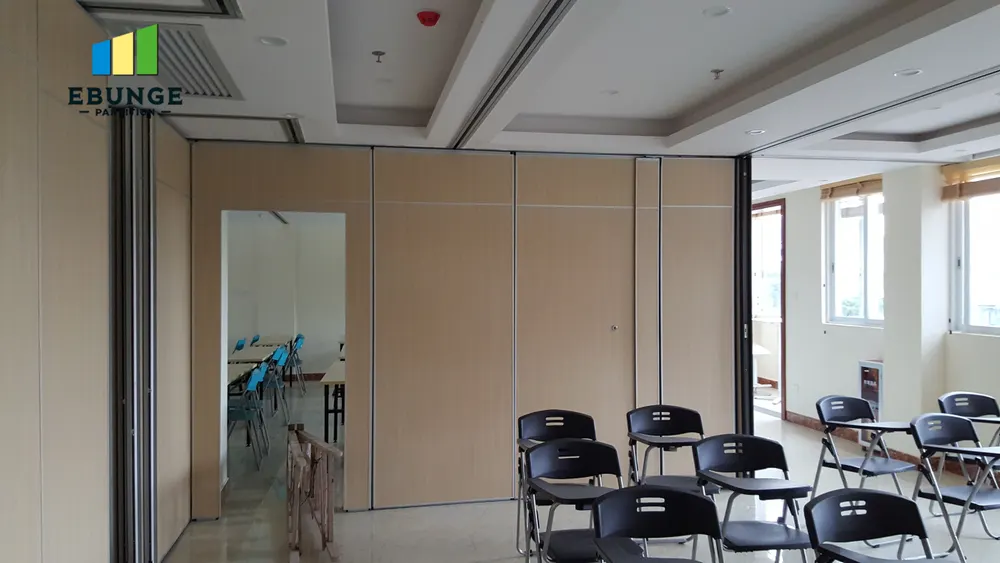
EBUNGE movable partition panels are individually movable, suspended from a top track, and cross the opening without a floor track. Panels park at a planned stacking position. Straight, turning and stacking routes are reviewed from the layout.
That makes route verification a drawing-and-site exercise. The exact route, junction arrangement, continuous overhead path and parking position must be confirmed from the coordinated project drawings. A route shown on an early revision may no longer align with the ceiling as built.
Route evidence note
Do not infer structural capacity, load paths or acoustic outcome from the visible shape of a track or a finish sample. Those items require matching project evidence and confirmation from the responsible parties. Where evidence is absent, record the item as open rather than assumed.
Record Finishes and Interfaces Zone by Zone
Confirmed finish options include laminate, melamine, fabric, leather, glass and other approved surfaces. Where revisions changed a finish in one zone but not another, the handover record should show the approved finish per zone, not a single blanket description.
Interface points deserve equal attention: junctions with adjacent walls, ceiling transitions, and the parking area. Each interface should reference the governing revision and any approved deviation.
| Record item | What it should show | Evidence limit |
|---|---|---|
| Track zone drawing | Revision code and zone identifier | Does not confirm as-built condition alone |
| Route description | Straight, turning and stacking paths | Requires layout review and support confirmation |
| Finish schedule | Approved surface per zone | Not evidence of cleaning or durability performance |
| Pass-door provision | Requirement noted and discussed | Configuration requires project confirmation |
| Open items | Owner, action and closure status | Closure needs documented sign-off |
Coordinate Acoustic Documentation Without Overclaiming
Where acoustic requirements exist, the handover record should identify the relevant specification, the responsible party and the evidence held. Confirm project-specific acoustic requirements with qualified specialists.
Run a Structured Handover Review
- Confirm the revision register is complete and current.
- Walk each track zone and match it to its governing drawing.
- Check that straight, turning and stacking routes are shown and reviewed.
- Verify finish records per zone against approved schedules.
- Note pass-door requirements and any project documentation still outstanding.
- List open items with owners and target closure dates.
- Obtain sign-off from the relevant parties before closing the file.
Review the movable wall product context alongside your own drawing set, and use the resources library for general planning background. Neither replaces project-specific confirmation.
Close Open Items Before Sign-Off
An open item is not a failure; an undocumented open item is. Give each one a clear description, the revision it relates to, the party responsible and the evidence needed to close it. Items that cannot be closed before handover should be carried forward explicitly, with the receiving party’s acknowledgement.
This discipline keeps the handover honest. It also protects later renovation teams, who may otherwise inherit a track zone with no reliable record of what was approved.
Frequently Asked Questions
What is track zone mixed revision handover documentation?
It is the record set showing which drawing revision governs each part of a movable partition track zone, together with route, finish and open-item information needed for handover.
Which revision should be treated as governing?
The revision formally issued and approved for that zone. Where this is unclear, record the ambiguity as an open item rather than choosing informally.
Can a route cross a gap with no overhead track?
No.
Does a finish sample prove acoustic performance?
No. A finish sample shows appearance only. Acoustic behaviour requires separate project-specific evidence and specialist confirmation.
How should pass doors be documented?
Record the requirement, the governing revision and the responsible party. Pass-door requirements and project documentation can be discussed directly with EBUNGE.
Who should sign off the handover file?
The parties named in the project’s own procedures. EBUNGE does not define contractual sign-off responsibilities.
Conclusion and Next Step
Mixed revisions are manageable when the record is explicit. Build a revision register, verify each route against the built condition, record finishes zone by zone, and close open items with named owners. Keep every statement within the evidence you actually hold, and confirm project-specific support, acoustic and dimensional requirements before sign-off.
To discuss pass-door requirements, documentation expectations or layout review for your project, contact the EBUNGE team.