
When Room Bookings Overlap, Who Owns the Changeover Buffer?
Quick answer: changeover buffer
Review focus: changeover buffer.
Changeover buffer ownership overlapping room bookings is rarely settled by a booking system alone. When two events sit back to back in the same flexible room, someone must decide who controls the minutes between them, who can shorten that window, and who is accountable when the room is not ready. For contractors, architects, designers and owners, the answer belongs in the project brief long before the first booking is accepted.
This article offers an evidence-bounded framework. It explains how to assign responsibility, how to test a schedule against the actual partition layout, and which statements need project-specific confirmation rather than assumption.
Why the Buffer Becomes Contested
Project review term: changeover buffer.
A changeover buffer is the reserved interval between one booking ending and the next beginning. It covers the work needed to return the room to its agreed starting condition: clearing the space, repositioning furniture, and reconfiguring any movable partition.
Contention appears when three groups hold different assumptions. Sales teams treat the buffer as sellable time. Operations teams treat it as protected time. The suitability of each route and parking arrangement depends on the approved layout, circulation, ceiling interfaces and operating sequence. Without a named owner, the buffer quietly shrinks until the first late finish exposes the gap.
The difference between a buffer and a gap
A gap is unbooked time. A buffer is governed time with a defined owner, a defined task list and a defined completion check. Only the second can be defended in a policy document.
Assigning Ownership: Four Workable Models
Coordination scope: changeover buffer.
There is no universal owner. The right model depends on who operates the space and who carries commercial risk. The table below compares common approaches without recommending one over another.
| Model | Buffer owner | Main strength | Main risk |
|---|---|---|---|
| Venue operations | Facilities or event operations team | Single accountable team for room condition | Sales pressure may erode protected time |
| Booking desk | Scheduling or reservations team | Buffer enforced at the point of booking | Limited visibility of physical changeover work |
| Event client | Hirer, under contract terms | Clear cost and responsibility for overruns | Requires explicit written terms and checks |
| Shared protocol | Named coordinator plus written rules | Flexible across mixed-use buildings | Fails if the rules are not maintained |
Whichever model is chosen, record it in the room scheduling and changeover policy, not only in a sales conversation. The owner should be a role, not an individual, so the arrangement survives staff changes.
A Numbered Process for Setting the Buffer
Checklist focus: changeover buffer.
- Define the room’s start and end states. State what “ready” means for each booking type, including furniture layout and partition position.
- List the physical tasks. Identify what must happen between bookings and who performs each task.
- Review the partition route on the layout. Confirm how panels travel from the closed position to the planned stacking position.
- Agree the buffer duration with operations. Base it on the task list and a project-specific assessment, not on a generic figure.
- Encode the buffer in the booking system. Make it non-bookable by default, with a named exception route.
- Set a completion check. Define who confirms the room is ready and how that confirmation is recorded.
- Review after real use. Adjust the policy when repeated overruns show the buffer is unrealistic.
Testing the Schedule Against the Partition Layout
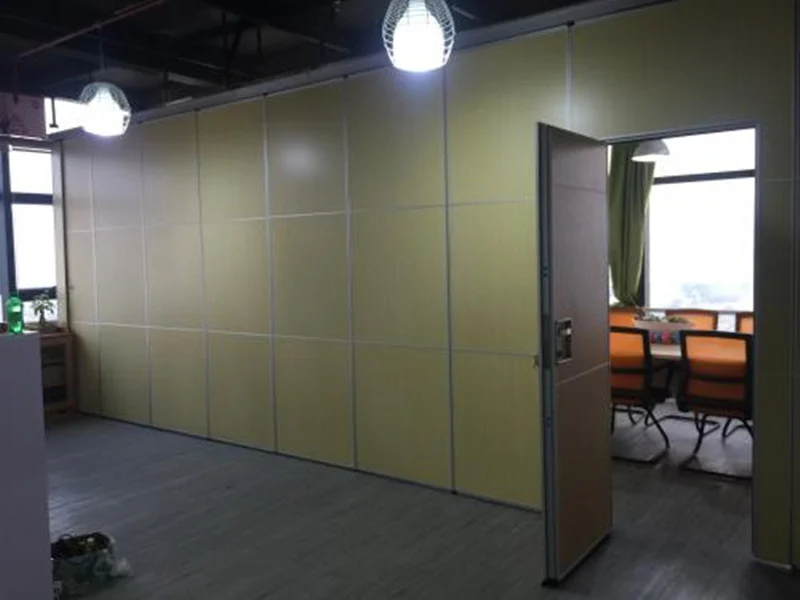
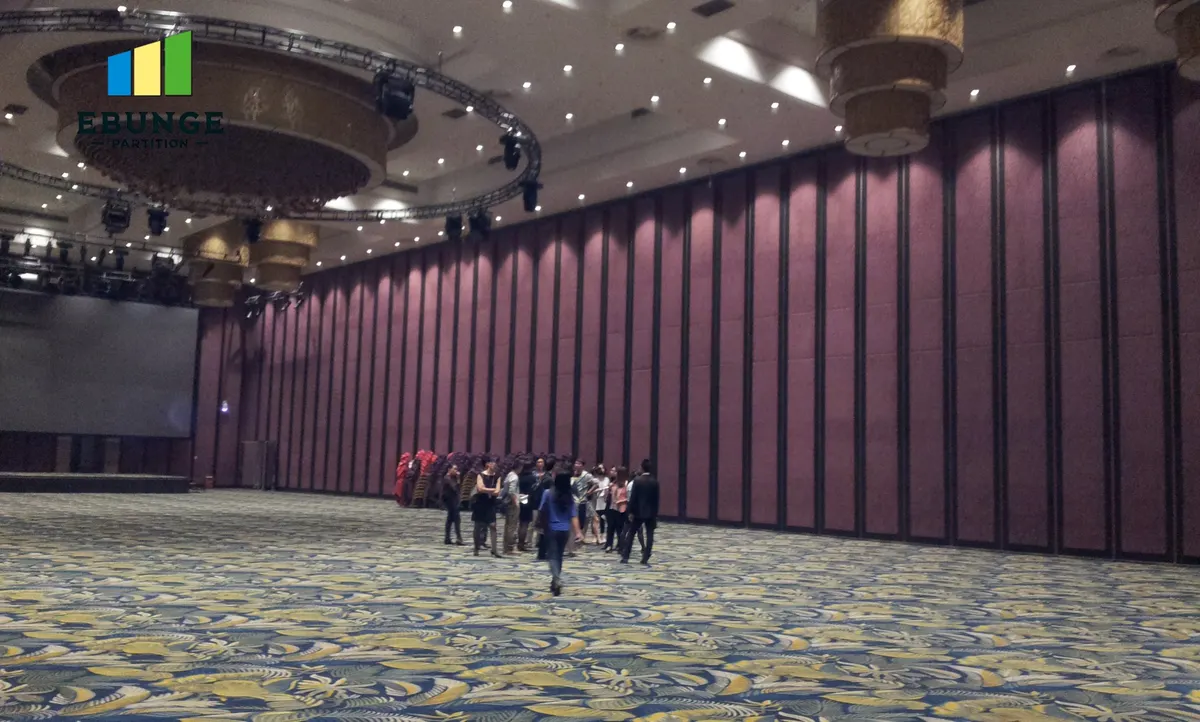
EBUNGE movable wall panels are individually movable and suspended from a top track. They cross the opening without a floor track and park at a planned stacking position. That clear-floor operation matters for changeover because furniture and equipment can move through the opening without a floor track to bridge.
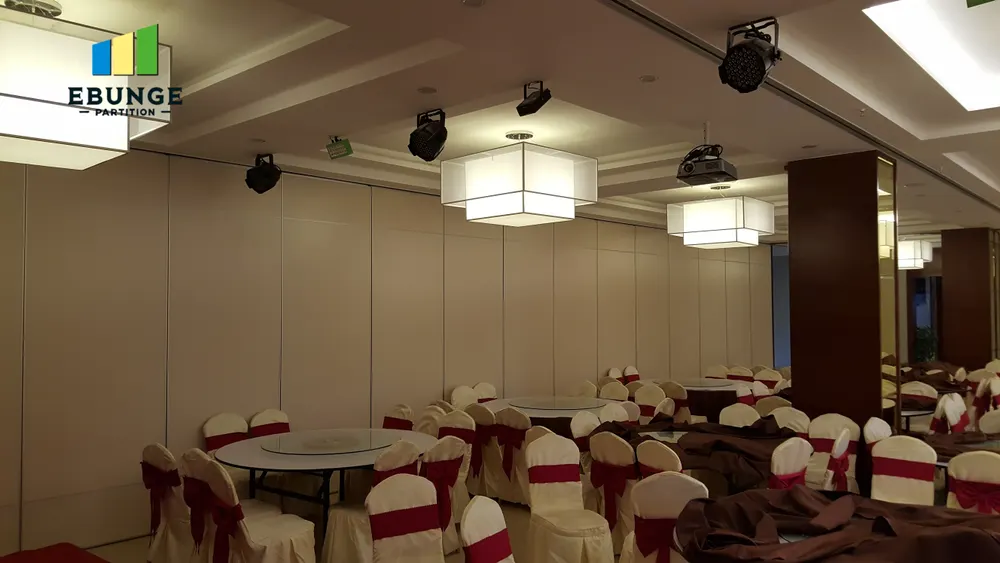
It does not, however, make changeover automatic. Straight, turning and stacking routes are reviewed from the layout. A route that looks short on a plan may pass through a circulation zone or conflict with a stacking position. Every proposed movement path requires a continuous connected overhead route and project-specific support review.
Questions to put to the project team
- Where is the planned stacking position, and does it obstruct any other use of the space?
- Does the route cross a doorway, corridor or service zone used during changeover?
- Are pass-door requirements defined for the way the room will actually be used?
- Has the structural support for the top track been reviewed for this specific layout?
- Which finish option has been approved, and does it affect handling or cleaning instructions?
Confirmed finish options include laminate, melamine, fabric, leather, glass and other approved surfaces. Review the movable wall product range for maintained product context before specifying.
Where Evidence Ends and Assumptions Begin
Evidence note: A drawing, photograph or finish sample does not demonstrate acoustic performance, structural capacity, fire behaviour, durability or maintenance outcomes. Those require matching project-specific evidence. Acoustic ratings such as STC or Rw are single-number descriptors used in testing and specification; they are not a count of decibels and should not be presented as a guarantee of soundproofing in a furnished, occupied room.
Seals and acoustic concepts can be explained generically, but their behaviour depends on the complete assembly, the surrounding construction and how the room is used. Ask for the documentation that applies to your project rather than transferring a figure from another scheme.
Writing the Policy So It Survives Pressure
A policy is only useful if it answers the awkward questions in advance. Who may shorten a buffer? What happens when a booking overruns? Who absorbs the cost of a delayed start? Put these answers in writing and reference them in hire agreements.
Keep the policy short enough to be read. One page covering ownership, task list, buffer duration, exception route and completion check is usually more effective than a long document nobody opens. The EBUNGE resources library offers general planning context, while project-specific requirements still need confirmation.
Coordinating across design and operations
Design teams should hand over the partition layout, stacking position and route review to operations before the room opens. Operations should then feed back real changeover experience so the specification and the policy stay aligned.
Frequently Asked Questions
Who should own the changeover buffer in a shared venue?
Assign a role rather than a person. Many venues give ownership to operations, with the booking desk enforcing the protected window. The essential point is that one named role is accountable and the rule is written into the scheduling policy.
Can the buffer be shortened when bookings overlap?
Only through a defined exception route with named approval. Shortening a buffer without checking the task list and partition route transfers risk to the next booking and to the operations team.
Does a floor-track-free partition reduce changeover work?
EBUNGE panels are top-hung and cross the opening without a floor track, so there is no continuous floor running track along the partition line to manage. The actual changeover still depends on the layout, stacking position and agreed task list, which require project-specific review.
How is the buffer duration decided?
From the task list, the room’s start and end states, and a project-specific assessment by the operating team. No generic duration should be assumed without that review.
What documentation should be requested?
Request the layout drawings showing routes and stacking, the approved finish schedule, and the project-specific support and acoustic documentation relevant to your scheme. Confirm what is available for your project rather than relying on examples.
Can pass doors be included?
Pass-door requirements can be discussed as part of the project review. Confirm the arrangement against the layout and the way the room will be used.
Conclusion
Panel handling and the operating sequence must be confirmed for the selected layout and project conditions. Decide who owns the buffer, define what the room must look like at each end of it, and test the schedule against the real partition route and stacking position. Keep performance statements tied to project-specific evidence, and confirm acoustic, dimensional and support requirements with the project team before committing to a specification.
To discuss pass-door requirements, layout review or project documentation for a movable partition scheme, contact the EBUNGE team with your drawings and room schedule.