
Quick answer: stair head circulation review
Review focus: stair head circulation review.
A stacking pocket stair head circulation review is a drawing-stage exercise: it checks how a top-hung movable partition travels, turns and parks when the parking position sits close to a stair head. Because EBUNGE movable panels are individually movable, suspended from a top track and cross the opening without a floor track, the review focuses on the overhead route, the stacking zone and the clear space people use to reach the stairs. This article sets out a coordination framework; it does not replace project-specific support, acoustic and dimensional confirmation.
Why the Stair Head Changes the Review
Project review term: stair head circulation review.
A stair head is a transition point. People arrive, turn and continue, often while carrying items or moving in groups. When a stacking pocket is planned nearby, the partition’s parked position and the route to it share that same zone. The review therefore asks two questions at once: can the panels reach the pocket along a continuous connected overhead route, and does the pocket leave the stair approach usable for the building’s occupants?
This is a coordination question, not a performance claim. The suitability of each route and parking arrangement depends on the approved layout, circulation, ceiling interfaces and operating sequence. Those items require matching project evidence and confirmation with the responsible parties.
What the Maintained Product Facts Allow Us to Say
Coordination scope: stair head circulation review.
EBUNGE movable wall panels are individually movable and suspended from a top track. They cross the opening without a floor track, so the partition line itself does not introduce a continuous floor running track or floor hardware. Panels park at a planned stacking position. Straight, turning and stacking routes are reviewed from the layout, and parking style is customized to the customer layout and project requirements, which may support compact stacking when the coordinated design permits it.
Finish options include laminate, melamine, fabric, leather, glass and other approved surfaces. Pass-door requirements and project documentation can be discussed. Everything beyond these maintained facts — support points, loads, acoustic values, dimensions, installation sequence and commercial terms — needs its own project-specific confirmation.
A Step-by-Step Circulation Review Sequence
Checklist focus: stair head circulation review.
- Mark the stair head envelope. Draw the arrival area, turning zone and any door swings on the same plan as the partition line.
- Trace the full travel route. Follow the panels from the open position to the pocket, including every turn. Confirm the route is a continuous connected overhead path.
- Draw the parked footprint. Show the stacking position at full park, not just the open partition line.
- Check the approach to the stairs. Confirm the parked panels do not sit inside the route people use to reach or leave the stair.
- Coordinate adjacent elements. Review lighting, signage, handrails, finishes and services that share the stair head zone.
- Record open items. List every dimension, support condition and acoustic question that still needs project-specific confirmation.
Overhead Route and Support Coordination
Review focus: stair head circulation review.
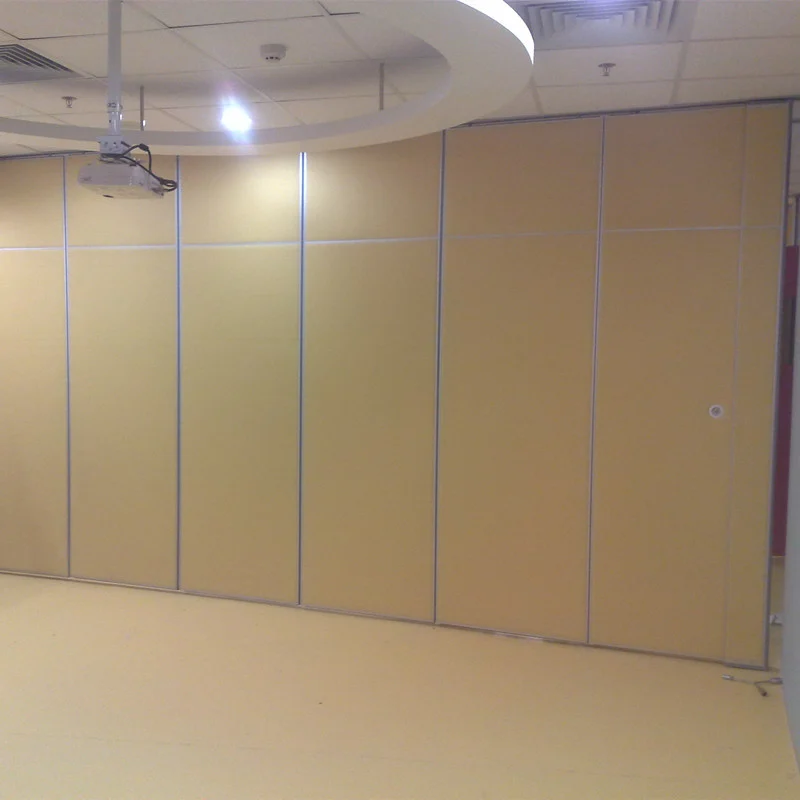
The top track is the defining element of this system. Because panels hang from it, the route must be continuous and connected wherever panels are expected to travel. A gap in the overhead route is not a travel path.
This is where the review becomes a coordination document rather than a single drawing. The circulation review should identify where those responsibilities meet, and which items remain open until the relevant party confirms them.
Evidence note: what a drawing can and cannot show
A plan can show a proposed route, a pocket location and a clear floor area. It cannot confirm structural capacity, acoustic performance, fire behaviour, durability or dimensional fit. Those conclusions require matching project evidence, not inference from a visible shape or finish.
Parking Geometry at a Stair Head
Project review term: stair head circulation review.
Parking style is customized to the layout. Near a stair head, the practical question is how the parked panels occupy space relative to the stair approach. A compact stacking arrangement may be possible when the coordinated design permits it, but compactness is a design outcome, not a default. The review should test the parked condition against the same clear-space expectations used elsewhere in the building.
If the pocket is recessed, the recess depth and the surrounding wall build-up both matter. If the pocket is surface-mounted, the parked panels project into the room. Either way, the drawing should show the parked condition clearly enough for other disciplines to coordinate their work.
Comparison: Open, Travelling and Parked Conditions
| Condition | What to review | Evidence needed |
|---|---|---|
| Open | Clear opening width, pass-door position, adjacent door swings | Project dimensions and layout confirmation |
| Travelling | Continuous connected overhead route, turns, obstructions | Coordinated track route and support review |
| Parked | Stacking footprint, stair approach clearance, finish protection | Parked-position drawing and project-specific confirmation |

Acoustic Concepts Without Invented Numbers
A stair head can be an acoustically sensitive location because sound may travel through the stairwell and adjacent openings.
For this reason, acoustic expectations should be stated as project requirements and confirmed against the specific assembly, seals and interface details proposed. This article does not assign any rating to any configuration. Confirm acoustic requirements with the responsible acoustic consultant and the partition supplier before finalising drawings.
Finish and Interface Checks Near a Stair Head
Confirmed finish options include laminate, melamine, fabric, leather, glass and other approved surfaces. Near a stair head, finishes meet handrails, wall protection, signage and lighting. The review should note where the partition finish transitions to adjacent surfaces and whether the parked panels sit against a finish that needs protection during movement.
Those attributes require separate confirmation. Treat the finish schedule as a visual and coordination document, and keep performance questions in their own evidence track.
Documentation to Bring to the Review
- Floor plans showing the stair head, partition line and proposed pocket.
- Reflected ceiling plans and service routes crossing the travel path.
- Elevations or sections at the pocket and stair approach.
- Pass-door requirements and expected use patterns.
- Open-item list with named responsible parties.
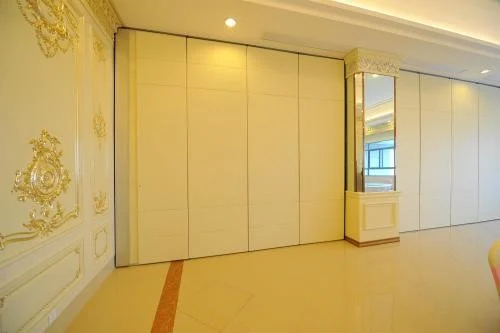
Project documentation can be discussed with the supplier so that the review is based on the actual layout rather than assumptions. See the movable walls product page and the resources section for maintained product context.
Frequently Asked Questions
Can a stacking pocket be placed directly at a stair head?
It can be considered, but the layout must be reviewed as a whole. The parked panels, the stair approach and the overhead route all share the same zone, so the design needs project-specific confirmation of dimensions, support and clear space.
Do movable partitions need a floor track to reach the pocket?
No. EBUNGE movable panels are top-hung and cross the opening without a floor track. The travel route is defined by a continuous connected overhead track, and the route is reviewed from the layout.
How is the stacking position decided?
Parking style is customized to the customer layout and project requirements. The review should show the parked footprint and confirm that it works with the stair head and adjacent spaces.
Can you confirm acoustic performance for this condition?
No rating is assigned here.
What finishes are available?
Confirmed options include laminate, melamine, fabric, leather, glass and other approved surfaces.
What should be confirmed before drawings are issued?
Confirm support conditions, track route continuity, parked dimensions, pass-door requirements and acoustic criteria with the responsible parties. Keep every open item documented until it is resolved.
Conclusion and Next Step
A stacking pocket stair head circulation review succeeds when it separates what is known from what still needs confirmation. The maintained facts are clear: panels are individually movable, top-hung, floor-track-free along the partition line, and parked at a planned stacking position. The rest — support, acoustics, dimensions and interfaces — belongs to project-specific review.
Bring your layout, ceiling plans and open questions to the team. Contact EBUNGE to discuss pass-door requirements, project documentation and the coordination items that need confirmation before your drawings are finalised.