
Quick answer: movable partition handover file track serviceability proof
Review focus: movable partition handover file track serviceability proof.
A movable partition handover file track serviceability proof is often requested at project closeout, yet the phrase can mean different things to a contractor, an architect and a facilities team. The file is a record of what was installed and reviewed. It is not a substitute for project-specific engineering confirmation. This article explains what a handover file can reasonably document about a top-hung track, where its evidence limits sit, and which questions should be answered from the coordinated drawings rather than assumed from a folder.
What the handover file is meant to record
Project review term: movable partition handover file track serviceability proof.
A handover file is a project record. For a top-hung movable partition, it should describe the installed configuration: the overhead route, the parking position, the panel finish selected, and the pass-door arrangement if one is included. It can also log the documents exchanged between the supplier, the installer and the project team.
The file does not create performance. It records what was agreed and what was installed. The exact route, junction arrangement, continuous overhead path and parking position must be confirmed from the coordinated project drawings. It cannot turn an unverified route into a confirmed one.
Why track serviceability is a project-specific question
Coordination scope: movable partition handover file track serviceability proof.
Serviceability is not a single property that a document can declare in isolation. It depends on how the overhead route is supported, how the panels travel, and how the parking position is coordinated with the surrounding structure. These are project-specific conditions.
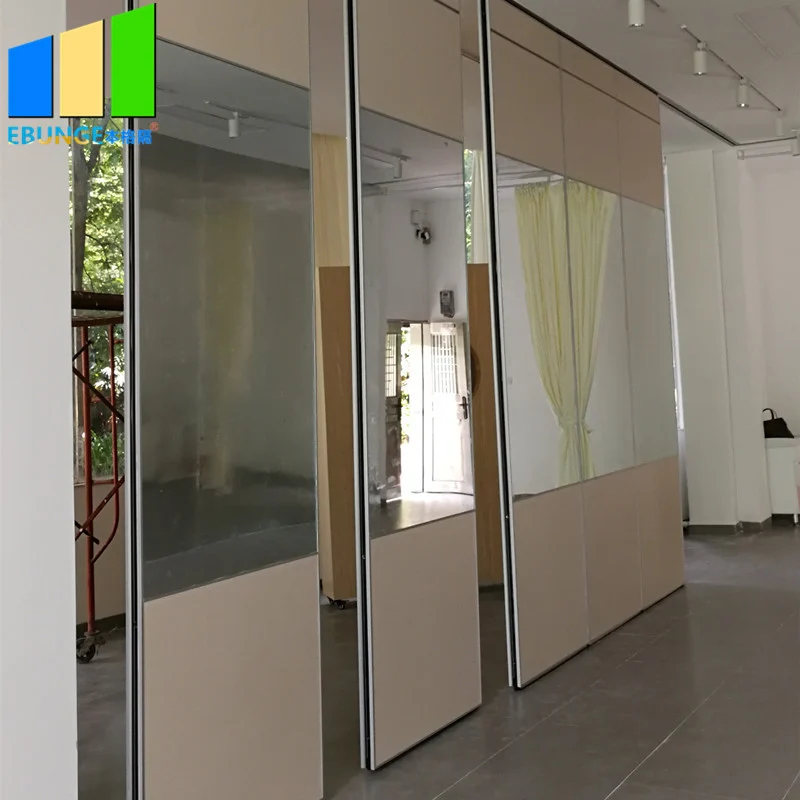
EBUNGE movable partition panels are individually movable, suspended from a top track, cross the opening without a floor track, and park at a planned stacking position. That is the maintained product context. Whether a particular route is serviceable for a given opening still requires review of the layout, the support conditions and the dimensional coordination.
What the file can show
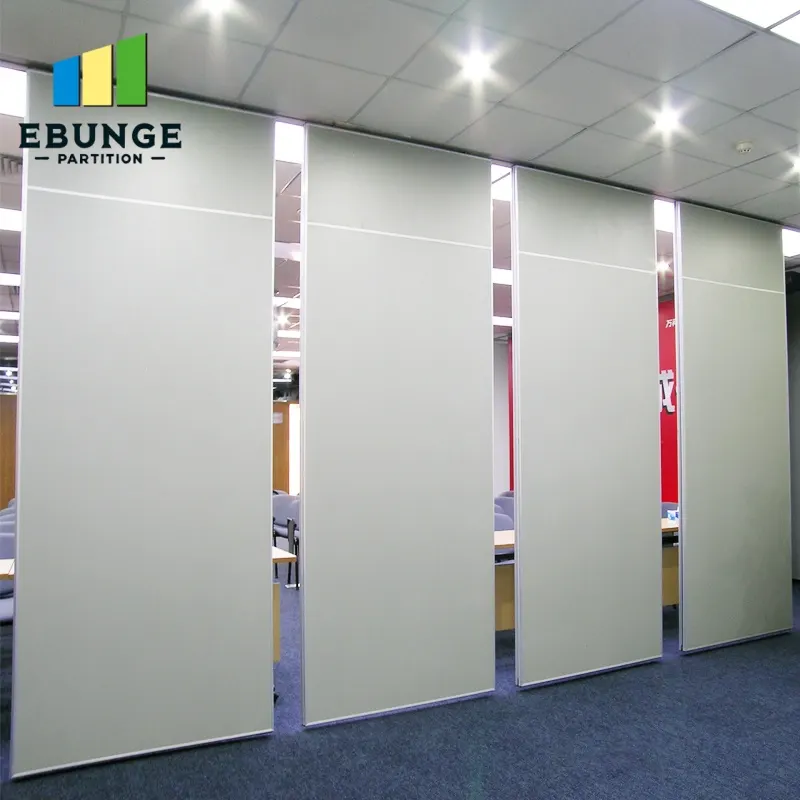
- The installed overhead route as drawn, including straight, turning and stacking paths.
- The parking position selected for the project layout.
- The finish option recorded for the panels, such as laminate, melamine, fabric, leather, glass or another approved surface.
- Whether a pass-door requirement was discussed and documented.
- The document set exchanged during handover.
What the file cannot prove on its own
- The suitability of each route and parking arrangement depends on the approved layout, circulation, ceiling interfaces and operating sequence.
- That the route remains serviceable after later building modifications.
- That a finish is suitable for a specific cleaning or maintenance regime.
- That any performance figure applies beyond the tested or specified configuration.
A practical handover checklist for track documentation
Checklist focus: movable partition handover file track serviceability proof.
Use this checklist to separate what is documented from what still needs confirmation. It is a coordination aid, not a certification.
- Confirm the overhead route drawing matches the installed condition.
- Confirm the parking position is shown and coordinated with adjacent trades.
- Confirm the panel finish schedule matches the approved selection.
- Confirm any pass-door requirement is recorded.
- Confirm acoustic requirements are stated as project criteria, not inferred from the file.
- Confirm dimensional tolerances are recorded for the opening and the track line.
How to read acoustic statements in a handover file
Review focus: movable partition handover file track serviceability proof.
A handover file may reference an acoustic requirement, but the file itself does not prove that the installed assembly achieves it.
If acoustic separation matters for the room, treat it as a project-specific confirmation item. The responsible acoustic consultant or project engineer should confirm the requirement against the actual configuration, including the track interface and the surrounding construction.

Evidence boundaries that protect the project team
An evidence-bounded handover file is more useful than an overreaching one. It states what was installed, what was reviewed, and what remains subject to project-specific confirmation.
Evidence note: a handover file documents the installed condition and the exchanged documents. It does not independently prove structural capacity, acoustic performance, durability or long-term serviceability. Those require matching project evidence.
Coordination questions for contractors and designers
Before treating a handover file as complete, the project team should agree on who confirms each item. The supplier can document the product configuration. The installer can document the installed route. The acoustic consultant confirms acoustic criteria.
This division of responsibility is not a formality. For broader planning context, see the EBUNGE resources and the movable walls product page.
Frequently asked questions
Does a handover file prove the track is serviceable?
It documents the installed route and the exchanged documents. Those require project-specific confirmation.
Can the file confirm acoustic performance?
No. The file may reference the requirement but does not prove the result.
What should be included for a turning or stacking route?
The coordinated layout should show the straight, turning and stacking paths, and the parking position. The handover file can reference these drawings, but the support and dimensional review remains project-specific.
Does the file need to list the panel finish?
It should record the approved finish selection, such as laminate, melamine, fabric, leather, glass or another approved surface.
Who confirms the support structure?
The handover file can record that the review was requested or completed, but it does not replace that review.
Can a pass-door requirement be documented?
Yes. Pass-door requirements and project documentation can be discussed with the supplier and recorded in the handover set. The specific arrangement still requires project coordination.
Conclusion and next step
A movable partition handover file is a record, not a guarantee. It can show the installed overhead route, the parking position, the finish selection and the documents exchanged. It cannot replace project-specific confirmation of support, acoustics or dimensional fit. Treat the file as one part of a coordinated evidence set.
If your project requires a clear handover record for a top-hung movable partition, contact EBUNGE to discuss your layout, pass-door requirements and documentation needs. Confirm all project-specific support, acoustic and dimensional requirements with the responsible parties before finalizing the handover file.