
Quick project answer
Review focus: track fixing sequence.
In a movable wall package, the bidder track fixing sequence programme risk partition tender review is often treated as a technical formality. That is a mistake. The sequence a bidder proposes for setting out, supporting and connecting the overhead route tells you how that bidder understands the building, the ceiling zone and the order in which other trades must finish. It also reveals where programme risk is hiding, because a top-hung partition depends on a continuous, supported overhead route rather than a floor track. If the sequence ignores that dependency, the tender may look complete while the installation logic is not.
This article is an evidence-bounded framework for contractors, architects, interior designers, owners and renovation teams comparing bids. The suitability of each route and parking arrangement depends on the approved layout, circulation, ceiling interfaces and operating sequence.
Why the Track Fixing Sequence Is a Programme Document
Project review term: track fixing sequence.
A track fixing sequence describes the order of operations that must happen before panels can be hung and moved. Each of those steps belongs to another trade or another approval. When a bidder compresses them into one line, the reviewer cannot see which predecessor must finish first.
Programme risk appears when the sequence is logically impossible or silently assumes that earlier work is complete. A bidder who writes ‘install track, hang panels’ without explaining how the overhead route is verified is not necessarily wrong, but the tender gives you nothing to coordinate against. The gap becomes a site problem later.
What the sequence should connect to
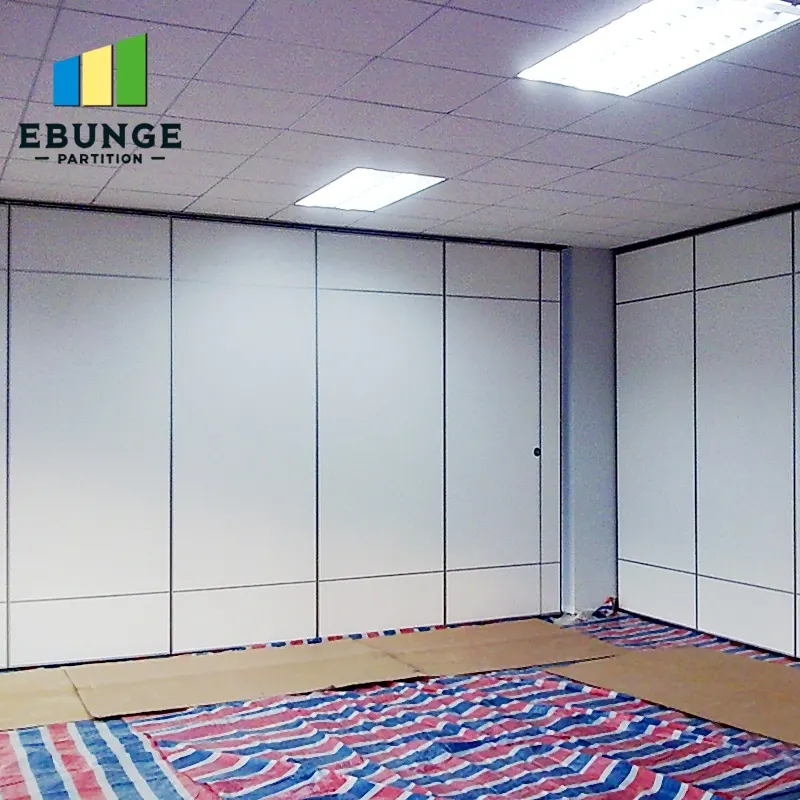
At minimum, the sequence should reference the approved layout, the planned stacking position and the movement route. EBUNGE movable partitions are individually movable, suspended from a top track, cross the opening without a floor track and park at a planned stacking position. Straight, turning and stacking routes are reviewed from the layout. A bidder’s sequence should show awareness of those route decisions rather than treating the track as a single straight line.
Reading the Sequence Against the Drawing Set
Coordination scope: track fixing sequence.
Compare the written sequence with the drawings the bidder priced. Look for the overhead route, the parking zone and the relationship between the partition line and adjacent finishes. The exact route, junction arrangement, continuous overhead path and parking position must be confirmed from the coordinated project drawings. That disagreement is a programme risk because someone must resolve it before fabrication or installation planning can proceed.
A compact comparison for reviewers
| Sequence signal | What it suggests | Reviewer action |
|---|---|---|
| Names the overhead route and parking zone | Bidder read the layout | Confirm route continuity and support review |
| Lists predecessors and handover points | Bidder sees trade dependencies | Check dates against the main programme |
| Treats track as a single activity | Coordination may be underdeveloped | Request a step-by-step sequence |
| Omits stacking position | Parking may be unresolved | Ask for the planned stacking location |
The table is a prompt, not a scoring system. What matters is whether the tender documents together give a coherent picture.
Evidence Limits: What a Sequence Cannot Prove
Checklist focus: track fixing sequence.
Those require project-specific confirmation against the actual support conditions, ceiling zone and opening. Do not infer hidden performance from a clean-looking sequence or a finish sample.
If acoustic separation matters, ask how it will be confirmed for the specific opening, seal condition and support arrangement.
Evidence note for tender reviewers
Treat every sequence statement as a claim about coordination, not as proof of engineering outcome. Where the bidder asserts a result, ask for the matching project-specific confirmation. Where the bidder stays silent, record the silence as an open item rather than filling it with an assumption.
Questions That Expose Programme Risk Early
Use a short question set in clarification rather than a long narrative. The goal is to make the bidder’s assumptions visible while there is still time to adjust the programme.
- Which drawing defines the overhead route, and does it show every turn and the parking zone?
- Which predecessor activity must finish before track setting-out can begin?
- How will the support condition be confirmed, and by whom?
- Where is the planned stacking position, and does it conflict with other trades?
- What pass-door requirements apply, and how are they reflected in the sequence?
- Which project documentation will be issued for review before installation planning?
Pass-door requirements and project documentation can be discussed with the supplier as part of tender clarification. The answers should be traceable to drawings or written confirmations, not verbal assurances.
Coordination Signals in a Strong Bid
A strong bid does not need to be long. It needs to show that the bidder understands the order of work and the limits of its own scope. Look for a sequence that separates setting-out, support readiness, track installation, panel hanging and final movement checks. Look for a parking plan that matches the layout. Look for a clear statement of what the bidder needs from others.
Weak signals include a sequence that assumes a finished ceiling before support is verified, a parking zone that appears only in a note, or a route that stops at a wall without explanation. These are coordination gaps, not necessarily disqualifying errors, but they should be priced and programmed as risks.
Checklist before award
- Sequence matches the approved layout and route.
- Parking position is stated and coordinated.
- Support confirmation is assigned to a responsible party.
- Predecessor activities and handover points are listed.
- Pass-door and documentation requirements are addressed.
- Open items are recorded for project-specific confirmation.
How to Use This in the Tender Evaluation
Score the sequence as part of coordination maturity, not as a standalone technical test. That difference often matters more than a polished narrative.
Keep the review proportionate. Confirm project-specific support, acoustic and dimensional requirements before relying on any sequence. Where the tender is silent, issue a clarification and record the response.
FAQ
What is a track fixing sequence in a movable partition tender?
It is the bidder’s proposed order of operations for setting out, supporting and connecting the overhead route before panels are hung and moved. It should connect to the layout, parking position and trade handover points.
Why does the sequence reveal programme risk?
Because it shows which predecessor activities the bidder assumes are complete. If those assumptions are not stated or coordinated, the installation logic may not survive contact with the main programme.
Does a detailed sequence prove acoustic or structural performance?
No. A sequence is a coordination document.
How should reviewers treat a short sequence?
Check whether the drawings and clarifications carry the missing detail. A short sequence is acceptable if the combined documents give a coherent, traceable picture of route, support and parking.
What should be confirmed before award?
Confirm project-specific support, acoustic and dimensional requirements, the planned stacking position, pass-door needs and the documentation to be issued for review. Record any open item rather than assuming a result.
Can EBUNGE help review a bidder’s sequence?
Project documentation and pass-door requirements can be discussed. Use the contact page to raise specific drawing questions, and review the operable wall partition range alongside the resources for general planning context.
Conclusion
A bidder’s track fixing sequence is a window into how that bidder will coordinate with the rest of the project. Read it against the drawings, test its assumptions, and record what remains unconfirmed. That discipline reduces programme risk without inventing performance claims the documents cannot support.
For project-specific support, acoustic and dimensional confirmation, speak with the EBUNGE team through the contact page and share the relevant layout and tender documents for review.