
Quick project answer
Review focus: end corridor circulation review.
A stacking pocket dead-end corridor circulation review asks one deceptively simple question: when panels leave the opening, where do they go, and what happens to the corridor while they are moving? The answer is not a product specification. It is a drawing-coordination exercise that connects the partition layout, the parking position, the overhead route and the people who use the corridor every day. This article gives project teams a structured way to run that review without inventing performance, engineering or commercial conclusions.
EBUNGE movable wall panels are individually movable, suspended from a top track, cross the opening without a floor track, and park at a planned stacking position. Those maintained facts are the starting point. The exact route, junction arrangement, continuous overhead path and parking position must be confirmed from the coordinated project drawings.
Why a Dead-End Location Changes the Review
Project review term: end corridor circulation review.
A stacking pocket at a dead-end corridor is not automatically a problem. It becomes a coordination issue because the corridor may serve two roles at once: everyday circulation and temporary staging space while panels move. When the pocket sits at the end of a run, the review must consider how panels travel to that point, how they accumulate there, and whether the remaining corridor width still supports the intended use.
The review is about sequence and space, not about a single product attribute. A layout that works when panels are parked may behave differently during the minutes when they are in motion. That is why the stacking pocket dead-end corridor circulation review should be treated as a project-planning activity, not a catalogue selection.
What the maintained product facts allow us to say
We can state that panels are top-hung, move without a continuous floor running track along the partition line, and park at a planned stacking position. We cannot state how much corridor width remains, how many panels fit a pocket, or how long a movement takes unless the project provides matching evidence. Those are project-specific confirmations.
Route Logic: Straight, Turning and Stacking
Coordination scope: end corridor circulation review.
Every proposed movement path needs a continuous connected overhead route. The review therefore separates the route into three parts and checks each one against the layout.
- Straight run: the path from the closed position to the first change of direction. Confirm the overhead route is continuous and supported per project requirements.
- Confirm the geometry is reviewed on the drawings, not assumed from a similar project.
- Stacking route: the final approach into the parking position. Confirm the pocket location, approach direction and adjacent obstructions are coordinated with the architectural layout.
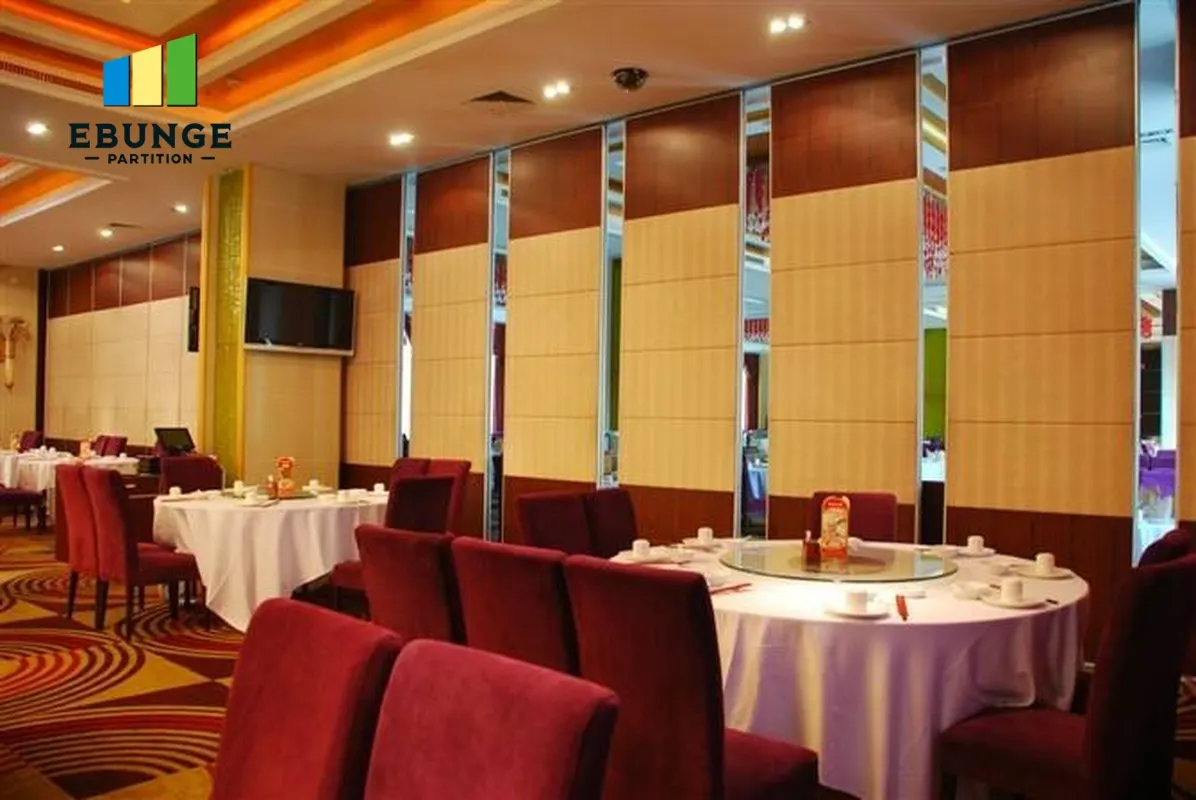
This three-part split keeps the conversation concrete. It also prevents a common error: treating a parking position as a destination without reviewing how panels get there.
Drawing Checks Before the Review Meeting
Checklist focus: end corridor circulation review.
Good circulation reviews fail when the drawings are incomplete. Before the meeting, collect the reflected ceiling plan, the partition layout, the corridor widths and the intended stacking position. Mark the overhead route on the plan and note where it crosses other services.
| Drawing item | What to confirm | Evidence boundary |
|---|---|---|
| Overhead route | Continuous connected path from opening to pocket | Support and fixing details require project-specific review |
| Stacking pocket | Location, approach direction and adjacent clearances | Pocket dimensions and capacity require project confirmation |
| Corridor use | Everyday circulation and temporary staging during movement | Remaining width and accessibility require local code review |
| Finish selection | Laminate, melamine, fabric, leather, glass or other approved surfaces | Finish choice does not prove acoustic or structural performance |
Use this table as a checklist, not as a compliance certificate. Each row ends with a confirmation boundary because the drawings, not the article, carry the project evidence.
Accessibility and Circulation Review Coordination
Accessibility and Circulation Review coordination brings together the people who own different parts of the problem: the architect who sets the corridor, the contractor who installs the overhead route, the owner who operates the space, and the team responsible for daily use. The review should agree on what happens during movement, not only what the space looks like when panels are parked.
Questions that expose hidden assumptions
- Does the corridor remain usable while panels are moving, or is temporary closure acceptable?
- Is the stacking pocket visible from the corridor, or does it sit behind a return?
- Are there doors, services or equipment near the pocket that could conflict with the approach?
- Has the project team confirmed support, acoustic and dimensional requirements with the relevant specialists?
These questions do not produce performance claims. They produce a list of items that must be confirmed before the layout is fixed.
Evidence Boundaries for the Specification
A stacking pocket dead-end corridor circulation review specification should separate maintained facts from project-specific requirements. Maintained facts include top-hung movement, no continuous floor track along the partition line, and parking at a planned stacking position. Project-specific requirements include support, acoustics, dimensions, clearances and route geometry.
If a statement depends on the building, the structure, the local code or the intended use, it belongs in the project documentation — not in a generic product description.
The suitability of each route and parking arrangement depends on the approved layout, circulation, ceiling interfaces and operating sequence. Where acoustic separation matters, confirm the requirement with the project team and the relevant specialists.
Pass-Doors, Documentation and Handover
Pass-door requirements and project documentation can be discussed as part of the layout review. A pass-door changes how people move through the partition line, so it belongs in the same circulation conversation as the stacking pocket. Document the agreed route, the parking position and the confirmation boundaries so that installation and operation teams work from the same understanding.
For product context, see the movable walls page. For broader planning material, see the resources page. When the drawing set is ready, contact the team to discuss project-specific support, acoustic and dimensional requirements.
FAQ: Stacking Pocket Dead-End Corridor Circulation Review
What is a stacking pocket dead-end corridor circulation review?
It is a drawing-based review of how movable panels travel from the opening to a parking position at the end of a corridor, and how that movement affects everyday circulation. It coordinates layout, route and project requirements without assuming performance.
Can panels cross a gap in the overhead route?
No. Every proposed movement path requires a continuous connected overhead route. If the route is interrupted, the layout must be reviewed and the project team must confirm the correct solution.
Does a dead-end location always require a different partition?
Not necessarily. The location changes the review, not automatically the product. The project team should confirm support, acoustic and dimensional requirements against the specific drawings.
Which finish options can be considered?
Confirmed finish options include laminate, melamine, fabric, leather, glass and other approved surfaces.
How should STC or Rw be used in this review?
Provide the current layout, opening dimensions, ceiling information, intended room use, and relevant project drawings for review. The exact overhead route and support arrangement must be confirmed by the responsible project team from coordinated drawings.
What should be confirmed before fixing the layout?
Confirm the overhead route, the stacking position, corridor use during movement, pass-door requirements and all project-specific support, acoustic and dimensional requirements with the relevant specialists.
Conclusion: Review the Route, Confirm the Project
A stacking pocket at a dead-end corridor is manageable when the review starts early and stays evidence-bounded. Separate maintained product facts from project-specific requirements, check the straight, turning and stacking routes on the drawings, and agree how the corridor behaves while panels move. Do not infer support, acoustic or dimensional outcomes from a finish, a photograph or a similar project.
When your drawing set is ready, contact EBUNGE to discuss pass-door requirements, project documentation and the specific support, acoustic and dimensional confirmations your project needs.