
Quick project answer
For a contractor track fixing sequence ceiling grid release, the critical question is not simply when to drill or anchor. It is how the overhead route, ceiling grid release, and movable partition parking position are coordinated before any fixing begins. EBUNGE movable wall panels are individually movable, suspended from a top track, cross the opening without a floor track, and park at a planned stacking position. The exact overhead route and support arrangement must be confirmed by the responsible project team from coordinated drawings.
This article gives project teams an evidence-bounded framework. The suitability of each route and parking arrangement depends on the approved layout, circulation, ceiling interfaces and operating sequence. Every project still needs its own drawings, support verification, and written confirmation of interface responsibilities.
Why the ceiling grid release point controls the sequence
A ceiling grid release is the planned interruption or transition in the ceiling system where the partition route passes. If the grid is installed before the track route is agreed, the release point may be in the wrong place, too narrow, or incompatible with the parking position. The contractor track fixing sequence should therefore start with the layout, not with the anchor.
EBUNGE straight, turning, and stacking routes are reviewed from the layout. That review is the first control point. It tells the team where the track must run, where panels will park, and where the ceiling grid must release to avoid conflict.
What to confirm before fixing
- Approved layout showing straight, turning, and stacking routes.
- Ceiling grid release location and its relationship to the track line.
- Parking position and whether it is inside or outside the room being divided.
- Interface responsibility between ceiling, track, and partition trades.
- Written confirmation of support and dimensional requirements for the project.
Sequence the work in four coordination stages
Sequencing is a coordination tool. It prevents one trade from closing access that another trade still needs. The following stages are generic planning steps, not a substitute for project-specific engineering.
- Layout freeze. Confirm the movable wall route, parking position, and ceiling grid release on the same coordinated drawing.
- Support review. Verify that the overhead support condition is suitable for the track and its intended use. This review is project-specific and must be confirmed by the responsible parties.
- Release and rough-in. Coordinate the ceiling grid release so the track route remains continuous and accessible for fixing.
- Track fixing and verification. Install and verify the track before ceiling closure limits access. Confirm that panels can travel the full route and park as planned.
Keep the overhead route continuous
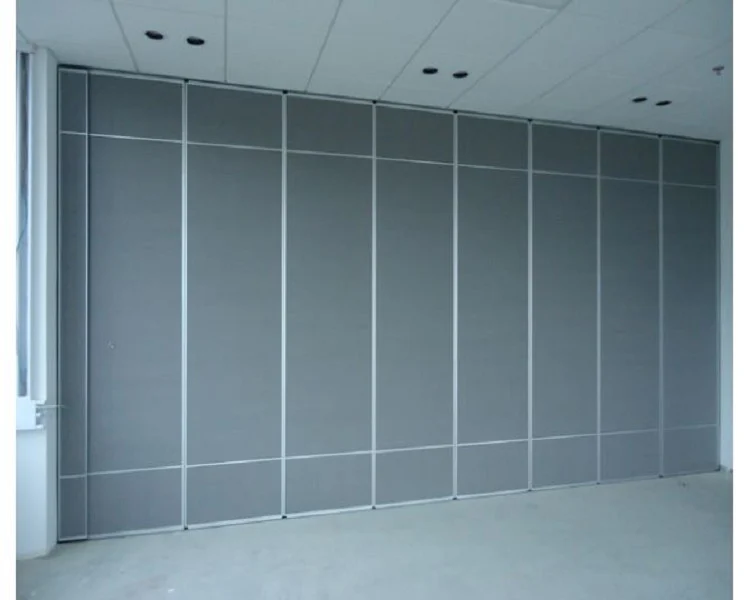
Movable partitions are top-hung and move without a continuous floor running track or floor hardware along the partition line. That does not mean the overhead route can be discontinuous. Every proposed movement path requires a continuous connected overhead route and project-specific support review. A gap in the track route is a functional break, not a design detail.
When the ceiling grid release is planned, the team should ask whether the release preserves that continuity. If the release interrupts the track line, the layout and ceiling coordination must be revisited before fixing.
Evidence note: what drawings can and cannot show
Drawings can show intended routes, release locations, and parking positions. They do not prove structural capacity, acoustic performance, fire performance, or completed installation quality. Those items require separate project-specific evidence and confirmation.
Coordinate ceiling grid release with other trades
Ceiling grid release rarely belongs to one trade alone. Mechanical, electrical, sprinkler, and ceiling contractors may all have work near the same zone. The track fixing sequence should be discussed in a coordination meeting where each trade can confirm access and sequence.
If the ceiling grid is released too early, the track may be fixed without a stable reference. If it is released too late, the track route may be blocked. The contractor track fixing sequence ceiling grid release should therefore be a named item in the coordination plan, not an assumed outcome.
Compact comparison: early versus late release
| Release timing | Potential coordination effect | What to confirm |
|---|---|---|
| Release before track route is fixed | Track may lack a coordinated reference and ceiling closure may proceed without the partition interface | Layout freeze, support review, and interface responsibility |
| Release after track route is fixed | Track may be installed but ceiling access and release geometry may still conflict | Ceiling grid release location and access sequence |
| Release coordinated with track fixing | Route continuity and parking position can be reviewed together | Project-specific support, acoustic, and dimensional requirements |
Document assumptions before installation
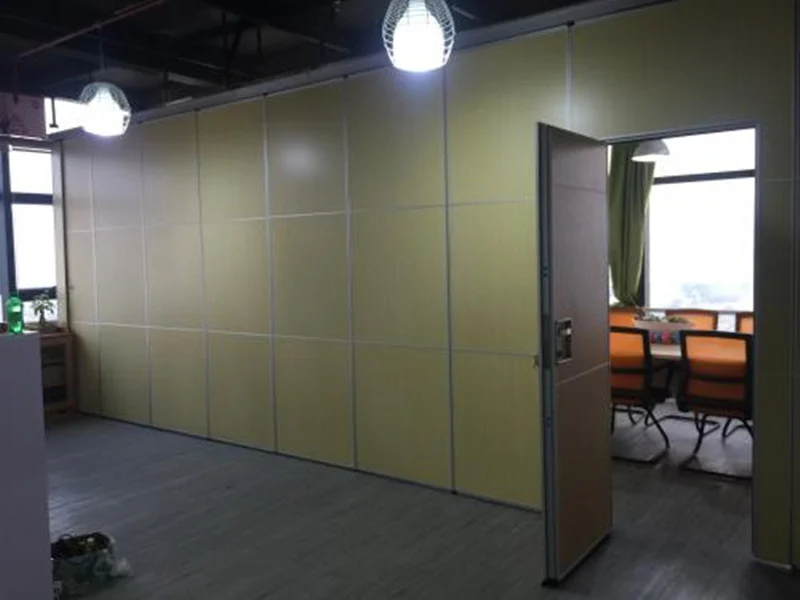
Good documentation protects every party. It records what was reviewed, what remains open, and who must confirm it. For movable partitions, useful documentation includes the approved layout, the parking position, the ceiling grid release detail, and the agreed sequence for track fixing.
Pass-door requirements and project documentation can be discussed with the supplier. Finish options include laminate, melamine, fabric, leather, glass, and other approved surfaces.
Decision checklist for the site team
- Has the layout been reviewed for straight, turning, and stacking routes?
- Is the ceiling grid release shown on the same coordinated drawing as the track?
- Has the support condition been confirmed by the responsible party?
- Is the parking position accessible and consistent with the layout?
- Are pass-door and finish requirements documented?
- Has the project confirmed its own acoustic and dimensional requirements?
Acoustic concepts: use them carefully
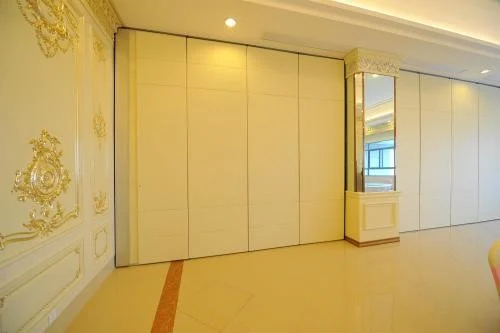
Visible references can support layout discussion but do not verify hidden construction or performance.
Frequently asked questions
What is the first step in the contractor track fixing sequence?
The first step is to freeze the layout, including the straight, turning, and stacking routes, and to show the ceiling grid release on the same coordinated drawing.
Can the track be fixed before the ceiling grid is released?
It can be considered, but the sequence must be reviewed against access, support, and release geometry. The project team should confirm the order in writing.
Do movable partitions need a floor track?
EBUNGE movable wall panels are top-hung and move without a continuous floor running track or floor hardware along the partition line.
How is the parking position decided?
Parking style is customized to the customer layout and project requirements and may support compact stacking when the coordinated design permits it.
What documentation should be reviewed before fixing?
Review the approved layout, ceiling grid release detail, support confirmation, parking position, and any pass-door or finish requirements. Project documentation can be discussed with the supplier.
Can acoustic performance be confirmed from the track sequence?
No.
Conclusion: sequence is a coordination discipline
The contractor track fixing sequence ceiling grid release is ultimately a coordination discipline. This approach keeps the overhead route continuous and the parking position workable without inventing performance claims.
To discuss movable wall layouts, finishes, pass-door requirements, or project documentation, contact EBUNGE. You can also review movable walls and the resources for further planning context.