
Quick answer: movable partition track envelope encroachment escalation ladder
Review focus: movable partition track envelope encroachment escalation ladder.
The movable partition track envelope encroachment escalation ladder is a coordination tool, not a construction shortcut. It helps a project team respond in a consistent order when ductwork, conduit or sprinkler runs are found inside the space reserved for the top track after ceiling services have already been routed. The ladder does not decide the outcome by itself. It structures the questions, the evidence and the escalation points so that rerouting services and adjusting the partition layout can be compared on the same basis.
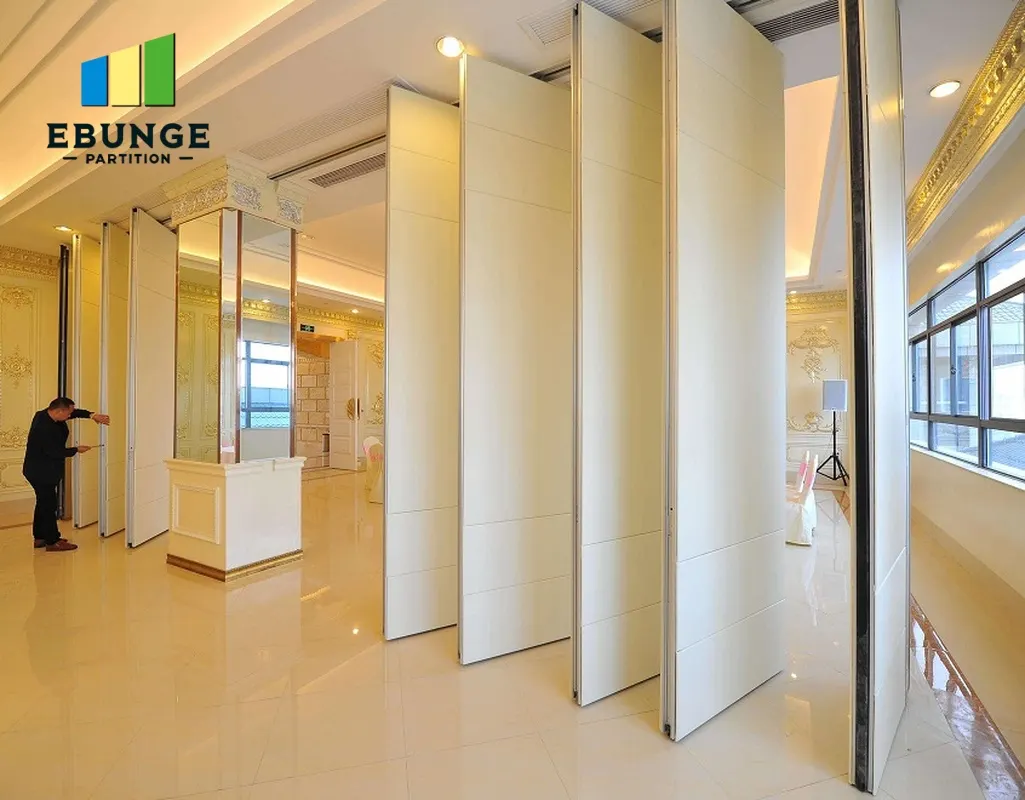
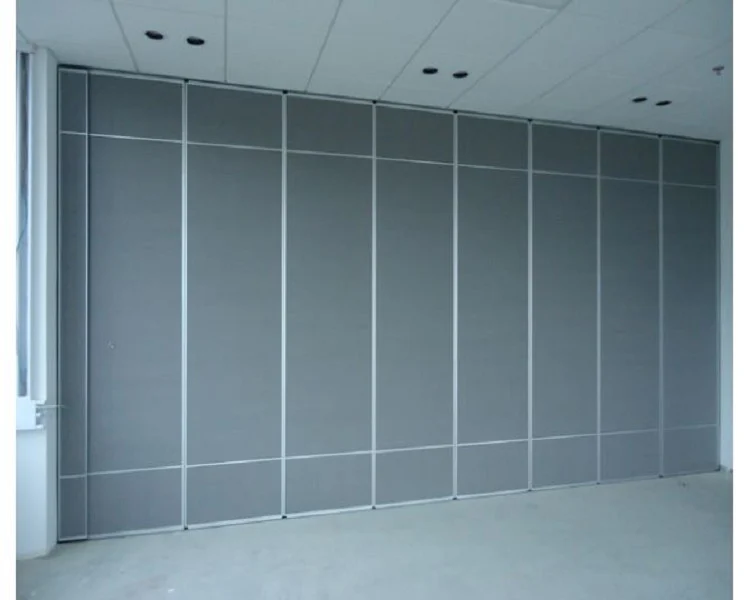
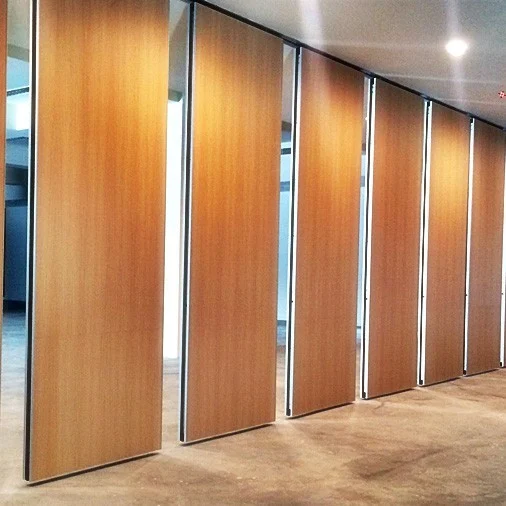
EBUNGE movable partition panels are individually movable, suspended from a top track, cross the opening without a floor track and park at a planned stacking position. Straight, turning and stacking routes are reviewed from the layout. That maintained product context is the starting point. The exact overhead route and support arrangement must be confirmed by the responsible project team from coordinated drawings.
Why the Track Envelope Is a Coordination Zone, Not a Line
Project review term: movable partition track envelope encroachment escalation ladder.
The track envelope is the volume around the top track that must remain available for the track, its suspension and the movement of panels. It is not a single line on a reflected ceiling plan.
Because panels are top-hung and cross the opening without a floor track, the overhead route must be continuous and supported. A service that interrupts the route is therefore a layout issue as much as a services issue. The escalation ladder exists to keep that relationship visible when ceiling services are already installed.
What the envelope review should capture
- The planned track route, including straight runs, turning points and the stacking position.
- The vertical and horizontal space reserved around the track for suspension and panel movement.
- Any duct, conduit, pipe or sprinkler run that enters or crosses that reserved space.
- The ceiling zone affected by each conflict, including access panels and maintenance routes.
- The drawing revision in which the conflict was first visible.
The Escalation Ladder: Six Stages from Observation to Decision
Coordination scope: movable partition track envelope encroachment escalation ladder.
The ladder is deliberately sequential. Skipping stages tends to produce site-level decisions that are difficult to defend later. Each stage should end with a recorded outcome, even if the outcome is to escalate further.
- Record the conflict. Mark the exact service, the track route and the drawing revision. Photograph the condition if the ceiling is open.
- Verify the reserved envelope. Confirm the track route and stacking position against the current layout, not an earlier revision.
- Classify the intrusion. Decide whether the service crosses the route, runs parallel within the envelope, or only touches the edge.
- Test service rerouting. Ask the services trade whether the run can be moved, lowered, raised or re-sequenced without creating a new conflict.
- Test layout adjustment. Ask whether the track route, turning point or stacking position can change while keeping the room function and panel movement viable.
- Escalate for decision. If neither side can resolve the conflict alone, escalate to the design lead with both options costed and documented.
Evidence note
This ladder does not establish support capacity, acoustic performance or dimensional limits. Those items require project-specific confirmation from the responsible engineer and the partition supplier. Do not infer them from a drawing, a finish sample or a photograph.
Comparing Rerouting Services with Adjusting the Partition Layout
Checklist focus: movable partition track envelope encroachment escalation ladder.
The comparison is rarely about one trade being cheaper in isolation. It is about which option preserves the project’s confirmed requirements with the least unresolved risk. The table below is a decision aid, not a cost model.
| Factor | Reroute above-ceiling services | Adjust partition layout |
|---|---|---|
| Primary impact | Services trade, ceiling zone, access | Room function, track route, stacking position |
| Drawing change | Services and ceiling drawings | Partition layout and ceiling interface drawings |
| Acoustic coordination | May affect ceiling penetrations and seals | May affect the partition line and seal continuity |
| Operational outcome | Room layout unchanged | Room layout or stacking position changes |
| Evidence needed | Services coordination and support review | Layout review and support review |
Use the table to frame the conversation, then confirm the actual consequences with the relevant disciplines. A change that looks minor on one side may create a larger coordination problem on the other.
When Rerouting Is Usually the More Defensible Path
Review focus: movable partition track envelope encroachment escalation ladder.
Rerouting tends to be more defensible when the partition layout is already fixed by room function, when the stacking position is constrained, or when the track route has been reviewed and accepted. In those cases, moving the service keeps the confirmed layout intact.
It also tends to be more defensible when the intrusion is local and the service can be re-routed without creating a new conflict elsewhere. The key test is whether the new route stays outside the reserved envelope for its full length, not just at the point of conflict.
What to confirm before choosing rerouting
- The revised service route does not enter the track envelope at any point.
- The ceiling zone still allows access for maintenance and inspection.
- The support strategy for the track remains reviewable and unchanged in principle.
- The acoustic concept for the ceiling and partition interface is not compromised without review.
When Adjusting the Partition Layout Is Usually the More Defensible Path
Project review term: movable partition track envelope encroachment escalation ladder.
Adjusting the layout tends to be more defensible when the service run is large, fixed or expensive to move, and when the room function can tolerate a different track route or stacking position. The suitability of each route and parking arrangement depends on the approved layout, circulation, ceiling interfaces and operating sequence.
Layout adjustment is not a free action. It can change the usable room area, the parking position, the turning geometry and the ceiling interface. Each of those changes needs its own review before the adjustment is accepted.
What to confirm before choosing layout adjustment
- The revised route still provides a continuous connected overhead path.
- The stacking position remains practical for the room’s intended use.
- The exact route, junction arrangement, continuous overhead path and parking position must be confirmed from the coordinated project drawings.
- The ceiling interface and support conditions are re-reviewed for the new route.
Documentation and Sign-Off Discipline
Coordination scope: movable partition track envelope encroachment escalation ladder.
The escalation ladder only works if each stage produces a record. A conflict noted verbally on site and resolved informally is difficult to defend if the ceiling is later closed. The record should identify the conflict, the options considered, the decision made and the discipline that accepted it.
Project documentation can be discussed with the supplier as part of coordination. Pass-door requirements and project documentation can also be discussed where they affect the layout. The aim is to keep the track envelope, the services and the room function aligned in the same drawing set.
Minimum record for each escalation
- Drawing revision and date of the conflict observation.
- Description of the service and its position relative to the envelope.
- Options tested at stages four and five.
- Decision, decision-maker and any conditions attached.
- Confirmation that support, acoustic and dimensional requirements remain subject to project-specific review.
Frequently Asked Questions
What is a movable partition track envelope?
It is the space reserved around the top track for the track itself, its suspension and the movement of panels. It is a coordination zone, not a single line, and it must be reviewed against the layout.
Can a service run pass through the track envelope if the ceiling hides it?
A hidden conflict is still a conflict. The overhead route must remain continuous and supported, so any service entering the reserved space should be recorded and escalated through the ladder.
Does the escalation ladder decide whether to reroute or redesign?
No. It structures the comparison.
How does STC or Rw relate to this decision?
Visible references can support layout discussion but do not verify hidden construction or performance. Acoustic requirements need project-specific confirmation.
What finish options are available for movable partition panels?
Confirmed finish options include laminate, melamine, fabric, leather, glass and other approved surfaces.
When should the project team involve the partition supplier?
Involve the supplier as soon as a conflict is recorded, so the track route, stacking position and documentation can be reviewed together. Early involvement keeps the ladder evidence-based.
Conclusion: Keep the Ladder Evidence-Bounded
The movable partition track envelope encroachment escalation ladder is most useful when it stays within confirmed facts. Record the conflict, verify the envelope, classify the intrusion, test both options and escalate with documentation. Do not treat the ladder as a substitute for project-specific support, acoustic and dimensional review.
For coordination on a live project, review the maintained product context at movable walls, check the planning resources at resources, and contact the team through contact to discuss pass-door requirements, project documentation and layout-specific questions.