
Quick answer: movable partition changeover demand forecasting
Review focus: movable partition changeover demand forecasting.
Movable partition changeover demand forecasting room release buffer sizing is the operational discipline that connects a venue’s booking pattern to the time a room must be released before the next event. The suitability of each route and parking arrangement depends on the approved layout, circulation, ceiling interfaces and operating sequence. It is to define a repeatable planning method that protects the changeover window, documents assumptions, and separates confirmed product facts from project-specific requirements that still need review.
This framework is written for contractors, architects, interior designers, owners, renovation teams and distributors who coordinate flexible-space projects. It uses maintained EBUNGE product facts and treats every venue type as an example, not a limitation. The exact route, junction arrangement, continuous overhead path and parking position must be confirmed from the coordinated project drawings.
Why Changeover Demand Forecasting Belongs in Facility Operations Planning
Project review term: movable partition changeover demand forecasting.
Facility Operations Planning coordination usually starts with the room schedule, not the partition. A multi-room venue may host a plenary session in the morning, breakout rooms at midday, and a banquet in the evening. Each transition changes how many rooms are needed, how large they must be, and where panels should park when not in use.
Forecasting changeover demand means estimating how often rooms must be combined or divided, and how those transitions cluster across a day, week or season. Buffer sizing then asks how much release lead time should sit between the end of one use and the start of the next. Neither step requires a performance promise. Both require honest assumptions and a clear record of what has been confirmed.
What the forecast should capture
- Room combinations and divisions that recur in the booking pattern.
- Peak periods when several changeovers may compete for the same route or stacking position.
- Events that need a pass door or a specific finish, which may affect preparation.
What the forecast should not assume
Visible references can support layout discussion but do not verify hidden construction or performance. Those topics require matching evidence and project-specific confirmation. The forecast is a planning tool, not a substitute for engineering review.
Mapping Straight, Turning and Stacking Routes Before Sizing Buffers
Coordination scope: movable partition changeover demand forecasting.
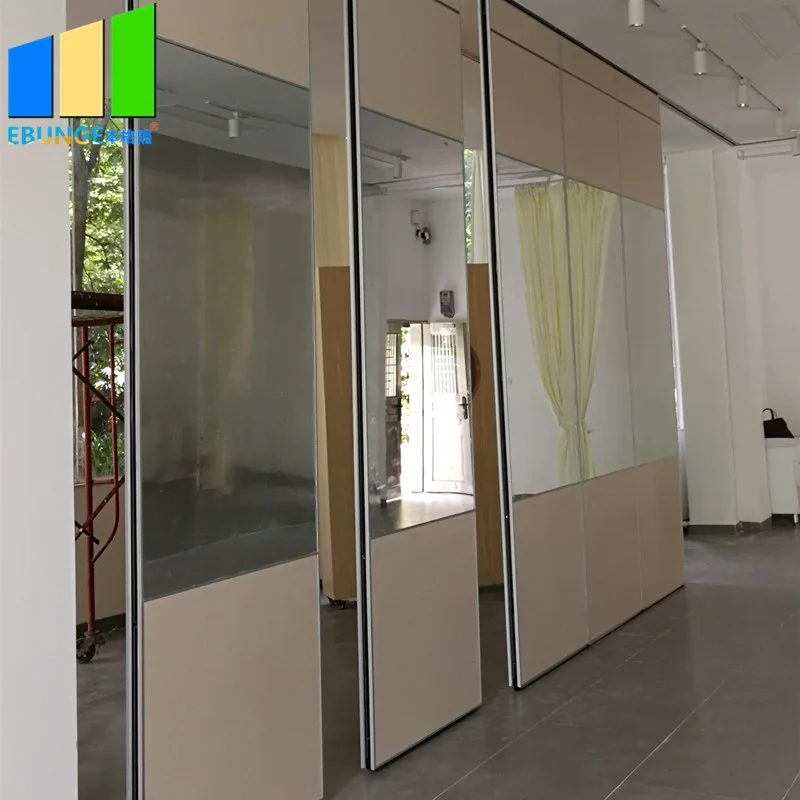
EBUNGE movable wall panels are individually movable, suspended from a top track, cross the opening without a floor track, and park at a planned stacking position. Straight, turning and stacking routes are reviewed from the layout. That review is the foundation of buffer sizing because a route that is longer, tighter or shared with other operations will need more release lead time.
Every proposed movement path requires a continuous connected overhead route and project-specific support review. If the layout shows a gap, a change of direction without a connected route, or a stacking position that conflicts with another use, the planning team should resolve it before the buffer is fixed.

Route review checklist
- Trace each straight run from the closed position to the opening.
- Identify every turning point and confirm it sits on a continuous connected overhead route.
- Mark the planned stacking position and check it against adjacent room uses.
- Note where routes from different rooms may overlap during peak changeovers.
- Record open questions for the project-specific support and dimensional review.
Room Release Lead-Time Buffer Sizing: A Practical Method
Checklist focus: movable partition changeover demand forecasting.
Buffer sizing is a scheduling decision. It sets the gap between the time a room becomes available and the time the next event can begin. A useful buffer is built from observable steps rather than a single guessed number.
| Buffer component | What it covers | Evidence needed |
|---|---|---|
| Room clear-down | Removing furniture and event equipment from the changeover zone | Venue operating procedure |
| Route preparation | Confirming the straight, turning and stacking routes are clear | Layout drawing and route review |
| Panel movement | Moving panels to the planned stacking position | Project-specific route and support confirmation |
| Room reset | Setting the next layout and checking finishes | Venue checklist and finish schedule |
| Contingency | Absorbing minor delays without compressing the next event | Operations policy, not a product claim |
Each component should be estimated from the venue’s own procedures and reviewed with the project team. The table is a structure for discussion, not a set of measured durations. Where a value is unknown, mark it as an open item rather than filling it with an assumption.
How to avoid over- and under-buffering
Over-buffering reduces usable room time. Under-buffering pushes changeover pressure into the next event. A balanced approach links the buffer to the forecast: peak periods may need a larger contingency, while quiet periods may allow a tighter release. The buffer should be reviewed after the venue has real operating data.
Coordinating Finishes, Pass Doors and Documentation
Review focus: movable partition changeover demand forecasting.
Confirmed finish options include laminate, melamine, fabric, leather, glass and other approved surfaces. Finish choice can affect preparation and handling, so it belongs in the changeover plan. Pass-door requirements and project documentation can be discussed with the project team. Documentation should record the agreed routes, stacking positions, finish schedule and any open questions.
Those are separate project-specific confirmations. If a venue expects frequent changeovers, the finish schedule and the room release plan should be reviewed together.
Evidence note
Maintained EBUNGE facts cover top-hung clear-floor movement, continuous supported routes, customized parking and broad application scope. They do not establish acoustic, structural, durability, maintenance or commercial outcomes. Confirm project-specific support, acoustic and dimensional requirements before finalizing the plan.
Acoustic Concepts and the Limits of Generic Language
Project review term: movable partition changeover demand forecasting.
Acoustic behavior depends on the full assembly, the surrounding construction, the seals and the project-specific design.
For planning purposes, the changeover forecast should note which rooms need acoustic separation and which do not. That note helps the project team decide where to focus the acoustic review. It does not replace that review.

FAQ: Changeover Forecasting and Buffer Sizing
What is movable partition changeover demand forecasting room release buffer sizing?
It is a planning method that estimates how often rooms must be reconfigured and sets a release lead-time buffer between uses. It combines booking patterns, route review and venue procedures without relying on unsupported performance claims.
Which project information is needed before sizing a buffer?
Useful inputs include the room combination schedule, layout drawings showing straight, turning and stacking routes, the planned parking positions, finish requirements and any pass-door needs. Support, acoustic and dimensional requirements should be confirmed for the specific project.
Can panels move across a gap in the overhead route?
No. Every proposed movement path requires a continuous connected overhead route and project-specific support review. If the layout shows a gap or an unconnected turn, resolve it before finalizing the changeover plan.
Does a finish choice change the buffer size?
Finish choice may affect preparation and handling, so it should be recorded in the plan. Confirmed options include laminate, melamine, fabric, leather, glass and other approved surfaces. The buffer itself should be based on the venue’s procedures and the reviewed routes.
How should STC or Rw be used in planning?
Provide the current layout, opening dimensions, ceiling information, intended room use, and relevant project drawings for review. The exact overhead route and support arrangement must be confirmed by the responsible project team from coordinated drawings.
When should the buffer be reviewed?
Review it after the venue has operating data, and whenever the booking pattern, room layout or route plan changes. The review should update assumptions and record any new project-specific confirmations.
Conclusion: Plan the Changeover, Confirm the Details
A reliable changeover plan connects demand forecasting to room release buffer sizing through documented routes, finishes and operating procedures. It keeps confirmed product facts separate from project-specific requirements and avoids unsupported claims about acoustics, structure or commercial outcomes.
To discuss your layout, routes, finishes, pass-door requirements and project documentation, contact the EBUNGE team. You can also review movable wall products and browse planning resources before your next coordination meeting.