
Quick answer: closeout record dependency chain map
Review focus: closeout record dependency chain map.
A movable partition wall closeout record dependency chain map is a planning tool that shows which handover documents can only be completed after an upstream trade sign-off. It prevents facility acceptance from stalling because a track record, stack record or panel record was submitted before the supporting structure, ceiling or power rough-in was verified. The suitability of each route and parking arrangement depends on the approved layout, circulation, ceiling interfaces and operating sequence.
Use the map early, ideally during coordination meetings when the partition layout is still being reviewed. The goal is to align document order with physical order, so no closeout item is signed before its dependency is real.
Why Closeout Records Fail Out of Sequence
Project review term: closeout record dependency chain map.
Facility acceptance often depends on a chain of documents that must be signed in a logical order. When a panel record is submitted before the overhead route is confirmed, reviewers cannot verify that the movement path is continuous and supported. When a stack record is submitted before the parking zone is dimensionally coordinated, the record may describe a condition that does not match the final layout.
Out-of-sequence submittals create rework, not because the product is wrong, but because the evidence is premature. The dependency chain map makes those dependencies explicit so each trade knows what must be signed before the next record is issued.
What the map is not
Visible references can support layout discussion but do not verify hidden construction or performance.
Core Records in the Dependency Chain
Coordination scope: closeout record dependency chain map.
Most movable partition closeout packages include three record families: track and support records, stack and parking records, and panel and finish records. Each family depends on upstream sign-offs from other trades.
| Record family | Typical upstream dependency | What the record should confirm |
|---|---|---|
| Track and support | Structural review of the overhead support condition; ceiling coordination | That the top track route is continuous, connected and reviewed against the approved layout |
| Stack and parking | Architectural coordination of the parking zone; adjacent finishes | That the planned stacking position matches the coordinated layout and does not conflict with other trades |
| Panel and finish | Approved finish schedule; dimensional review of the opening | That panel sizes, finish selections and pass-door requirements are documented as approved |
This table is a planning aid, not a fixed template. The exact overhead route and support arrangement must be confirmed by the responsible project team from coordinated drawings.
Building the Dependency Chain Map Step by Step
Checklist focus: closeout record dependency chain map.
- List every closeout record required by the contract. Include track, stack, panel, finish, pass-door and any acoustic documentation the project team intends to submit.
- Identify the upstream sign-off for each record. Ask which trade or consultant must confirm a condition before the record can be considered complete.
- Draw the dependency arrows. Show which records cannot be issued until another record or sign-off is in place.
- Assign a responsible party and a target date. Keep the map live and update it as coordination decisions change.
- Review the map at each trade coordination meeting. Confirm that no record is being submitted ahead of its dependency.
- Escalate blocked dependencies early.
Keep the map tied to the approved layout
The map should reference the same layout drawings used for the partition route review. Straight, turning and stacking routes are reviewed from the layout, so any change to the layout can change the dependency chain. When the layout changes, update the map before the next submittal.
Track and Support Records: The First Dependency

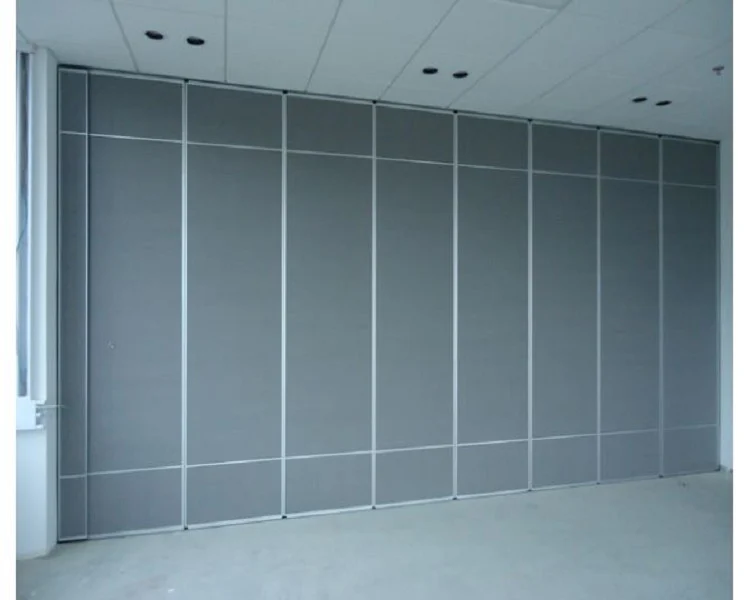
Movable partition panels are individually movable and suspended from a top track. They cross the opening without a floor track and park at a planned stacking position. Because the system is top-hung, the overhead support condition is a primary dependency for the track record.
Evidence note
Do not infer support capacity, load values or fixing details from a drawing or photograph. The closeout map only sequences the records; it does not replace the engineering evidence.
Stack and Parking Records: Layout-Dependent
Parking style is customized to the customer layout and project requirements and may support compact stacking when the coordinated design permits it. The stack record therefore depends on the architectural coordination of the parking zone, including adjacent finishes and any conflicts with other services.
If the parking zone changes, the stack record must be revisited. The dependency chain map should show that the stack record follows the approved layout and the architectural sign-off for the parking area.
Panel, Finish and Pass-Door Records
Confirmed finish options include laminate, melamine, fabric, leather, glass and other approved surfaces. The panel record should document the approved finish selection and the dimensional review of the opening. Pass-door requirements and project documentation can be discussed with the supplier and should be included in the map as a separate dependency if a pass door is part of the scope.
Those require project-specific confirmation.
Using the Map During Facility Acceptance
Before facility acceptance, review the map against the actual submittal log. Confirm that every record has its upstream sign-off and that no record was issued out of sequence. If a dependency is still open, document it as an open item rather than submitting a premature record.
The map also helps owners and facility managers understand what remains before acceptance. It shows the chain of evidence, not just a list of documents.

FAQ
What is a movable partition wall closeout record dependency chain map?
It is a planning diagram that shows which closeout records depend on which upstream trade sign-offs, so track, stack and panel records are submitted in a logical order before facility acceptance.
Does the map confirm acoustic performance?
No. It sequences documentation.
Which records usually come first?
Stack records depend on layout and parking zone coordination. Panel and finish records depend on approved finishes and dimensional review.
Can the map be used for renovation projects?
Yes.
Who should maintain the map?
It should be reviewed at coordination meetings and updated when the layout changes.
What should be confirmed with the supplier?
Confirm project-specific support, acoustic and dimensional requirements, finish selections, pass-door requirements and the documentation needed for closeout. Use the contact page to discuss project documentation.
Conclusion and Next Steps
A closeout record dependency chain map keeps movable partition handover aligned with the physical sequence of the project. Start by listing the required records, identify upstream sign-offs, and review the map at every coordination meeting. Keep the map tied to the approved layout and update it when routes or parking zones change.
For product context, review the movable walls page and the resources section. Then contact EBUNGE to discuss project-specific support, acoustic and dimensional requirements before finalizing your closeout sequence.