
Quick project answer
Review focus: changeover capacity handover protocol.
Handing over a movable partition installation is not the same as handing over a building. The movable partition changeover capacity handover protocol is the structured moment when construction-stage assumptions stop and steady-state operating assumptions begin. It is a documentation and coordination exercise, not a performance promise. This article sets out a practical protocol for contractors, architects, interior designers, owners and renovation teams who need to align drawings, routes and responsibilities before a flexible room enters daily use.
Why Changeover Capacity Needs Its Own Handover Protocol
Project review term: changeover capacity handover protocol.
The suitability of each route and parking arrangement depends on the approved layout, circulation, ceiling interfaces and operating sequence. In steady state, the same partition is assessed against daily reconfiguration: who moves panels, where they park, which routes are used and how the room returns to its base layout. These are different questions.
A changeover capacity handover protocol records the assumptions that survive into operations. It does not certify a number of moves per hour, a staffing level or a service life. Instead, it captures the layout logic, the approved movement routes and the open items that still require project-specific confirmation.
What the Maintained Product Facts Actually Support
Coordination scope: changeover capacity handover protocol.
EBUNGE movable wall panels are individually movable and suspended from a top track. They cross the opening without a floor track and park at a planned stacking position. Straight, turning and stacking routes are reviewed from the layout. Confirmed finish options include laminate, melamine, fabric, leather, glass and other approved surfaces. Pass-door requirements and project documentation can be discussed.
Those facts define the operating model. Where a project needs those outcomes, the project team must confirm them against project-specific evidence.
A Six-Step Changeover Capacity Handover Protocol
- Freeze the as-built layout. Record the final opening, stacking position and any turning geometry shown on the coordinated drawings.
- Trace every movement route. Confirm that each proposed path follows a continuous connected overhead route. The exact route, junction arrangement, continuous overhead path and parking position must be confirmed from the coordinated project drawings.
- Map the operating states. List the room configurations the facility expects to use, from fully open to fully closed and any intermediate arrangement.
- Assign route ownership. Identify which team is responsible for each configuration and where the handover between construction and operations occurs.
- Record evidence boundaries. Note which statements are supported by maintained product facts and which require project-specific confirmation.
- Close the protocol with a review. Walk the routes, confirm the stacking position and agree the documentation set before steady-state use begins.

Construction-Stage Assumptions Versus Steady-State Assumptions
| Topic | Construction-stage assumption | Steady-state assumption |
|---|---|---|
| Primary concern | Installation access and coordination | Daily reconfiguration and route use |
| Route review | Delivery and lifting path | Straight, turning and stacking routes from the layout |
| Documentation | Shop drawings and submittals | Operating layout, stacking position and open items |
| Evidence | Approved construction documents | Maintained product facts plus project-specific confirmation |
The table is a coordination aid, not a performance comparison. Its purpose is to show where assumptions change and where a project team should pause before treating a construction-stage statement as an operating fact.
Route Logic: The Part Most Often Left Implicit
Straight, turning and stacking routes
Every movable partition layout has at least three route questions: how panels travel along the opening, how they turn if the layout requires it, and where they park. These routes are reviewed from the layout, not from a generic template. A route that works on one floor plan may not work on another.
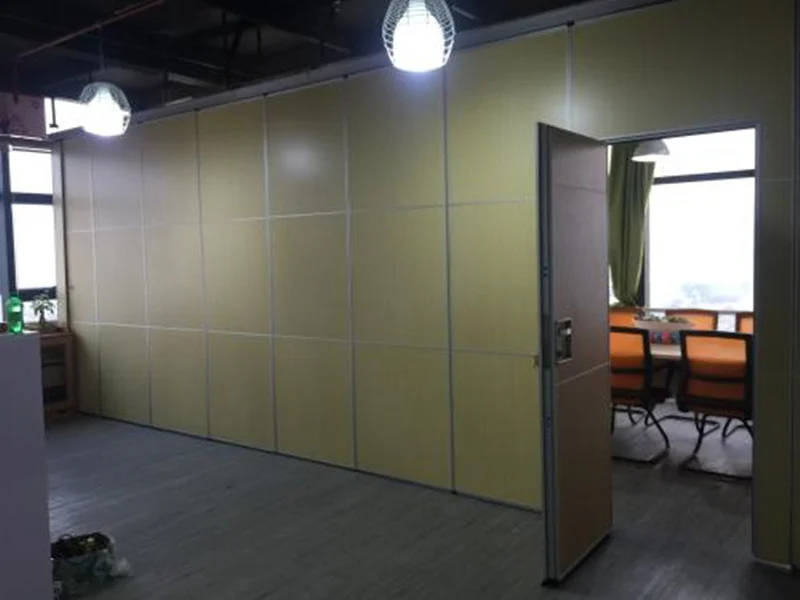
Continuous overhead support
Because panels are top-hung, the overhead route must be continuous and connected for the movement proposed. A gap in the route is a design issue, not an operating shortcut. The exact overhead route and support arrangement must be confirmed by the responsible project team from coordinated drawings.
Evidence Notes for the Handover File
Evidence note: A finish sample, photograph or drawing shows appearance and geometry only. Where those outcomes matter, request project-specific documentation and confirm it before handover.
If a project has an acoustic requirement, confirm the project-specific assembly and documentation rather than inferring performance from a finish or a visible panel shape.
Decision Checklist Before Steady-State Operations Begin
- As-built layout matches the coordinated drawing set.
- Straight, turning and stacking routes are documented and walked.
- Overhead route continuity is confirmed for every proposed movement.
- Stacking position is agreed and clear of other building services.
- Pass-door requirements are recorded if the project includes them.
- Finish selections are listed against approved options.
- Open items requiring project-specific confirmation are named, not hidden.
- Responsible parties for each configuration are identified.
Coordinating the Protocol Across Project Teams
The contractor confirms what was installed. The architect or designer confirms the layout intent. The owner or facility team confirms how the space will actually be used. The distributor or supplier confirms the maintained product facts and the documentation available for the project.
Where these views differ, the difference should be recorded rather than resolved by assumption. A short written note in the handover file is more useful than a verbal agreement that disappears after the site walk.
Frequently Asked Questions
What is a movable partition changeover capacity handover protocol?
It is a documented transition from construction-stage assumptions to steady-state operating assumptions. It records layout logic, movement routes, stacking position, finish selections and open items that still require project-specific confirmation.
Does the protocol certify how quickly a room can be reconfigured?
No. Panel handling and the operating sequence must be confirmed for the selected layout and project conditions. Those depend on project-specific conditions and should be confirmed separately by the responsible parties.
Why are straight, turning and stacking routes reviewed from the layout?
Because the layout determines whether a continuous connected overhead route exists for the movement proposed. A generic route assumption cannot replace a review of the actual floor plan.
Can acoustic performance be confirmed from a finish sample?
No. A finish sample shows appearance and surface character.
What should be included in the handover file?
At minimum: the as-built layout, documented routes, stacking position, finish list, pass-door requirements if applicable, and a clear list of open items requiring project-specific confirmation.
Who should attend the handover review?
The contractor, designer or architect, owner or facility representative, and the supplier or distributor where product documentation is being transferred. Roles should be agreed before the walk.
Conclusion and Next Step
A changeover capacity handover protocol protects the project by separating what is known from what still needs confirmation. It keeps the maintained product facts visible, documents the route logic and gives facility teams a realistic basis for steady-state operations.
To review your layout, route logic and documentation requirements, contact the EBUNGE team. You can also review the movable wall product context and the project resources before your next coordination meeting.