
Quick answer: movable partition wall
Review focus: movable partition wall.
Movable partition wall bid evaluation criteria should help a procurement team compare supplier submittals on the same evidence basis. The goal is not to find the longest specification or the most confident claim. It is to identify which submittals answer the project’s layout, movement, finish and documentation questions, and which leave gaps for later clarification. This framework is written for overseas contractors, architects, interior designers, owners, renovation teams and distributors who must review tenders without treating unverified performance statements as facts.
Use the criteria below as a review structure, not as a substitute for project-specific engineering, acoustic or dimensional confirmation. Every tender should be checked against the actual room, the approved drawings and the required evidence boundary.
Start With the Project Information Required for Evaluation
Project review term: movable partition wall.
A supplier cannot be compared fairly if the tender package does not state the project conditions. Before scoring any submittal, confirm that the invitation to bid includes the room or opening dimensions, the intended flexible-space use, the required finish direction and the planned stacking position. The named venue or room type is an example only; movable partitions can be considered wherever flexible spatial division, combination or reconfiguration is required.
Ask each bidder to confirm what information they still need. A submittal that identifies missing dimensions or unresolved interfaces is often more useful than one that assumes conditions without stating them.
Minimum tender information checklist
- Opening width, height and any turning or stacking route shown on the layout.
- Required finish options, such as laminate, melamine, fabric, leather, glass or other approved surfaces.
- Pass-door requirements and how they interact with the panel layout.
- Project documentation expectations, including drawings, schedules and submittal format.
- The suitability of each route and parking arrangement depends on the approved layout, circulation, ceiling interfaces and operating sequence.
Evaluate the Movement and Parking Concept
Coordination scope: movable partition wall.
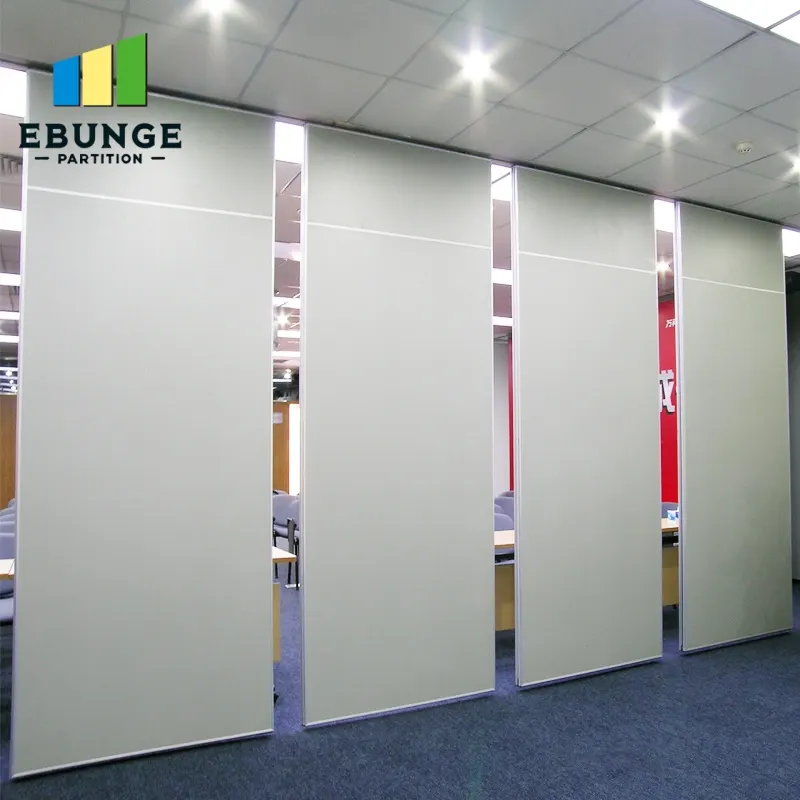
EBUNGE movable wall panels are individually movable, suspended from a top track, cross the opening without a floor track, and park at a planned stacking position. This maintained product fact gives reviewers a clear baseline: the partition line should not require a continuous floor running track or floor hardware along the partition line.
However, a top-hung system still depends on a continuous connected overhead route and project-specific support review. The exact route, junction arrangement, continuous overhead path and parking position must be confirmed from the coordinated project drawings. Straight, turning and stacking routes should be reviewed from the layout, not inferred from a photograph or a generic drawing.
Route review questions
- Does the submittal show the straight route across the opening?
- Does it show any turning route required by the room geometry?
- Does it identify the planned stacking position and its relationship to the room layout?
- Does it state that support and overhead route conditions require project-specific confirmation?
Compare Finish and Surface Submittals
Checklist focus: movable partition wall.
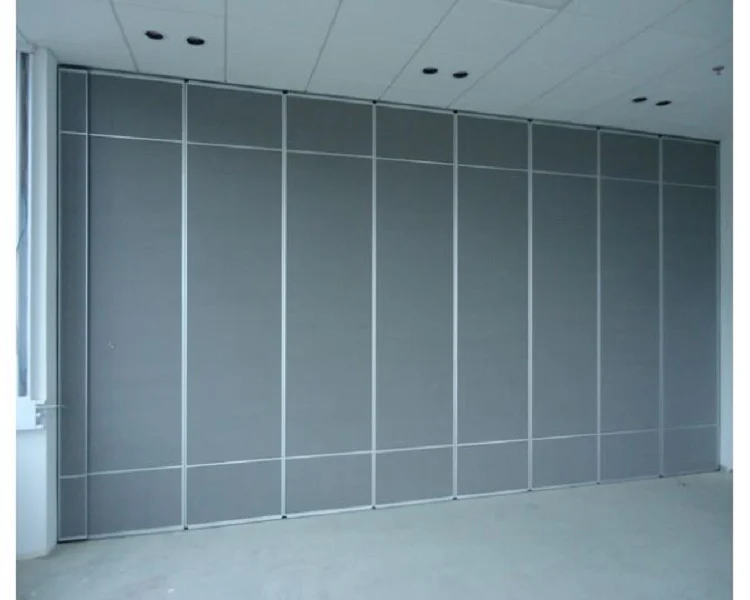
Confirmed finish options include laminate, melamine, fabric, leather, glass and other approved surfaces.
Ask for finish samples or approved surface references where the project requires them. If a submittal uses a generic finish image, treat it as a visual reference only. The project team should confirm the exact surface, edge detail and any maintenance requirement with the supplier before award.
Finish comparison table
| Review point | What to look for | Evidence boundary |
|---|---|---|
| Finish category | Laminate, melamine, fabric, leather, glass or other approved surface | Confirm exact product and sample approval |
| Surface reference | Clear reference to the proposed finish | Do not infer durability or cleaning performance |
| Pass-door finish | Consistent treatment with adjacent panels | Confirm door hardware and dimensional requirements separately |
Review Acoustic and Seal Concepts Without Overclaiming
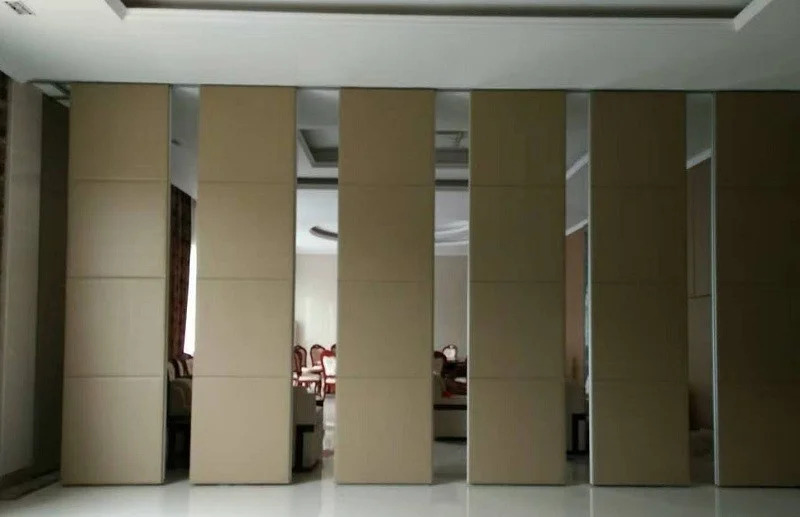
If a submittal cites a rating, ask for the corresponding test report and confirm that the tested configuration matches the proposed project configuration. If that match cannot be shown, record the item as requiring project-specific confirmation.
Evidence note for acoustic claims
Any acoustic statement in a submittal should be traceable to a test report, a defined configuration and a project-specific review. Without those elements, the claim is not a comparison criterion.
Score Documentation and Coordination Readiness
A strong submittal is not only a product description. It shows how the supplier will coordinate with the project team. Look for clear drawing references, finish schedules, pass-door requirements and a stated process for resolving dimensional or support questions.
Procurement and Tender Review coordination should include a defined point for technical clarification.
Documentation scoring prompts
- Are layout drawings marked with routes and stacking positions?
- Are finish options listed against the project schedule?
- Are pass-door requirements described without assuming unstated hardware?
- Is there a clear path for project-specific support, acoustic and dimensional confirmation?
Use a Weighted Evaluation Structure
Assign weights that reflect the project’s priorities, then score each submittal against the same evidence standard. A simple structure can include layout fit, movement and parking concept, finish compliance, documentation quality and clarification readiness.
Do not award points for unsupported performance claims. Instead, award points for traceable evidence, clear assumptions and a willingness to confirm project-specific requirements.
Example evaluation categories
- Completeness of project information and assumptions.
- Movement route and stacking concept shown on layout.
- Finish options and sample approval process.
- Acoustic and seal statements with traceable evidence.
- Documentation, pass-door coordination and clarification process.
Frequently Asked Questions
What is the first step in movable partition wall bid evaluation criteria?
Confirm the project information package: dimensions, layout, finish direction, stacking position and documentation expectations. Without that baseline, submittals cannot be compared fairly.
Should I compare suppliers by acoustic rating alone?
No. Compare the tested configuration, the project requirement and the evidence provided, then confirm project-specific acoustic requirements.
How do I check the movement route in a submittal?
Review the layout for straight, turning and stacking routes. Confirm that the overhead route is continuous and connected, and that support conditions are subject to project-specific review.
What finish evidence should a supplier provide?
Ask for the proposed finish category and a sample or approved surface reference. Visible references can support layout discussion but do not verify hidden construction or performance.
How should pass-door requirements be evaluated?
Check that the submittal describes pass-door requirements in relation to the panel layout and project documentation. Confirm dimensional and hardware details with the supplier before award.
Can I rely on a supplier’s performance claim without a test report?
No. Treat unsupported claims as clarification items. Ask for traceable evidence or record the item as requiring project-specific confirmation.
Conclusion and Contact
A disciplined movable partition wall bid evaluation criteria framework helps procurement teams compare submittals on layout fit, movement concept, finish compliance, documentation and evidence quality. It does not replace project-specific support, acoustic and dimensional confirmation. Use the checklist and scoring prompts above to keep every supplier on the same evidence basis.
To discuss pass-door requirements, project documentation or a specific tender package, contact EBUNGE. You can also review the movable wall product context and the resources page before finalizing your evaluation criteria.