
Quick answer: movable partition accessibility circulation review
Review focus: movable partition accessibility circulation review.
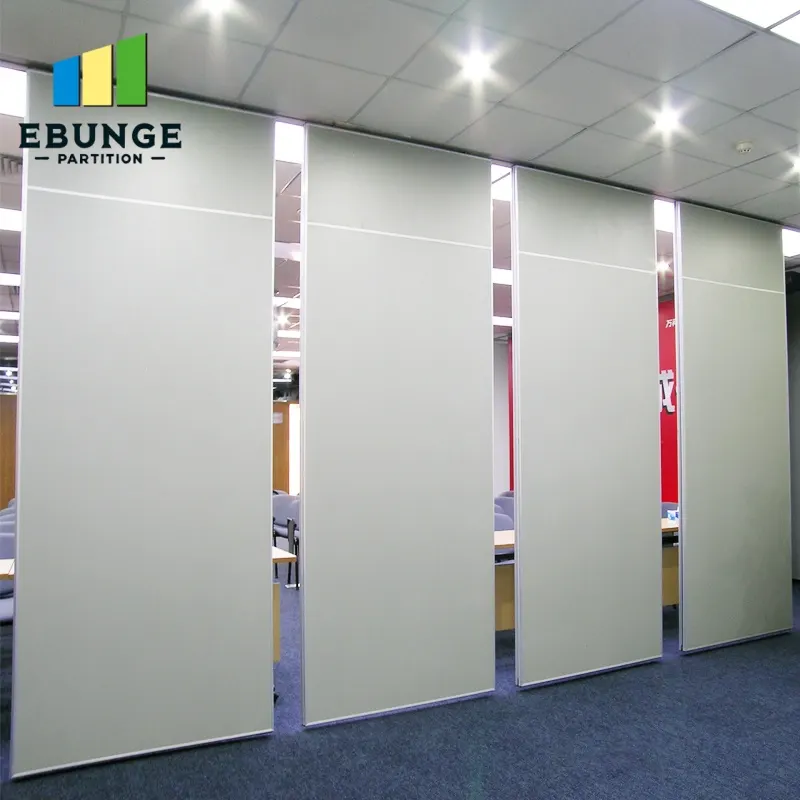
A movable partition accessibility circulation review is a drawing-based exercise: you check how people, wheelchairs, trolleys and furniture will move through the opening, around the panel face and into the space beyond. The suitability of each route and parking arrangement depends on the approved layout, circulation, ceiling interfaces and operating sequence. It is a coordination step that helps the project team confirm clear widths, turning zones and accessible routes before the partition layout is fixed. Because EBUNGE panels are top-hung and cross the opening without a continuous floor track, the floor plane stays clear along the partition line. That single fact changes how circulation is planned, but it does not remove the need for project-specific review.
Why Circulation Review Belongs in the Early Layout Stage
Project review term: movable partition accessibility circulation review.
Movable partitions are often selected for flexibility: a room can be divided, combined or reconfigured. That flexibility is only useful if the resulting spaces still work for the people who use them. A circulation review at concept stage exposes conflicts while they are still cheap to resolve on paper.
Three questions drive the review. Where does the partition open? Where do the panels park? What route remains clear when the room is divided and when it is open? Each answer depends on the layout, not on a generic rule. The review should be repeated whenever the furniture plan, door position or seating layout changes.
What the review can and cannot establish
A drawing review can establish whether a proposed route is geometrically continuous and whether a turning zone fits within the available floor area. Those require separate, project-specific evidence and the input of the responsible design professionals.
Clear Widths at the Opening and Along the Route
Coordination scope: movable partition accessibility circulation review.
Clear width is the usable distance between the nearest obstructions. At a movable partition opening, the obstructions may include the panel face, a pocket edge, a return wall, a column or a piece of fixed joinery. The review should measure the narrowest point on the route, not the widest.
Because panels are individually movable and suspended from a top track, the opening width can change as panels are stacked or spread. The team should therefore review clear width in the configurations that will actually be used, including the partially open condition. A route that works when the partition is fully open may fail when it is half closed.
Points to check on the drawing
- The narrowest point between the panel face and any fixed obstruction.
- The position of any pass-door and how it interacts with the main route.
- The clearance needed to move panels by hand along the track.
- The route from the opening to the nearest exit, lift or accessible facility.
- Whether furniture, AV equipment or temporary seating can encroach on the route.
Turning Zones and Approach Space
Checklist focus: movable partition accessibility circulation review.
A turning zone is the floor area a person needs to change direction. The exact route, junction arrangement, continuous overhead path and parking position must be confirmed from the coordinated project drawings. The review should treat these as fixed constraints, not as leftover space.
Movable partitions can create new decision points because the room geometry changes. When panels are parked, the route may bend around the stack. When panels are spread, the route may pass through a narrower opening. Both conditions deserve a separate check.
Parking position and route interaction
Parking style is customized to the customer layout and project requirements, and compact stacking may be possible when the coordinated design permits it. The parking position is therefore a design decision with circulation consequences. A stack placed in a primary route can block movement even though the partition itself is top-hung and the floor is clear. The review should confirm that the parked panels do not reduce any accessible route below the project’s required clear width.
Overhead Route and Support Coordination
Review focus: movable partition accessibility circulation review.
Top-hung panels travel along a continuous connected overhead route. This is a hard planning boundary: every proposed movement path, including straight runs, turns and the route to the parking position, must be supported by a continuous overhead structure.
A route that looks simple on the floor plan may require a turning or junction detail above.
Evidence note
Visible geometry on a drawing does not prove acoustic performance, structural capacity, fire behaviour or compliance. Treat the circulation review as a coordination tool, and confirm all performance and engineering requirements against project-specific evidence.
Accessible Routes Through Flexible Spaces
Project review term: movable partition accessibility circulation review.
An accessible route should remain continuous, unobstructed and usable in every configuration the project intends to operate. In flexible rooms, that means reviewing the route when the partition is open, closed, partially open and parked.
The review should also consider how the space is used. A training room, conference room or coworking area may have different furniture layouts on different days. The route that works for one layout may not work for another. Where layouts are expected to change, the team should agree which configurations are fixed design cases and which are operational choices.
Compact comparison: what to review in each configuration

| Configuration | Primary circulation check | Supporting check |
|---|---|---|
| Fully open | Clear route through the opening | Parking stack position |
| Fully closed | Route around the closed partition | Pass-door location |
| Partially open | Narrowest point on the route | Panel movement path |
| Panels parked | Route past the stack | Turning zone at the stack |
Documentation and Project-Specific Confirmation
A useful circulation review produces a short, traceable record. It should identify the configurations reviewed, the clear widths and turning zones assumed, the parking position, and any open items that require confirmation. This record helps contractors, architects, interior designers and owners coordinate without relying on assumptions.
Pass-door requirements and project documentation can be discussed with the supplier. Where acoustic separation matters, the project team should confirm the requirement against project-specific evidence rather than inferring performance from a finish or a drawing.
Decision checklist before layout sign-off
- Confirm the configurations the room will actually operate in.
- Mark the narrowest clear width on each route.
- Check turning zones at doors, corners and parking positions.
- Verify the overhead route is continuous and supported.
- Confirm pass-door and access requirements with the project team.
- Record open items and assign responsibility for confirmation.
Frequently Asked Questions
Does a top-hung movable partition remove the need for a circulation review?
No. A top-hung system keeps the floor clear along the partition line, but clear widths, turning zones, parking positions and accessible routes still depend on the layout. The review remains necessary.
Can panels move across a gap in the overhead track?
No. Every proposed movement path requires a continuous connected overhead route. The exact overhead route and support arrangement must be confirmed by the responsible project team from coordinated drawings.
How should clear width be measured at a movable partition?
Measure the narrowest usable distance between the panel face and the nearest fixed obstruction, in each configuration the room will use. Do not rely on the widest point or on the nominal opening size alone.
Where should the parking position be located?
Parking style is customized to the customer layout and project requirements. The position should be chosen so that parked panels do not obstruct an accessible route or reduce a required clear width.
Can the circulation review confirm acoustic performance?
No. A circulation review is a layout and coordination exercise.
What documentation should be prepared?
Record the configurations reviewed, assumed clear widths and turning zones, the parking position, pass-door requirements and any open items. Pass-door requirements and project documentation can be discussed with the supplier.
Conclusion and Next Steps
A movable partition accessibility circulation review is most useful when it is treated as a live coordination document rather than a one-off check. Review the opening, the route, the turning zones and the parking position in every configuration the project intends to operate.
For product context, start with the movable walls range and the planning resources. When your layout is ready, contact the EBUNGE team to discuss pass-door requirements, documentation and project-specific confirmation.