
Quick answer: movable partition wall sustainability
A movable partition wall sustainability project review starts from the confirmed room layout and coordinated drawings.
Movable partition wall sustainability is often treated as a single attribute to be selected from a catalogue. In practice, it is a documentation and coordination topic. A project team may need to show how a partition system supports flexible space use, how it is specified, and what evidence exists for each environmental statement. The useful question is not whether a system is sustainable in the abstract, but which claims can be supported for this project, in this location, with this configuration.
This checklist is written for overseas contractors, architects, interior designers, owners, renovation teams and distributors who must assemble a procurement package without inventing performance. It uses maintained EBUNGE product facts and keeps every recommendation inside a clear evidence boundary. The exact overhead route and support arrangement must be confirmed by the responsible project team from coordinated drawings.
Why Sustainability Documentation Differs from Product Marketing
The movable partition wall sustainability selection remains specific to the documented opening, track route, parking position and finish schedule.
Marketing language often compresses many separate issues into one word. Environmental documentation separates them. A procurement team may need to distinguish between material content, indoor air quality, recyclability, reuse potential, transport impact, maintenance expectations and end-of-life routes. Each of these may require different evidence, and some may not be available for a given configuration.
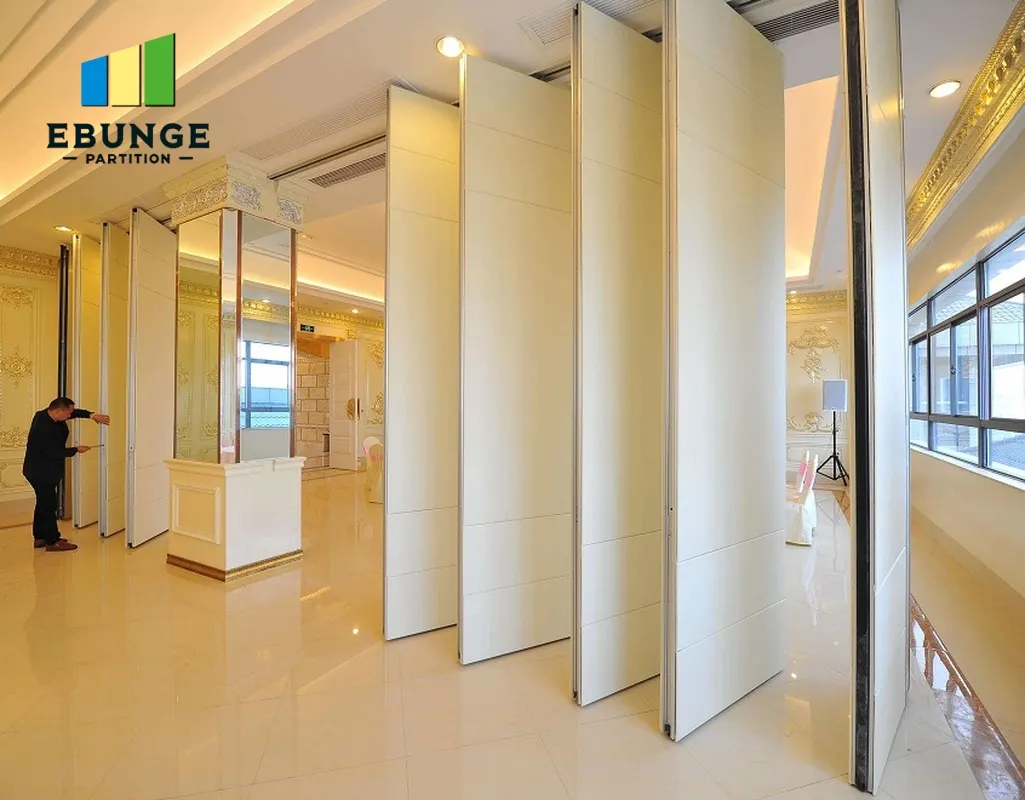
The maintained product facts for EBUNGE movable partitions describe a top-hung system: panels are individually movable, suspended from a top track, cross the opening without a floor track, and park at a planned stacking position. Straight, turning and stacking routes are reviewed from the layout. These are functional facts. They do not, by themselves, prove an environmental outcome. They do, however, affect how a project team should frame questions about space efficiency, reconfiguration and long-term use.
Separate the claim from the evidence
A statement such as “low-impact partition” is not a specification. It is a conclusion that needs a defined basis. Before accepting any environmental statement, ask what document supports it, what scope it covers, and whether it applies to the exact panel build, finish and route proposed for the project.
Build a Project-Specific Evidence Register
For movable partition wall sustainability, compare supplier proposals against the approved project inputs.
An evidence register is a simple table that lists each sustainability-related statement, the document that supports it, and the person responsible for confirming it. It prevents informal claims from entering the tender package. The register should be started before specification is finalised, because missing evidence can change the direction of a procurement decision.
| Statement type | Typical evidence question | Who confirms |
|---|---|---|
| Material or finish content | Does the proposed finish have a documented composition or declaration? | Supplier and specifier |
| Indoor environmental quality | Is there a project-relevant emission or air-quality document? | Supplier and project team |
| Reuse or reconfiguration | Does the layout allow panels to be moved and parked as planned? | Design team and supplier |
| End-of-life route | Is a recovery or disposal route defined for the selected materials? | Owner and supplier |
This table is a framework, not a set of confirmed values. Each row must be completed with project-specific evidence. If a document does not exist, the correct action is to record the gap, not to infer a result from a photograph, a finish sample or a generic brochure.
Review the Layout Before Accepting Environmental Claims
The movable partition wall sustainability scope covers the confirmed room use, route, stacking area and finish requirements.
Movable partition sustainability is closely tied to how the system is used. The suitability of each route and parking arrangement depends on the approved layout, circulation, ceiling interfaces and operating sequence. A layout that requires awkward movement routes may reduce the practical benefit. This is why the drawing review matters as much as the material discussion.
Straight, turning and stacking routes
Every proposed movement path requires a continuous connected overhead route and project-specific support review. The exact route, junction arrangement, continuous overhead path and parking position must be confirmed from the coordinated project drawings. The design team should confirm the straight runs, any turning sections and the planned stacking position.
Parking and space efficiency
Parking style is customised to the customer layout and project requirements and may support compact stacking when the coordinated design permits it. Compact parking can be relevant to space efficiency, but it should not be presented as a measured environmental saving without project evidence. The correct approach is to describe the planned parking arrangement and let the project team evaluate it against their own criteria.
Coordinate Finishes, Seals and Acoustic Concepts
A movable partition wall sustainability project review starts from the confirmed room layout and coordinated drawings.
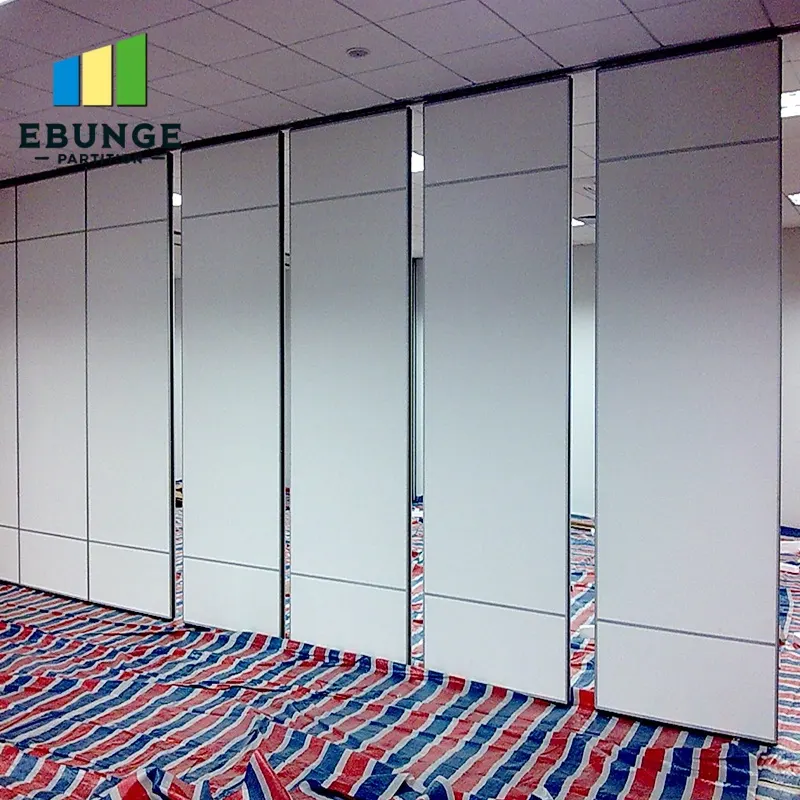
Confirmed finish options include laminate, melamine, fabric, leather, glass and other approved surfaces. Each finish should be confirmed against the project’s actual requirements.
Seals and acoustic concepts can be explained generically. A project may require a specific acoustic target, but that target must be confirmed through project-specific documentation rather than assumed from a product category.
Pass doors and documentation
Pass-door requirements and project documentation can be discussed with the supplier. If a pass door is needed, its position, size and relationship to the panel route should be shown on the layout. This is a coordination item, not an environmental claim, but it affects how the system is specified and documented.
Procurement Checklist for Specification and Tendering
- Define the spaces that need flexible division and the reconfiguration pattern.
- Confirm the straight, turning and stacking routes from the layout drawings.
- List every environmental statement the project intends to make.
- Match each statement to a document, declaration or project-specific confirmation.
- Record gaps explicitly rather than filling them with assumptions.
- Confirm finish options against the application reference requirements.
- Confirm support, acoustic and dimensional requirements with the responsible parties.
- Include pass-door and documentation requirements in the tender package.
This sequence keeps the procurement process evidence-bounded. It also gives reviewers a clear record of what was confirmed and what remains open.
Common Evidence Gaps and How to Handle Them
Evidence gaps are normal in early design. The problem is not the gap itself, but treating a gap as a confirmed result. A product photograph does not prove a application reference. Each of these requires separate confirmation.
If a sustainability statement cannot be tied to a document or a project-specific confirmation, it should be marked as unverified in the procurement record.
This rule protects the project team from later disputes and keeps the specification honest. It also helps suppliers understand exactly what information is needed.
Frequently Asked Questions
What does movable partition wall sustainability actually cover?
It covers the environmental documentation relevant to a movable partition specification, such as material and finish information, indoor environmental quality, reuse and reconfiguration potential, and end-of-life routes. The exact scope depends on the project and the evidence available.
Can EBUNGE provide environmental documentation for a project?
Project documentation can be discussed. The available documents depend on the project requirements and the proposed configuration. The project team should confirm what is needed and request matching evidence before finalising the specification.
Do movable partitions require a floor track?
EBUNGE movable partition panels are top-hung and move without a continuous floor running track or floor hardware along the partition line. The movement path still requires a continuous connected overhead route and project-specific support review.
How should acoustic performance be described in a sustainability document?
Any acoustic target must be confirmed through project-specific documentation.
What finish options are available?
Confirmed finish options include laminate, melamine, fabric, leather, glass and other approved surfaces. Finish selection should be confirmed against the project’s cleaning, appearance and maintenance requirements.
When should the layout be reviewed?
The layout should be reviewed before environmental documentation is finalised. Straight, turning and stacking routes, parking position and pass-door requirements all affect how the system is specified.
Conclusion and Next Steps
Start with the layout, define the environmental statements the project needs, and match each statement to evidence. Where evidence is missing, record the gap. This approach keeps the procurement package credible and avoids unsupported conclusions.
For product context, review the movable partition wall system page. For broader planning material, see the resources section. To discuss pass-door requirements, project documentation or a specific layout, contact the EBUNGE team and confirm the project-specific support, acoustic and dimensional requirements before specification.