
When planning a hotel banquet hall, the choice of a hotel acoustic movable wall supplier directly impacts guest experience, operational flexibility, and long-term maintenance costs. Architects often face uncertainty about acoustic performance, custom sizing, and installation complexity. This guide focuses on practical verification steps, quotation readiness, and technical requirements to help you make an informed decision. We answer common questions, provide a checklist, and explain how to communicate your project needs effectively to suppliers.
Direct answer: To verify a hotel acoustic movable wall supplier’s capabilities, request detailed product specifications, acoustic test reports, installation references, and a clear quotation based on your specific opening sizes and acoustic targets. Always ask for a site survey or detailed drawings review to confirm custom fit and top-hung track system feasibility.
Hotel Acoustic Movable Wall Supplier: Understanding Your Banquet Hall Requirements
Before contacting suppliers, define your project’s acoustic and spatial needs. Consider the maximum simultaneous events, desired sound isolation between rooms, and ceiling structure for track installation. For example, a banquet hall may require partitions that achieve a certain Sound Transmission Class (STC) rating, but exact values must be confirmed from project drawings and specifications. The supplier should ask for your opening sizes, ceiling height, and floor conditions.
Architects should prepare a detailed brief including floor plans, section details, and acoustic performance targets. This helps suppliers provide accurate quotations and identify potential issues early. For instance, if the ceiling is not designed to support the weight of top-hung partitions, additional structural reinforcement may be needed, affecting cost and timeline.
Need help turning the hotel acoustic movable wall supplier requirements into a practical project layout?
Key Technical Specifications to Verify
When evaluating a hotel acoustic movable wall supplier, focus on these technical aspects:
Acoustic Performance Evidence
Ask for acoustic test reports from independent laboratories. Verify the STC or Rw rating and ensure it matches your requirement. Remember that site conditions can affect real-world performance, so ask about sealing systems, perimeter gaskets, and panel construction. Do not rely solely on marketing claims.
Custom Sizing and Configuration
Banquet halls often have irregular shapes or large spans. Confirm the supplier can manufacture custom sizes and configurations, such as curved or angled partitions. Inquire about maximum panel width and height, and whether they can accommodate your specific opening dimensions.
Top-Hung Track System
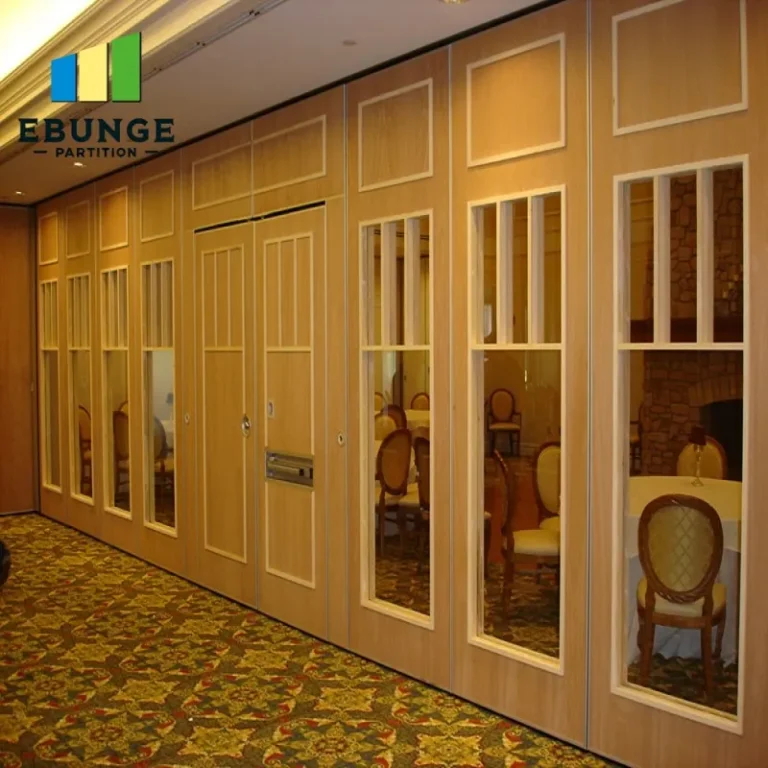
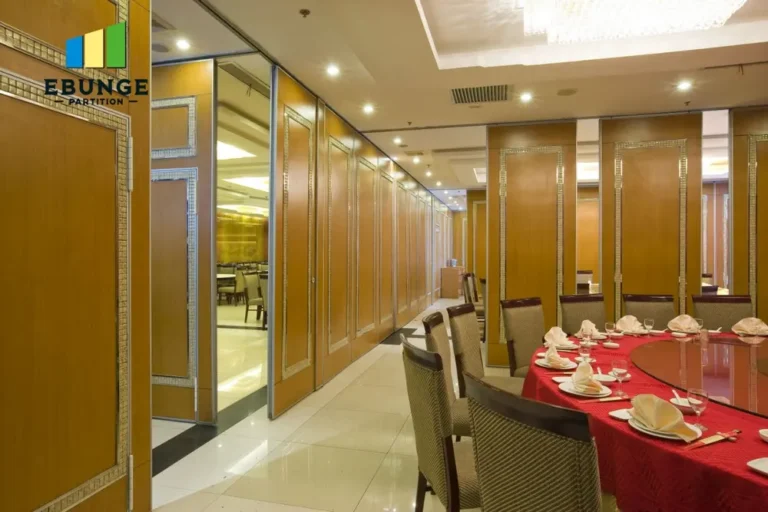
EBUNGE specializes in top-hung track systems without floor rails, which simplifies floor maintenance and improves safety. Verify the track capacity, suspension points, and operation smoothness. Ask about the track material and whether it is designed for heavy-duty use.
Evaluating Supplier Experience and References
Ask for case studies or references from similar hotel projects. While we cannot provide specific examples, you can request contact details of past clients and visit installations if possible. Inquire about the supplier’s experience with banquet halls, their understanding of hotel operations, and their ability to coordinate with other trades.
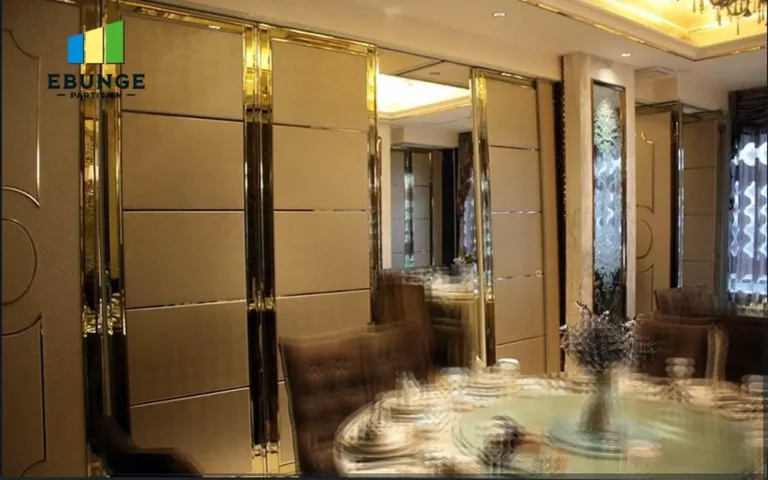
Check if they have experience with custom finishes, such as acoustic fabric, wood veneer, or high-gloss panels, that match your interior design. Also, ask about their project management approach and how they handle installation challenges.
Installation Complexity and Project Timeline
Understand the installation process and its impact on your construction schedule. Top-hung systems require precise track alignment and may need to be installed before ceiling finishing. Ask about lead time, installation duration, and whether they provide supervision or full installation services.
Clarify the sequence of work: track installation, panel installation, and final adjustments. Inquire about the need for a structural engineer’s approval and how they coordinate with electrical, mechanical, and fire safety systems. A detailed timeline helps you plan your project milestones.
Budget Control and Quotation Transparency
Request a comprehensive quotation that breaks down costs: materials, engineering, manufacturing, delivery, installation, and any additional charges. Be wary of quotes that omit critical items like acoustic seals or custom hardware. Ask for a timeline of payments and delivery milestones.
To get an accurate quote, provide the supplier with:
- Opening sizes and number of partitions
- Acoustic target (e.g., STC 45)
- Finish preferences (fabric color, panel material)
- Project location and site conditions
- Drawings (floor plans, sections) if available
This information allows suppliers to minimize assumptions and offer a more precise price. Remember that the lowest quote may not include necessary features, so compare like-for-like.
Quality Assurance and After-Sales Support
Ask about quality control processes during manufacturing and installation. Are there inspections? What warranties are offered? While we cannot specify warranty terms, you should request written documentation. Inquire about after-sales support: availability of spare parts, maintenance guidelines, and response times for issues.
A reliable supplier should provide operation and maintenance manuals, and be willing to train your facility team. Also, ask about their policy for repairs or adjustments after installation.
Share the opening, drawings, finish direction, and privacy target for a project-specific review.
How to Prepare for Supplier Inquiries
To facilitate a smooth quotation process, compile a comprehensive information package. Include your architectural drawings, acoustic specifications, and a list of questions. A clear brief helps suppliers understand your expectations and reduces back-and-forth communication.
Consider visiting the supplier’s factory or showroom to see the product quality and manufacturing capabilities. If not possible, request video demonstrations or virtual tours. This also gives you an opportunity to discuss custom requirements.
Practical Checklist for Supplier Verification
Use this checklist when evaluating a hotel acoustic movable wall supplier:
| Criteria | Questions to Ask |
|---|---|
| Acoustic Performance | Can you provide test reports? What is the STC rating? How is sealing achieved? |
| Customization | Can you manufacture non-standard sizes? What is the maximum span? |
| Track System | Is it top-hung? What is the weight capacity? Is a floor rail required? |
| Installation | Do you provide installation? What is the typical timeline? Who coordinates with other trades? |
| Quotation | Are all components itemized? Are there additional costs for delivery or installation? |
| After-Sales | What warranty do you offer? How do you handle repairs? Is maintenance training provided? |
Common Pitfalls to Avoid
One common mistake is focusing solely on price, which may lead to compromised quality. Another is overlooking the importance of acoustic sealing at the perimeter. Ensure the supplier explains how they handle gaps at walls, floor, and ceiling. Also, avoid vague specifications; always get exact values in writing.
Do not assume that a sample panel guarantees the same performance as the final product. Ask about production tolerances and quality control. Additionally, verify the supplier’s financial stability and capacity to handle your order size.
Conclusion
Selecting a hotel acoustic movable wall supplier requires careful evaluation of technical capabilities, experience, and support. By preparing a detailed brief and asking the right questions, you can ensure that your banquet hall meets acoustic and functional goals. We encourage you to share your opening sizes, drawings, acoustic targets, finish preferences, and project location with potential suppliers to receive accurate quotes. For more insights, explore our resources on movable partition walls and industry blogs. To discuss your project, contact us via our contact page. Remember, a well-informed decision leads to a successful installation.
Frequently Asked Questions
What is the typical lead time for custom movable walls?
Lead time varies by supplier and project complexity. It depends on engineering, manufacturing, and delivery schedules. Confirm with the supplier after providing your specifications.
Can movable walls achieve high acoustic ratings?
Yes, but performance depends on design, materials, and installation quality. Always request test reports and ensure the product meets your specific STC requirement.
Is a floor rail necessary for top-hung systems?
No, EBUNGE top-hung systems operate without floor rails, offering a clean floor surface and easier maintenance.
How do I get an accurate quote?
Provide detailed drawings, opening sizes, acoustic targets, finish preferences, and project location. The more information you give, the more precise the quote.
What after-sales support should I expect?
Reputable suppliers offer warranty, spare parts, and maintenance guidance. Ask for specific terms in writing.
Send the opening size and drawings to discuss a differentiated hotel acoustic movable wall supplier solution.